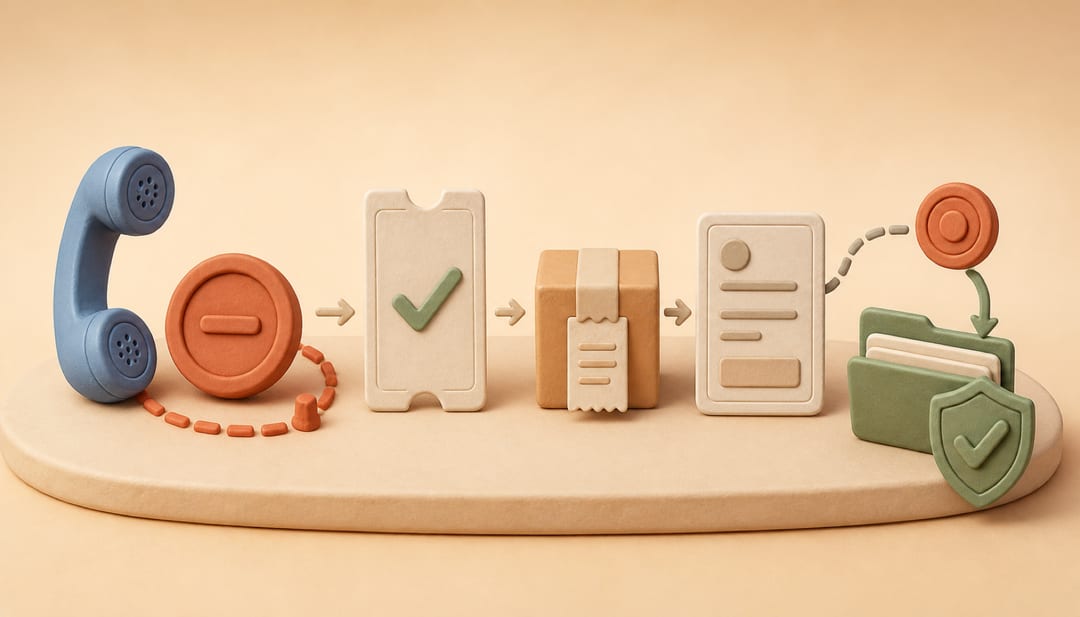
A cancellation dispute is easier to solve when you stop treating it as one failed phone call and build a record for each unfinished part of the account.
Quick answer: First confirm what you asked to cancel, when the provider received the request, whether it accepted the request, and the stated effective date. Then separate any later amount into a final service charge, early-termination fee, equipment fee, tax or other charge. Save the agreement, bills, call log, confirmation messages, account screenshots, payment records and equipment-return receipt. Send the provider a written request that identifies the disputed charges and asks it to confirm the account status and balance. If money continues to move, use the dispute process for the actual payment method—but do not assume that replacing a card, stopping a debit or disputing a transaction also cancels the underlying service contract.
Editorial note: This article uses a generalized scenario derived from user-provided community material. It does not identify a provider or treat social-media comments as verified facts. It provides general U.S. consumer information, not legal, credit or financial advice. Contracts, provider policies, payment rights and state laws vary.
A Familiar Failure: The Call Ended, but the Account Did Not
Imagine that you call an internet provider because its website does not offer a usable cancellation option. You wait on hold, reach a representative and say that you want the service canceled. The representative discusses a final date, but you never receive an email or confirmation number.
The next month, another charge appears. The online account still shows active service, or it shows a balance for equipment you thought had been returned. You call again. The new representative cannot find the cancellation, says it was scheduled for a later date or tells you to contact another department.
This is not one question. It is at least six:
- Request: Did you clearly request cancellation for the correct account and service?
- Acceptance: Did the provider open, accept or complete that request?
- Effective date: When did service actually end under the agreement and provider record?
- Final accounting: What service, fee, tax, credit or refund produced the remaining balance?
- Equipment: Was rented hardware returned, scanned and credited to the correct account?
- Downstream reporting: Is the balance only on the provider account, with a collector, or on a consumer report?
A phone memory cannot reliably answer all six. Build a cancellation record that can.
Cancellation Is a Sequence, Not One Event
The sentence “I canceled on the phone” may describe very different records.
| What may have happened | What the record might show | Best next question |
|---|---|---|
| You asked how to cancel | Call notes or no account action | Did the representative actually submit a cancellation request? |
| You requested cancellation | A case or order was opened | Was it accepted, and what effective date was entered? |
| Cancellation was scheduled | Service remained active until a future date | Was that date consistent with your request and the agreement? |
| Service ended | A final balance remained | Which service dates and fees make up the balance? |
| Equipment was returned | The warehouse or store has a separate scan | Was the serial number matched to your account? |
| A payment was disputed or blocked | The charge stopped or was reversed | Does the provider still claim that the contract or balance remains? |
| A balance was transferred | A collector or credit-report entry appeared | Who currently owns, collects or reports the balance? |
Do not begin by arguing that every post-cancellation amount is fraudulent. A final bill can include service through the effective date, an agreed early-termination amount, usage posted after the closing date, taxes or an equipment charge. It can also be wrong. The itemization determines which problem you have.
Does Federal Law Guarantee “Click to Cancel” for Every Service?
No. The FTC's broad 2024 amended “click-to-cancel” rule was vacated in full by a federal appeals court in July 2025. As of August 2026, consumers should not assume that rule creates one nationwide cancellation method for every subscription or service contract. The FTC has reopened rulemaking, but a proposal or request for public comment is not a final consumer right. FTC: 2026 Negative Option Rule ANPRM · Eighth Circuit: Custom Communications, Inc. v. FTC
Other federal and state protections may still apply. For example, the federal Restore Online Shoppers' Confidence Act applies to negative-option transactions completed online and requires clear disclosure of material terms, express informed consent before charging and simple mechanisms to stop recurring charges. That does not mean every phone, in-person or offline service contract must end immediately, or that a consumer can ignore a legitimate final contractual amount. State automatic-renewal laws may add separate requirements. FTC: Restore Online Shoppers' Confidence Act
The practical lesson is to follow the provider's current official cancellation instructions, preserve the request and then verify that the account, billing and equipment records all close. FTC consumer guidance likewise recommends keeping the cancellation request and notes of related conversations, then monitoring later statements for additional charges. FTC: Free Trials, Auto-Renewals and Negative Option Subscriptions
Build the Cancellation Record Before You Call Again
Create one folder and one timeline. Use the original files whenever possible rather than rewriting every fact from memory.
1. The source agreement
Save the contract, order confirmation, current plan terms and any cancellation or equipment policy that applied when you enrolled. Look for:
- the account and services covered;
- the billing-cycle dates;
- the required cancellation method;
- notice or minimum-term language;
- early-termination terms;
- whether charges are prorated;
- rented equipment and return instructions; and
- the address or online channel designated for notices or disputes.
Do not rely only on the provider's current public page. It may have changed after you enrolled, and it may not contain your account-specific terms.
2. The cancellation timeline
Record each contact in chronological order:
- date and local time;
- number called or official channel used;
- call duration;
- department and representative name or ID, if given;
- the exact service and account you asked to cancel;
- the requested and stated effective dates;
- any quoted balance, credit, refund or fee;
- case, order or confirmation number;
- equipment instructions; and
- the promised follow-up date or channel.
A phone log can support that contact occurred. It does not, by itself, prove what either person said. See How to Prove What Happened on a Customer-Service Call for a fuller evidence workflow.
3. Provider-generated acknowledgments
Save every record the provider created:
- confirmation email or text;
- portal message;
- chat transcript;
- cancellation order;
- final-service notice;
- return label;
- appointment or disconnection notice; and
- account-status screenshot.
If the provider says it sent an email that you never received, ask it to confirm the destination address and resend the message while you are still connected.
4. Every bill and payment after the request
Save the complete bills, not only a cropped transaction. For each amount, record:
- statement date;
- service period;
- description;
- amount;
- payment method;
- posting date; and
- whether the provider later credited, refunded or transferred it.
The service period matters. A charge posted after your call may concern service delivered before the cancellation became effective.
5. Equipment records
For a modem, router, receiver, phone or other rented item, keep:
- the device type and serial number;
- a photo of the device and serial label before return;
- the provider's return authorization or label;
- carrier or store receipt;
- tracking and delivery record;
- the provider's warehouse or store acceptance; and
- the bill or portal screen showing the equipment charge was removed.
“Delivered” and “credited to the account” are two different events. Track both.
Classify the Later Charge Before Disputing It
Use the bill and agreement to place the amount into one of these categories.
| Charge type | Evidence to compare | Focused request |
|---|---|---|
| Recurring service after the stated end date | Cancellation confirmation, effective date, service period, later bills | Correct the service end date and remove charges after it |
| Final partial or full billing cycle | Proration language, cycle dates, cancellation date | Explain the final-cycle calculation and applicable term |
| Early-termination fee | Minimum term, fee schedule, exceptions or waiver | Identify the contract provision and calculation |
| Equipment nonreturn fee | Serial number, return receipt, delivery and account credit | Match the returned device to the account and reverse the fee if appropriate |
| Tax or third-party service | Bill line item and enrollment record | Identify the service, taxing basis or third-party relationship |
| Past-due balance | Full account ledger and payment history | Reconcile every charge, payment, credit and adjustment |
| Collector or credit-report amount | Provider ledger, collection notice and consumer report | Identify who owns, collects and reports the balance |
This classification prevents a common mistake: asking a bank to reverse one transaction while the provider continues to treat the account as active.
Send a Written Cancellation-Verification Request
Use an official provider email, secure portal, complaint form or contractual notice address. Do not send account credentials, full Social Security numbers, one-time passcodes or unnecessary identity documents.
Subject: Written verification of cancellation and disputed post-cancellation charges
I requested cancellation of [service] for account ending [last four digits] on [date] by [phone/official channel]. I requested an effective date of [date]. The call or case reference is [number, if available].
My account currently shows [active status/balance/charge] of [$ amount] dated [date] for the service period [dates]. I dispute [identify each specific amount] because [brief factual reason].
Please provide in writing:
- the date the cancellation request was received;
- the cancellation status and effective date;
- an itemized final account ledger;
- the contractual or policy basis for each disputed amount;
- the status of equipment serial number [last identifying characters], returned on [date] under receipt or tracking [reference]; and
- confirmation of the corrected balance, refund or next review step.
Attached are [list only the relevant records]. Please reply through this official channel and assign a case number.
Save the submitted message, attachments, timestamp and any delivery or portal confirmation. Keep later responses in the same thread when possible.
If the provider does not correct the account, use the escalation path named in the agreement or on the official provider site. You can also report recurring cancellation problems or charges you did not agree to at ReportFraud.ftc.gov. An FTC report can help law enforcement identify patterns; it does not adjudicate an individual contract dispute or guarantee a refund.
If Money Keeps Moving, Use the Right Payment Track
The payment track depends on how the money moved and what makes it disputed. Do not use “chargeback” as a synonym for every billing complaint.
Credit card
For a qualifying billing error on an open-end credit card account, federal Regulation Z provides a written billing-error process. The creditor generally must receive the written notice at its designated billing-inquiries address within 60 days after the creditor transmitted the first periodic statement reflecting the alleged error. Calling customer service or submitting a merchant complaint is useful, but it may not preserve that specific federal process.
Read the statement's billing-error instructions, identify the exact amount and explain why it is wrong. Pay undisputed amounts as required. A merchant disagreement and a statutory billing error are not always the same thing, and card-network protections may differ from federal law. CFPB: How do I dispute a charge on my credit card bill? · CFPB Regulation Z, § 1026.13
Debit card or bank-account transfer
Debit-card and electronic bank-transfer disputes follow different rules under the Electronic Fund Transfer Act and Regulation E. The available process depends on whether the transfer was unauthorized, incorrect or authorized as a recurring debit that should have stopped. For an error covered by § 1005.11, notice generally must reach the institution no later than 60 days after it sends the first statement showing the alleged error; the institution may ask for written confirmation within 10 business days after an oral notice, which can affect provisional-credit duties. Notify the financial institution promptly and follow its instructions rather than copying the credit-card procedure. CFPB: Regulation E, § 1005.11
For a preauthorized recurring bank debit, federal rules provide a way to stop payment by notifying the financial institution at least three business days before the scheduled transfer; the institution may require timely written confirmation. Revoking or stopping the debit can prevent a future transfer, but it does not by itself prove that the provider accepted cancellation or that no contractual balance exists. CFPB: Regulation E, § 1005.10
Replacing the card
Replacing a card is an account-security step, not a cancellation record. Depending on the payment arrangement and account updater services, a recurring merchant may receive updated card credentials. More importantly, the provider may continue claiming a balance even if a future charge fails.
Use the provider cancellation process and the payment dispute process as two coordinated tracks.
If the Balance Reaches Collections or a Credit Report
Do not treat “collections” as one system. Identify the current stage.
Stage 1: The provider still owns and bills the account
Send the cancellation and account-ledger dispute to the provider. Ask whether it has assigned or sold the balance, to whom, and whether it is furnishing information to a consumer reporting company.
Stage 2: A debt collector contacts you
Federal debt-collection rules generally require a covered debt collector to provide validation information about the debt, either in the initial communication or within five days. The notice includes a 30-day period to dispute the debt in writing. If a consumer submits a written dispute within that period, the collector generally must pause collection of the disputed amount until it sends verification or judgment information responsive to the dispute. These rules do not automatically apply to every original-creditor interaction, and disputing does not automatically erase a valid debt. CFPB: Original creditor versus debt collector · CFPB: Required debt-validation information · CFPB Regulation F, § 1006.34 · CFPB Regulation F, § 1006.38
Your collector dispute should identify the debt, state what you dispute and attach only the necessary cancellation, billing and equipment evidence. Keep proof of delivery.
Stage 3: Information appears on a consumer report
A provider dispute, collector dispute and consumer-report dispute are separate tracks. Obtain the report through AnnualCreditReport.com, identify the company furnishing the information, and dispute inaccurate or incomplete information with the consumer reporting company and, where appropriate, the furnisher. The CFPB recommends explaining what is wrong, why it is wrong and including supporting documents. CFPB: Dispute an error on your credit report
Do not promise yourself that one email will instantly restore a score or remove an accurate balance. The goal is to send the relevant decision-maker a complete, consistent record.
What Not to Do
Do not rely on another unrecorded call
A second call can move the issue, but ask for the case number, exact account status and a written confirmation. Immediately save the account result.
Do not block payment and assume the service is canceled
A stopped payment can create a declined transaction while the provider continues billing the account. Close the service and reconcile the balance separately.
Do not ignore equipment because the service stopped
Equipment fees can appear after service ends. Return devices using the provider's authorized method, preserve the serial number and verify the account credit.
Do not discard the final bill
The final bill is the ledger you need to test. Keep it even if the amount looks obviously wrong.
Do not label every disputed charge “fraud”
Describe the facts: when you requested cancellation, what was confirmed, which service period is disputed and what documents support the claim. Fraud, billing error and contract dispute are not interchangeable labels.
Do not record a call secretly without checking the law
Call-recording consent rules vary by state and can become more complicated across state lines. Use contemporaneous notes, case numbers and written recaps unless you have confirmed that recording is lawful and appropriate.
Where Pine Fits
A post-cancellation dispute quickly fragments across the contract, phone log, confirmation, bills, payment statements, equipment receipt, collection notice and credit report.
Open Pine to organize those records into one cancellation timeline, identify missing confirmation, prepare a focused provider message and keep track of promised follow-ups. Pine can also help you plan the next customer-service contact after you verify the correct official channel.
Pine does not determine that a debt is invalid, guarantee a refund or credit-report change, provide legal advice, or replace a bank's, regulator's, court's or credit bureau's official dispute process. Minimize sensitive data before uploading documents; do not include passwords, one-time codes or complete account and identity numbers.
If the provider's current cancellation path is still unclear, start with Pine's Cancel Subscription guide. If the problem now requires a formal provider complaint, see Complaint Filing.
Frequently Asked Questions
Can a company charge me after I cancel?
Possibly. A post-cancellation bill may cover service through the effective date, a final billing cycle, usage, an agreed early-termination fee, taxes or unreturned equipment. It may also reflect an error or a cancellation that was never completed. Compare the service period and line items with the cancellation confirmation and contract before deciding what to dispute.
What if I have no cancellation confirmation number?
Build the best timeline available from the phone log, bill, account screenshots, contemporaneous notes and any later provider messages. Ask the provider in writing to search its account notes and call history, state whether a request was received, and identify the effective date. Do not invent a confirmation or overstate what the call log proves.
Does disputing the card charge cancel the subscription?
No. A payment dispute addresses a transaction. It does not necessarily terminate the provider contract, close the account, return equipment or resolve a claimed balance. Use the provider cancellation and account-dispute process at the same time.
Will replacing my card stop recurring charges?
Not reliably, and it does not cancel the service. A merchant may receive updated card information through an updater arrangement, and the provider may continue to claim payment even if a charge fails. Confirm cancellation directly with the provider.
Should I return equipment while disputing the bill?
Follow the provider's authorized return instructions and applicable deadline unless a qualified adviser tells you otherwise. Preserve the serial number, return authorization, receipt, tracking and provider credit. Holding equipment can create a separate fee even when the service-charge dispute is valid.
What should I do if the balance was sent to a debt collector?
Save the collector's validation notice, identify the original creditor and account, and use the written dispute instructions and deadline if you contest the debt. Send focused supporting records and preserve delivery. Continue the provider account dispute separately when relevant.
What if the collection appears on my credit report?
Obtain your reports from the federally authorized source, identify the furnisher and dispute inaccurate or incomplete information with the consumer reporting company and, where appropriate, the furnisher. A provider complaint or bank charge dispute does not automatically correct a consumer report.
How long should I keep the cancellation record?
Keep it while any billing, refund, equipment, collection, credit-report, tax or contract issue remains possible, and follow any longer retention period stated by the provider, payment institution, regulator or applicable law. At minimum, do not delete it after the first zero-balance screen; preserve the final bill and closure confirmation.
Official Sources
- CFPB: How do I dispute a charge on my credit card bill?
- CFPB Regulation Z, § 1026.13: Billing error resolution
- FTC: Free Trials, Auto-Renewals and Negative Option Subscriptions
- FTC: 2026 Negative Option Rule ANPRM
- FTC: Restore Online Shoppers' Confidence Act
- CFPB Regulation E, § 1005.10: Preauthorized transfers
- CFPB Regulation E, § 1005.11: Error resolution
- CFPB: What information does a debt collector have to give me about a debt?
- CFPB Regulation F, § 1006.34: Notice for validation of debts
- CFPB Regulation F, § 1006.38: Disputes and requests for original-creditor information
- CFPB: Dispute an error on your credit report
- FTC: Solving Problems With a Business
This article provides general information, not legal, credit or financial advice. Rights and remedies depend on the agreement, payment method, transaction, company, collector, consumer report, state law and deadlines. Verify current requirements with the provider and the relevant official agency or a qualified professional.