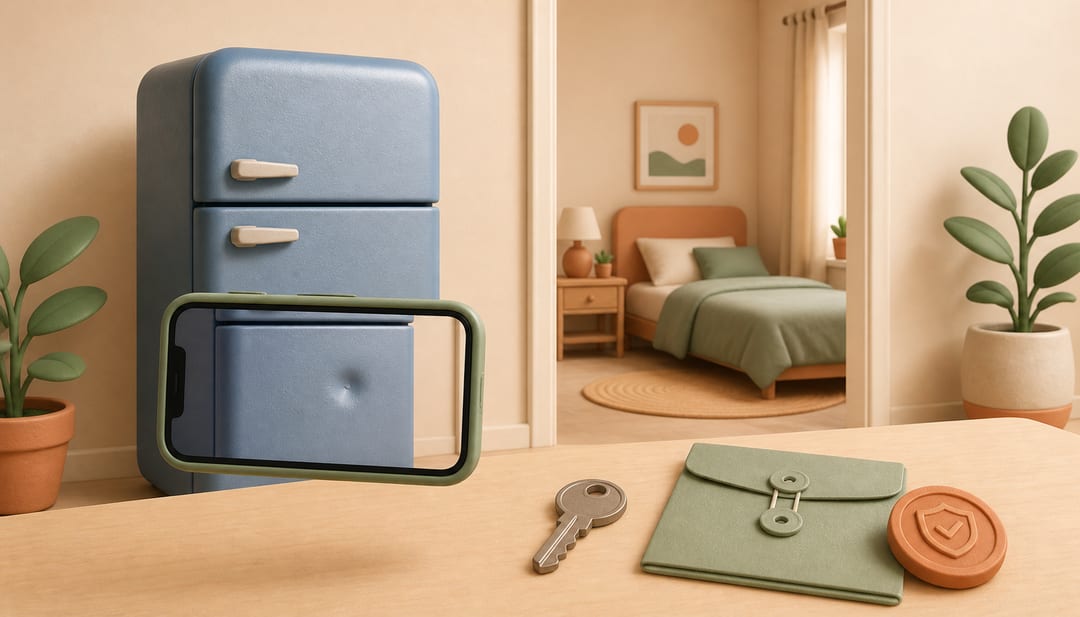
A friendly handshake does not establish a room’s move-in condition. When a California landlord says you damaged an old appliance, the useful questions are baseline condition, causation, authorized deduction, reasonable cost and statutory documentation—not who seemed trustworthy at the showing.
Quick answer: A California residential landlord generally may use a security deposit for a reasonably necessary amount to repair damage caused by the tenant or the tenant’s guests beyond ordinary wear and tear. The landlord should not charge the tenant for damage that already existed at move-in. If the disputed item is an old refrigerator dent, neither “the refrigerator was old” nor “the tenant lived there when the dent was noticed” resolves the claim. Compare the move-in record with the move-out condition, ask what work was actually necessary, and audit the landlord’s photographs, itemization and cost documents. California’s current deposit law adds important photo requirements, including move-in photographs for tenancies beginning on or after July 1, 2025 and before-and-after documentation for many repair or cleaning deductions.
Editorial note: This article uses an anonymized summary of user-provided community material. We did not inspect the home, refrigerator, agreement, deposit record, photographs or communications from both sides. It provides general information about California, not legal advice. The result can depend on who owns and occupies the home, how many rooms are rented, the agreement, the dates and local rules.
A Concrete Shared-Home Dispute
A newly arrived parent and adult child rented rooms in a Southern California home. The arrangement was informal, and the owner lived at the property. Months later, one renter left and another person was expected to move into the room. The owner then alleged that a dent in an older refrigerator had been caused during the tenancy and proposed retaining $300 from the deposit.
The renters said the dent was present when they arrived. They had not documented it because it did not affect the refrigerator’s operation and the relationship had seemed friendly. The disagreement then became mixed with complaints about household chores, internet use, plumbing, noise and the occupants’ personalities.
None of those allegations has been independently verified. More importantly, most of them do not answer the deposit question. A refrigerator claim should be analyzed as a refrigerator claim:
- What was the appliance’s condition at the beginning?
- Did its condition materially change during this tenancy?
- What evidence connects that change to this tenant or a guest?
- Was repair or replacement reasonably necessary?
- How was the amount calculated?
- Did the landlord follow California’s deposit-accounting process?
That framework is more reliable than deciding that a familiar language, shared background, low price or pleasant showing makes a private rental safe. Screen the transaction and preserve the evidence regardless of who the parties are.
First Correction: No SSN Does Not Mean “Private Rooms Only”
Newcomers often assume that a standard apartment is impossible without a Social Security number, U.S. credit file or long domestic rental history. Those are three different problems.
California’s Department of Real Estate explains that an applicant who cannot provide an SSN or driver’s-license number may be able to use government-issued photo identification, such as a passport or foreign driver’s license, to verify identity. California’s Civil Rights Department also says a housing provider should not require a U.S.-issued ID, visa or SSN and should accept foreign-issued identification such as a passport or consular ID for identity verification. That does not require every landlord or screening vendor to approve an applicant with no U.S. credit history. It does mean that “no SSN” is not the same as “no identity” and is not a legal rule limiting the applicant to an informal landlord of a particular ethnicity. California DRE: Looking for a Rental · California CRD: Know Your Top Fair Housing Rights
California Civil Code § 1940.3 also generally prevents a landlord or agent from asking about an applicant’s immigration or citizenship status, while preserving the ability to request information needed to verify identity and financial qualifications. California Civil Code § 1940.3
Before abandoning professionally managed housing, ask whether the provider accepts a passport, foreign ID, offer letter, bank records under a written asset policy, overseas rental references or a qualified guarantor. Our separate guide explains a safer California rental application plan without an SSN or U.S. credit.
Private room rentals can be legitimate and flexible. They are not a substitute for documentation.
Identify the Arrangement Before Applying Any Rule
“I rent a room in the landlord’s house” is not a complete legal classification. Write down:
- the property owner;
- whether that owner personally lives in the home;
- the person who signed the agreement and received the deposit;
- the exact bedroom rented to each person;
- the number of separately rented rooms and renters;
- the private and shared areas;
- whether the arrangement is fixed term or periodic; and
- the amount labeled rent, security, advance rent or another fee.
California has a narrow single-lodger rule in Civil Code § 1946.5. It concerns one lodger who contracts with an owner who personally occupies the dwelling, retains a right of access to all areas occupied by the lodger and maintains overall control. If there are multiple independent room renters, the owner is absent or someone other than the owner is the renter’s contracting party, do not assume the simplified single-lodger process applies. California Civil Code § 1946.5
Calling a renter a “lodger,” “guest” or “roommate” does not by itself decide the classification. Civil Code § 1940 generally brings tenants, lessees, boarders and lodgers renting a California dwelling unit within the residential chapter, subject to its exceptions. The special single-lodger termination rule is not permission to keep a deposit without an accounting. California Civil Code § 1940 Use our California shared-house room-rental checklist to document privacy, kitchen, laundry, mail, parking, occupants and house rules before paying.
The Six-Part Audit for a Pre-Existing Damage Claim
California Civil Code § 1950.5 allows specified residential security-deposit deductions. Relevant categories include a reasonably necessary amount to repair damage to the premises, exclusive of ordinary wear and tear, caused by the tenant or a guest or licensee of the tenant. The statute does not convert every defect discovered during a tenancy into tenant-caused damage. California Civil Code § 1950.5
Use this audit before debating the number:
| Question | What the landlord’s position needs | What the renter should collect |
|---|---|---|
| Was the condition pre-existing? | A reliable move-in baseline showing no dent or damage | Move-in photos or video, listing images, inventory, early messages and witnesses |
| Is there a new change? | Comparable images of the same surface and angle | Move-out images and a description of what changed—or did not |
| Who caused it? | Facts connecting the renter or guest to the change | Occupancy dates, access facts, repair history and communications |
| Is it beyond ordinary wear? | An explanation of why this is damage rather than aging or ordinary use | Appliance age, prior condition, function and maintenance history |
| Was work reasonably necessary? | The repair or replacement actually needed to address the tenant-caused change | Repair options, model/age information and evidence that the item still functioned |
| Is the amount supported? | Required itemization, photographs, invoice/receipt or labor-and-material detail | The deposit accounting, missing documents and any comparison estimate |
A tenant does not win merely by saying an appliance was old. An owner does not win merely by pointing to a dent at move-out. Age, initial condition, causation, function, repairability and reasonable cost all matter.
California’s Photo Rules Matter—But They Do Not Replace Your Own Record
California strengthened its security-deposit documentation requirements through AB 2801.
For tenancies that begin on or after July 1, 2025, a landlord generally must take photographs of the unit immediately before, or at the beginning of, the tenancy. For qualifying repair or cleaning deductions after possession is returned, the current law also requires photographs of the condition before the work and photographs after the repair or cleaning is completed. The landlord must provide the applicable photographs with the itemized statement. California Civil Code § 1950.5 · California AB 2801
This changes the evidence available in a modern California deposit dispute, but it does not mean:
- a landlord’s missing photo automatically proves the tenant’s version of events;
- one distant room photograph proves the condition of every appliance surface;
- a post-repair image proves that the tenant caused the original condition; or
- a photo establishes that the amount charged was reasonable.
Ask for the original, dated files covering the specific refrigerator panel—not a cropped image pasted into a message. Compare angles, reflections, lighting, image metadata and surrounding objects. If the landlord has the statutory move-in photograph, it may resolve the dispute in either direction.
If you took no move-in photos
Build the baseline from secondary evidence:
- the original listing and showing photos;
- videos sent to family or friends near move-in;
- messages describing the appliance or room;
- delivery, repair or maintenance records;
- photographs from another occupant;
- a witness who saw the appliance at move-in;
- the landlord’s own move-in photographs;
- older advertisements for the same room; and
- image metadata showing when and where a file was created.
Do not alter files, add a new timestamp to an old image or recruit someone to “confirm” something they did not observe. A smaller authentic record is more useful than a manufactured one.
Build a Room-and-Appliance Condition Packet at Move-In
The safest time to handle a future $300 claim is before the first night.
1. Record one continuous walkthrough
Start outside the private bedroom, identify the date and address for your own record, then film the bedroom and every included shared feature. Move slowly. Capture walls, floors, windows, doors, locks, furniture, bathroom fixtures, kitchen storage and appliances.
2. Open and operate included appliances
For the refrigerator, record:
- every exterior panel and handle;
- shelves, drawers, seals and interior surfaces;
- existing dents, scratches, stains or cracks;
- whether the light, cooling and freezer appear to operate;
- the model and serial label, if accessible; and
- any unusual sound, odor, leaking or icing.
Do not move an appliance or remove panels unless the owner permits it and the action is safe.
3. Create a written inventory
List each included item and its condition. “Old refrigerator” is too vague. Use a description such as “small dent on lower-right front panel; cosmetic; door closes and unit cools.” Attach numbered photos.
4. Send the record while the condition is current
Email or message the owner promptly:
Attached is my move-in condition record for the room and shared appliances. Please note the existing dent on the refrigerator’s lower front panel shown in photos 12–14. The unit appears to cool and the dent is cosmetic. Please reply with any correction to this record.
No reply is not the same as a signed admission, but a contemporaneous delivery record is better than an album that appears for the first time after a dispute.
5. Preserve the transaction documents
Keep the listing, agreement, house rules, deposit receipt, rent receipts, owner/manager contact, payment confirmations and any promise about furniture or appliances. Back up original media files without stripping metadata.
How to Respond When the Landlord Announces a $300 Charge
Do not turn the first message into a character argument. Do not offer a separate gift, errand payment or unrelated concession as a substitute for deciding the appliance claim. That can make the record harder to understand.
Send a narrow written response:
I dispute responsibility for the refrigerator dent. It was present when the tenancy began and was not caused by me or my guest. Please preserve and provide the move-in photographs for the refrigerator and any inventory, prior repair record or other evidence you rely on. If you later make a security-deposit deduction, please provide the itemized statement, statutory photographs and labor, material, invoice or receipt documentation required by California Civil Code § 1950.5. This message is not an agreement to a
$300charge.
Adapt the message to facts you can truthfully support. Do not say that photographs exist if they do not. If you agree that some new damage occurred, identify the limited area you accept and still request the cost support.
If the owner is trying to collect money immediately rather than deduct it after move-out, ask whether the demand is a repair invoice, an agreed payment or a proposed future deposit deduction. Do not let the same amount be paid now and withheld again later.
The Move-Out Process Creates a Second Evidence Window
Before the tenancy ends, California generally requires a landlord to notify the tenant in writing of the right to request an initial inspection. A tenant who requests it may have an opportunity to address identified conditions before the final move-out, subject to the statute’s timing and exceptions. The inspection is not the final deposit accounting, and the landlord can later identify damage that was concealed by possessions. California Courts: Security Deposits in California
At move-out:
- request the inspection in writing;
- take another continuous walkthrough and matching close-ups;
- photograph the refrigerator from the same angles used at move-in;
- return every key through a documented method;
- provide a forwarding address or agreed electronic-return details; and
- save proof of the date possession was returned.
Under Civil Code § 1950.5, the landlord generally has 21 calendar days after the tenant vacates to provide the remaining deposit and an itemized written statement of deductions. For a $300 repair deduction, which is above the statute’s $125 documentation threshold, the accounting ordinarily should include the required supporting documents. If the landlord or an employee performed the work, the statement should describe the work, time spent and reasonable hourly rate. If an outside person or business performed it, the landlord generally should provide the bill, invoice or receipt with identifying information. A good-faith estimate may be used in specified circumstances, followed by the final documentation within the statutory period after completion. California Civil Code § 1950.5
The landlord does not have to choose the cheapest person on the internet. The amount still must be reasonably necessary and documented.
How to Evaluate the Dollar Amount
Do not compare only the charge with the price of a new refrigerator. Ask what the charge represents:
| Claimed basis | Questions to ask |
|---|---|
| Cosmetic repair | What technique was used, by whom, for how long and at what rate? |
| Replacement panel | Is the part available, was it ordered and does the invoice identify the model? |
| Full appliance replacement | Why was replacement necessary rather than repair? What was the old appliance’s age and condition? |
| Landlord labor | What work was performed, how many hours were spent and what hourly rate was used? |
| Estimated future work | Why could the work not be completed within 21 days, and when will the final documentation be sent? |
| Loss in value without repair | What agreement and evidence support this measure, and how is it tied to the tenant-caused change? |
California’s deposit statute uses “reasonably necessary” amounts; it does not create a universal rule that every old refrigerator is worthless or that any visible dent is worth $300. Keep the analysis tied to the actual item, actual condition and actual work.
If the Deposit Accounting Is Unsupported
Use a staged response rather than jumping from an argument to public accusations.
Step 1: Reconcile the accounting
Write down the original deposit, every deduction, the refund and the date the tenancy ended. Separate rent or agreed early-termination amounts from damage deductions.
Step 2: Request the missing evidence
Identify the exact missing items: move-in photograph, pre-work photograph, post-work photograph, invoice, receipt, labor hours, material cost or explanation of causation.
Step 3: Send a focused demand
State the amount requested, the factual reason and a response date. Attach an index rather than sending an unorganized photo dump. California Courts provides a demand-letter guide.
Step 4: Use the correct local help
Azusa is an incorporated city in Los Angeles County. Do not automatically apply a City of Los Angeles ordinance or an unincorporated-county rent rule merely because the address is “in LA.” City of Azusa Code Enforcement handles matters such as substandard conditions, specified utility or plumbing problems, unpermitted construction, zoning and nuisance conditions. Its online request guidance distinguishes code violations from private civil disputes and evictions. A disputed $300 deposit deduction usually belongs in written reconciliation, mediation or court—not a request for a code officer to price the repair.
Los Angeles County’s rent-stabilization enforcement applies to eligible properties in unincorporated areas, not automatically to every independent city in the county. However, the county’s Dispute Resolution Program offers voluntary neutral mediation for security deposits, lease terms, landlord-tenant matters and shared-facility disputes. Its Small Claims Court Advisors can also explain the process. Confirm whether the property is actually inside incorporated Azusa before selecting a local channel.
Step 5: Consider small claims only after valuing the dispute
California small claims can hear many deposit disputes. The court evaluates evidence; filing does not guarantee recovery. Civil Code § 1950.5 allows a court to award statutory damages of up to twice the security for a bad-faith retention, in addition to actual damages, but that remedy is not automatic merely because a tenant disagrees with a charge. Review the California Courts small-claims process and local filing, service and hearing requirements before proceeding. Los Angeles Superior Court also states that a small-claims party does not need to be a U.S. citizen. LA Superior Court: Small Claims
Keep any public review factual. “I disputed a $300 deduction and requested the move-in photos and invoice” is different from declaring that someone committed a crime without an official finding.
A Better Rule Than “Trust People Like Me”
Shared language can make a showing easier. It cannot substitute for:
- a verified owner or authorized rental representative;
- written rent and deposit terms;
- a clear bedroom and shared-space description;
- a move-in inventory;
- contemporaneous photographs;
- traceable payments and receipts;
- written house rules; and
- a documented move-out process.
Evaluate conduct, authority, condition and records. Ethnicity is neither a warranty nor a red flag.
Where Pine Fits
Open Pine to organize the listing, rental agreement, deposit receipt, move-in and move-out photographs, appliance inventory, messages and deduction documents into one dated timeline. Pine can help identify which evidence is missing and prepare a focused list of questions or a draft response for you to review.
Pine does not decide whether someone is a tenant or lodger, determine who caused damage, provide legal advice, inspect the property or guarantee a deposit recovery.
Frequently Asked Questions
Can a California landlord charge $300 for a dent in an old refrigerator?
Possibly, but not simply because the dent was noticed during the tenancy. The landlord’s deposit claim should be tied to tenant-caused damage beyond ordinary wear and tear, a reasonably necessary remedy and the required documentation. The appliance’s age, move-in condition, continued function, repairability and actual cost are relevant. There is no universal rule making every old refrigerator worth zero or every dent worth $300.
What if the dent existed before move-in but I have no photo?
You can still gather listing images, early messages, witness evidence, repair history, other occupants’ photos and the landlord’s statutory move-in photographs. Missing tenant photos make causation harder to prove; they do not automatically establish the landlord’s claim.
Must the landlord repair the item before deducting from the deposit?
California permits specified deductions and recognizes a good-faith estimate when repair or documentation cannot be completed within the initial 21-day period under statutory conditions. The landlord must follow up with the final documentation within the required time. Audit the actual statement and dates rather than relying on a blanket “no repair, no deduction” rule.
Does the landlord have to give me receipts for a $300 repair?
Ordinarily, a repair or cleaning deduction above $125 requires the supporting documentation described in Civil Code § 1950.5. The form differs depending on whether the landlord, an employee or an outside vendor performed the work. The statute also requires applicable photographs for qualifying repair or cleaning deductions.
Am I automatically a lodger because the owner lives in the house?
No. California’s special single-lodger rule requires one lodger and other specific facts, including personal occupancy and retained access/control by the owner. Multiple room renters can change the analysis. Labels in a text message are not decisive.
Can a California landlord ask about my immigration status because I have no SSN?
California Civil Code § 1940.3 generally restricts immigration- and citizenship-status inquiries while allowing necessary identity and financial verification. Ask what alternative identification and screening documents the provider accepts; do not assume you must disclose an immigration file to rent.
Is a verbal room-rental agreement safe?
An oral arrangement may still create legal obligations, but it is much harder to prove the rent, deposit, term, private space, included appliances and house rules. Get a written agreement and receipts. Do not let informality erase the condition record.
Does California limit the size of a residential security deposit?
California generally limits security to one month’s rent in addition to the first month, with a narrow exception that may allow a qualifying small landlord to collect up to two months. Labels do not necessarily avoid the cap because the statute broadly defines security. Review the current text and the landlord’s eligibility rather than assuming every larger deposit is valid or invalid.
Official Sources
- California Civil Code § 1950.5 — residential security deposits
- California Civil Code § 1940 — residential chapter coverage
- California Courts — Security Deposits in California
- California AB 2801 — security-deposit photography and documentation
- California Civil Code § 1946.5 — single lodger in an owner-occupied dwelling
- California Civil Code § 1940.3 — immigration and citizenship status
- California Department of Real Estate — Looking for a Rental
- California Civil Rights Department — Housing discrimination
- California Courts — Ask for the Money
- California Courts — Small Claims
- City of Azusa — Code Enforcement
- Los Angeles County DCBA — Countywide Dispute Resolution Program
- Los Angeles County DCBA — Small Claims Court Advisors
This article provides general information, not legal advice. Security-deposit rights, tenant or lodger status, notice requirements, local protections and available remedies depend on the facts, agreement, dates and jurisdiction. Confirm current rules with the relevant agency or a qualified California professional.