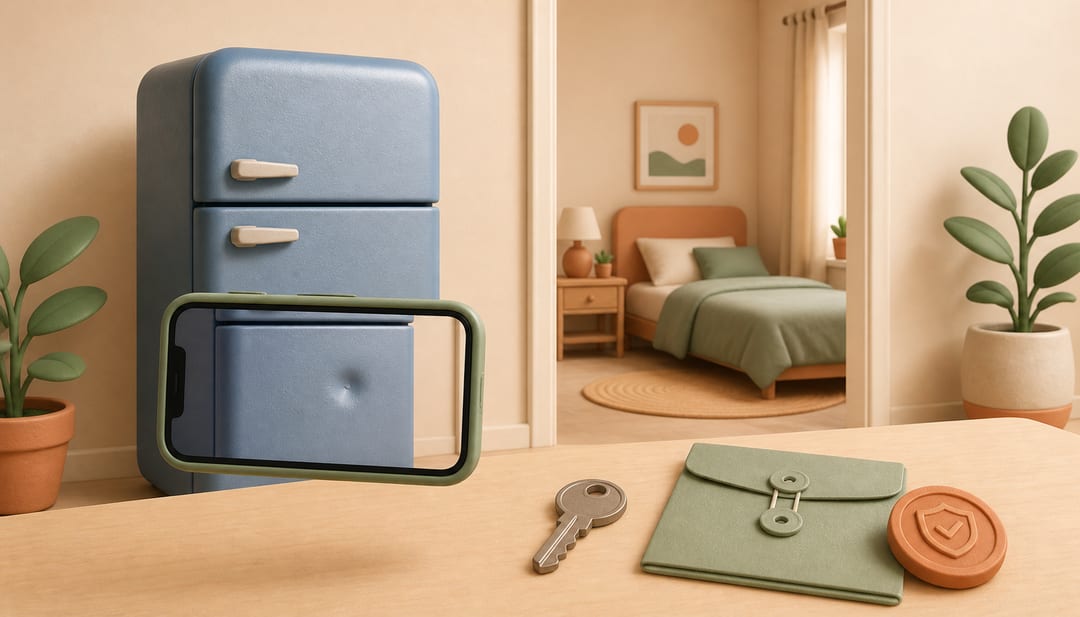
A guest's checkout photos can show a made bed and an empty floor while leaving the condition of the mattress, closets and corners completely unproven. For a landlord or host, the answer is not simply “take more photos.” It is to build an evidence chain that survives the gap between checkout, cleaning and the next guest.
At checkout, the room appeared ready.
The departing guest sent several photos that showed clean-looking sections of a New York City bedroom after a seven-night stay. Two days later, a new occupant entered and reported a very different scene: trash in the corners, used bedding left in disarray and a strong odor concentrated around the mattress. The mattress had allegedly been flipped, and the windows had been left open.
The host was outside New York City. No local representative had inspected the room at checkout. No deposit had been collected. By the time the problem was documented, the room had been empty for approximately 48 hours and another person had entered it. The departing guest disputed responsibility. The host later estimated about $200 in remediation and roughly $1,200 in missed short-term rental income.
The conflict looks like a dispute about cleanliness. Operationally, it is a dispute about evidence continuity.
The photos did not establish the condition of the whole room. The two-day inspection gap created alternative explanations. The odor could not be captured in a picture. The next occupant became both a witness and another person in the chain of access. And the host's projected rental loss was not automatically the same as a recoverable loss.
Quick answer: When a short-term rental guest leaves damage or abnormal cleaning behind, preserve the scene before cleaning, capture wide-to-close condition evidence, compare it with a pre-stay baseline, record who had access and when, obtain an independent assessment for conditions that cannot be photographed, and support every requested dollar with a receipt, estimate or confirmed canceled booking. Do not rely on guest-selected checkout photos, a deposit alone or a public accusation to prove the claim.
Editorial note: The opening scenario is an anonymized summary of user-provided material. The allegations have not been independently adjudicated, and identifying details have been removed. This article provides general information, not legal advice or a determination of platform coverage.
First Check: Was the Short-Term Stay Allowed?
Before improving a damage claim, confirm that the underlying rental was lawful and authorized.
New York City defines a short-term rental, in this context, as a rental for fewer than 30 consecutive days in a private dwelling or a Class A dwelling unit. NYC311 says owners and tenants generally cannot rent an entire apartment or home to visitors for fewer than 30 days. A lawful host in a covered permanent residential unit must stay in the same unit as the guests, may host no more than two paying guests, and must obtain a short-term rental registration. Rent-regulated, NYCHA and certain other units cannot be registered, and a building may be placed on the prohibited-buildings list because of law, a lease or another occupancy agreement. NYC311: Short-Term Rental Registration, NYC Office of Special Enforcement: Tips for Hosts
That means a seven-day room rental while the primary occupant is away raises a threshold compliance question in an ordinary NYC residential unit. The shared account does not establish the building classification, registration status, lease terms or exact legal relationship, so it would be irresponsible to declare that a particular person violated the law. But a host should resolve those questions before designing deposits, checkout procedures or damage claims.
Ask four questions:
- Does city law permit this length and type of stay?
- Does the lease, condominium declaration, cooperative rule or building policy permit it?
- Does the booking platform permit and process the transaction?
- Does the host have authority to give, disable and audit the guest's access?
If any answer is no or unknown, the operational problem is larger than a dirty room.
A Checkout Photo Is Not a Checkout Inspection
A photo proves what is visible inside its frame. It does not prove what was outside the frame, underneath an object, inside a closet, on the reverse side of a mattress or detectable only by smell.
This distinction matters because guest-provided checkout media is self-selected. Even an honest guest may photograph only the areas they think matter. A disputed guest can choose angles that omit a problem. Ten close-ups of clean surfaces may provide less useful evidence than one continuous room-level walkthrough.
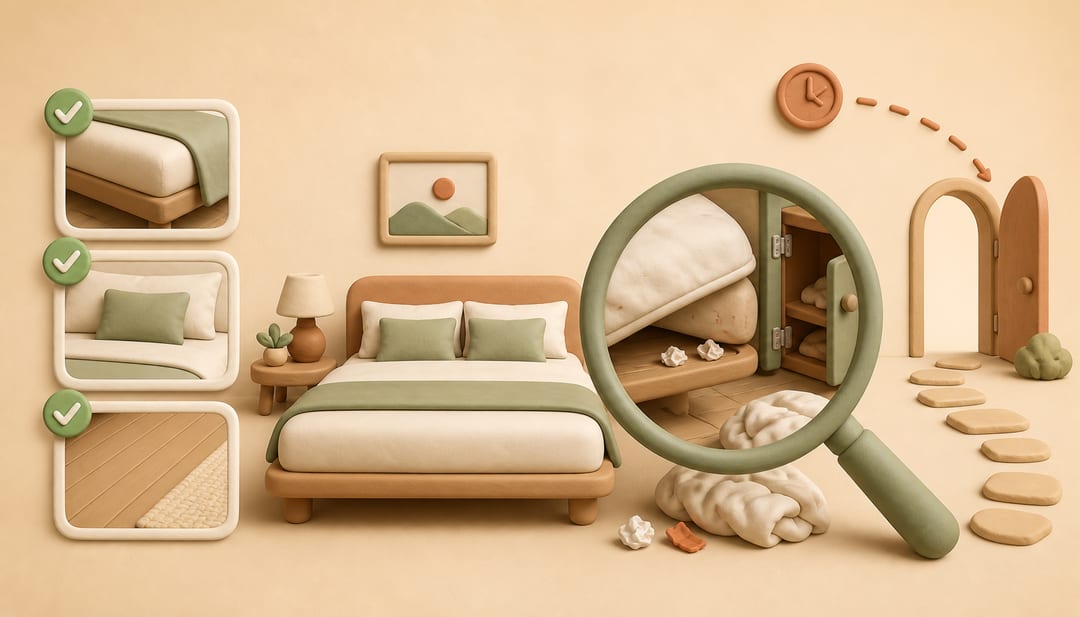
A defensible checkout record should use three visual levels:
| Evidence level | What it should show | What it prevents |
|---|---|---|
| Wide room view | The whole room from fixed doorway and corner positions | Selective framing and missing areas |
| Zone view | Bed, floor perimeter, closets, drawers, windows and soft furnishings | Hidden trash, moved items and incomplete inventory |
| Close-up | The specific stain, tear, broken part or residue with surrounding context | An isolated image that cannot be located or sized |
Keep the original files. Do not crop, annotate or resave the only copy. Pair the images with the reservation, checkout time and the name of the person who captured them. A platform message timestamp can help establish when a file was delivered, but it does not by itself prove when or where the underlying image was created.
For a remote host, the most important rule is simple:
The departing guest should not be the only person certifying the condition in which they returned the property.
A local cleaner, co-host, property manager or other authorized representative should inspect the room as soon as possible after checkout and before the scene is reset.
The 48-Hour Blind Spot Is a Causation Problem
In the opening scenario, the room was not independently inspected until the next occupant arrived two days later. That gap did not make the reported damage unreal. It made responsibility harder to prove.
During an undocumented interval, a reviewer can reasonably ask:
- Who had a key, code or building credential?
- Did a roommate, cleaner, building employee or other visitor enter?
- Were doors and windows secured?
- Did the room remain exactly as the departing guest left it?
- Did heat, humidity, ventilation or an existing mattress condition affect the odor?
- Did the next occupant move bedding or furniture before recording the scene?
Messages from roommates and smart-lock logs can narrow the timeline, but they have limits. An access log can show that a credential was used; it may not prove who used it or what happened inside. A roommate's statement can establish what they observed; it may not exclude every other cause.
The operational fix is not a longer argument after the fact. It is a shorter verification gap.
The next guest should never be the first inspector.
A practical remote-checkout sequence
- Set a checkout time and automatically expire the guest's unique access code at that time.
- Have an authorized inspector enter promptly after checkout.
- Record a continuous walkthrough before moving, cleaning or discarding anything.
- Capture fixed wide views, followed by zone views and close-ups.
- Open guest-accessible closets and drawers; inspect under the bed and around the room perimeter.
- Strip the bed and inspect the linens, protector, both sides of the mattress and the bed frame.
- Record keys, fobs and inventoried items returned or missing.
- Report any issue to the host immediately, with the original files and a short factual note.

Figure 1. Close the turnover gap: inspect after checkout and before the next occupant enters.
If a remote host cannot arrange timely local verification, frequent one-to-seven-day turnovers may be operationally unsafe even where the rental itself is legal.
Build an Evidence Chain, Not a Folder of Random Photos
The strongest record connects the condition before the stay, the authorized access during the stay, the condition at discovery and the amount requested afterward.
| Part of the chain | Records to preserve | Question it answers |
|---|---|---|
| Authority | Registration, lease/building permission, platform reservation or signed agreement | Was the stay permitted and who were the parties? |
| Baseline | Recent room-by-room photos, inventory and condition notes | Was the item intact and the room clean before check-in? |
| Rules | Signed or platform-delivered house rules, cleaning expectations and no-smoking terms | What standard did the guest agree to? |
| Access | Unique code history, key/fob inventory, cleaner and roommate access notes | Who could enter during the relevant period? |
| Discovery | Continuous video, wide/zone/close photos, original files and witness note | What was found, where and when? |
| Cause | Guest messages, physical evidence and independent assessment | What connects the condition to this stay? |
| Cost | Paid invoices, itemized estimates, receipts and repair-versus-replace analysis | Why is the requested amount reasonable? |
| Mitigation | Cleaning attempts, isolation steps, repair dates and rebooking efforts | What did the host do to limit the loss? |

Figure 2. A claim becomes easier to review when the baseline, access window and cost proof connect to one incident record.
No single row guarantees reimbursement. Together, they make it much easier for a platform, insurer, attorney or court to understand the claim without guessing.
How Do You Prove an Odor That a Camera Cannot Capture?
Odor claims are unusually difficult because the central condition is sensory, descriptions are subjective and the source may be uncertain. “The mattress smelled terrible” records a reaction. It does not establish the origin, severity, remediation cost or responsible person.
Use a more disciplined record.
1. Preserve the scene before masking it
Do not immediately spray fragrance, wash every textile, discard the mattress or run an ozone treatment. First record the room, ventilation state, bedding position, visible residue and the precise area where the odor is strongest. If an unknown odor could indicate smoke, chemicals, mold or a biological hazard, prioritize safety and use an appropriate professional rather than asking an untrained person to investigate closely.
2. Use independent observations
Ask the first authorized inspector to write a same-day note that identifies:
- entry date and time;
- whether anyone had cleaned or moved items;
- where the odor was first detected;
- whether it was room-wide or concentrated;
- which items were checked;
- visible stains, moisture, residue or other physical findings;
- ventilation conditions; and
- what was done immediately afterward.
A second independent observer or professional assessment is more useful than several messages from the host repeating the same conclusion.
3. Isolate the source
Document a reasonable sequence: remove and bag linens, check the protector, inspect both mattress surfaces, assess the frame and nearby soft goods, ventilate the empty room, and note whether the odor persists at each step. This helps distinguish an ordinary linen-cleaning issue from contamination or damage to the mattress itself.
4. Obtain a third-party assessment and cost
If ordinary turnover cleaning does not resolve the condition, ask an independent cleaner, restoration provider or relevant professional to describe the observed condition, recommended treatment and price in writing. If replacement is recommended, request the reason cleaning or repair is unlikely to restore the item.
5. Preserve the item when a claim is pending
Photograph the mattress label, model, age and condition; retain purchase records if available; and do not discard the item until the platform, insurer or adviser confirms that disposal will not impair the claim. Airbnb's 2026 Host Damage Protection Terms expressly require hosts to protect and preserve damaged eligible property and allow the company to request inspection. Airbnb: 2026 Host Damage Protection Terms
Airbnb's published coverage language is also narrower than “any bad smell.” Its current help page and terms specifically discuss unexpected cleaning for certain stains, pet-related events, unauthorized guests and smoke-odor removal. Normal checkout cleaning is excluded. A non-smoke body-odor claim is therefore not automatically covered merely because the host finds it severe; the host still needs to fit the facts to the current terms and provide verifiable evidence. Airbnb: Host Damage Protection
Separate Cleaning, Damage and Lost Income
One of the fastest ways to weaken a legitimate claim is to combine every inconvenience into a round number.
| Category | Example | Evidence needed | Important limitation |
|---|---|---|---|
| Normal turnover | Laundry, dishes, ordinary trash removal | Standard cleaning record | Airbnb says normal checkout cleaning is not covered by Host Damage Protection |
| Unexpected extra cleaning | Treatment beyond the normal turnover scope | Before/after evidence and itemized third-party invoice | Must fit the platform's current covered categories and exceed expected cleaning |
| Physical damage | Torn fabric, broken furniture, stained or unusable mattress | Baseline, discovery evidence, repair estimate and ownership/condition proof | Normal wear and unsupported replacement value can be disputed |
| Access/security cost | Missing key, copied credential concern, rekeying | Key inventory, messages, access log, invoice and security rationale | A suspected copy is not proof that every lock cost is chargeable |
| Booking income loss | A confirmed reservation canceled because covered damage made the space unusable | Confirmed booking, cancellation record, dates and causal connection | Projected demand or an empty calendar is not the same as confirmed lost income |
Airbnb's 2026 terms define covered booking-income loss around confirmed Airbnb reservations that were already in force and reasonably had to be canceled because eligible damage made the accommodation uninhabitable. A host's estimate that the room “could have rented for another two or three weeks” is economically understandable, but it is not the same evidence as a canceled confirmed booking. Airbnb: 2026 Host Damage Protection Terms
For a mattress replacement, document:
- the pre-stay condition;
- brand, model, approximate age and original purchase record;
- the physical or professionally assessed condition after checkout;
- cleaning attempts and their outcome;
- a cleaning or repair estimate;
- a replacement quote; and
- why replacement, rather than ordinary cleaning, is reasonable.
The goal is not to maximize the number. It is to make each dollar traceable.
“Always Collect a Deposit” Is Not a Universal Rule
Several hosts responding to similar disputes say they now collect a deposit even for two- or three-night stays. A deposit can create leverage, but it does not prove causation and it is not always permitted in the form a host expects.
Airbnb bookings
Airbnb says most hosts may not charge security deposits either through its Resolution Center or outside the platform. Certain software-connected hosts and hotels are exceptions, subject to disclosure requirements. Most home hosts should use the platform's reimbursement process rather than privately collecting an undisclosed deposit. Airbnb: Security Deposits
Airbnb's public help page tells hosts to request reimbursement within 14 days of the responsible guest's checkout. The 2026 terms separately require best efforts to recover from the guest and notify Airbnb within 14 days, followed by the Host Damage Protection payment request and supporting material within the terms' stated 30-day period. Use the earlier operational deadline, read the current terms displayed for the reservation and do not wait for an informal argument to conclude. Airbnb: Host Damage Protection, Airbnb: 2026 Host Damage Protection Terms
Airbnb also states that Host Damage Protection is not an insurance policy. Hosts should not assume it replaces appropriate property, liability or short-term-rental insurance.
Direct short stays
A lawful direct agreement should state the parties, authorized occupants, dates, price, checkout standard, access rules, prohibited conduct, inspection method and damage process. Whether money can be collected and retained as a “deposit” depends on the legal relationship, location, payment method, agreement and applicable consumer, lodging or landlord-tenant rules. Calling someone a guest does not necessarily decide their legal status.
Residential tenancies in New York
For tenants in non-rent-regulated residential units, New York's Attorney General explains that a security deposit is generally limited to one month's rent and, after move-out, the landlord must return it within 14 days or provide an itemized statement for any lawful deduction. The landlord bears important documentation obligations. Those residential-tenancy rules should not be applied automatically to every seven-night transient stay—but neither should a short-stay host assume that the word “deposit” eliminates regulation. New York Attorney General: Residential Tenants' Rights Guide, New York General Obligations Law § 7-108
The right question is not “How large should the deposit be?” It is “What legal and platform framework governs this stay, and what collection method does that framework permit?”
Two similar deadlines, two different systems
New York's 14-day residential security-deposit rule concerns a landlord's itemization and return of a qualifying tenant's deposit. Airbnb's 14-day step concerns notification and a platform reimbursement process, with additional requirements in the current Host Damage Protection terms. Meeting one deadline does not satisfy the other, and a seven-night occupant is not automatically a residential tenant merely because money was called a deposit.
What If a Tenant Re-lists the Apartment Without Permission?
If an owner discovers that a tenant has re-listed the apartment on Airbnb or another platform, start with preservation and classification—not a lock change.
Save the listing URL, full-page screenshots, advertised dates, prices, host profile and the date the listing was discovered. Compare those records with the lease, building rules and any prior written permission. Report the listing through the platform's official channel and notify authorized building management. NYC311 accepts reports of housing used for illegal short-term rentals, and the Office of Special Enforcement explains that owners can face compliance consequences even when a tenant operates the listing. NYC311: Housing Used for Short-Term Rental, NYC Office of Special Enforcement: Information for Hosts
Then determine the proper lease-enforcement and court process for the actual relationship. Do not remove belongings, shut off services or lock out a tenant or occupant merely because an unauthorized listing was found.
Treat Access Closeout as Part of the Inspection
Another host described a renter allegedly listing the unit again on a short-term rental platform, retaining a real key and attempting to return a copy. Whether or not every allegation can be proven, the operational lesson is clear: a checkout is incomplete while the former occupant may still have working access.
For digital access:
- issue one unique, time-limited credential per reservation;
- avoid shared codes that remain active across stays;
- expire the credential at checkout;
- preserve relevant access events when an incident occurs;
- separate guest, cleaner and maintenance credentials; and
- confirm that the host is actually authorized to administer the building or unit lock.
Access data has its own limits. New York City's Tenant Data Privacy Law imposes consent, minimization, retention and use requirements on smart-access systems in covered Class A multiple dwellings. Preserve incident-related records only through an authorized, lawful process; do not turn building-entry data into indefinite surveillance or publish it. NYC HPD: Tenant Data Privacy Law
For physical access:
- record how many keys and fobs were issued;
- record their return before closing the stay;
- do not treat a returned key as proof that no copy exists;
- notify the owner or building through the proper channel when a credential is missing or copying is credibly suspected; and
- obtain an itemized locksmith or building charge if rekeying or replacement is authorized and reasonably necessary.
A tenant using a building-controlled smart-lock system may not have permission to create or revoke every credential. If the person offering the short stay cannot control access and the building has not authorized the arrangement, that is a reason not to proceed—not a reason to invent a workaround.
Do not change locks or disable access in a way that unlawfully excludes a current tenant or other lawful occupant. Access controls are a security tool, not a substitute for required legal process.
What to Do in the First 24 Hours After Discovering Damage
Before cleaning or moving anything
- restrict unnecessary entry;
- confirm the discovery time and who is present;
- capture a continuous walkthrough;
- take fixed wide, zone and close-up photos;
- preserve original media;
- identify immediate health or safety concerns; and
- prevent further damage without destroying the record.
The same day
- compare the scene with the most recent baseline;
- obtain a factual note from the cleaner, co-host or next occupant;
- preserve the reservation, house rules and platform messages;
- export or screenshot relevant access events while retaining originals where possible;
- notify the guest in neutral language;
- open the platform process within the applicable deadline; and
- arrange an independent assessment for disputed or nonvisual conditions.
Within the next business day
- obtain itemized cleaning and repair estimates;
- locate purchase or ownership records;
- separate expected turnover from extra work;
- identify any confirmed booking that may need to be canceled;
- document reasonable mitigation; and
- review the applicable platform, insurance, building and local rules.
If a dispute proceeds to NYC Small Claims Court, the court's own preparation guidance lists photographs, written agreements, paid itemized bills or invoices, receipts, at least two itemized written estimates, damaged property and other written records as examples of useful evidence. Witnesses may also matter. New York Courts: Starting a Case in NYC Small Claims Court
A Claim-Ready Evidence Packet
Organize the file so a reviewer can follow it without opening 80 unlabeled images.
- One-page incident summary: property, reservation, dates, discovery time and requested amount.
- Authority and reservation: registration or authorization where relevant, agreement, guest identity and authorized occupants.
- Pre-stay baseline: dated room views, inventory and condition of the specific item.
- Checkout record: continuous walkthrough plus wide, zone and close-up originals.
- Access timeline: guest credentials, cleaner entry, roommate or building access and any unexplained gap.
- Communications: house rules, checkout instructions, guest responses and platform messages.
- Independent observations: signed or attributable cleaner note, vendor assessment and witness information.
- Cost support: invoices, receipts, estimates, ownership record and repair-versus-replace explanation.
- Income support: confirmed reservation, cancellation record and reason the room was unusable.
- Mitigation log: what was done, when, by whom and how the loss was limited.
A neutral request can be short:
At [time] on [date], [authorized inspector] entered the room after checkout and before cleaning. The attached wide and close-up files show [observable condition]. The attached pre-stay record from [date] shows the same area before the reservation. [Independent provider] assessed [condition] and quoted/invoiced $[amount] for [specific work]. I am requesting $[amount], itemized in the attached schedule. Please respond through [platform or agreed channel].
Avoid conclusions the evidence cannot support. “The inspector found a concentrated odor at the mattress” is stronger than “the guest intentionally ruined the mattress” when intent and source have not been established.
Public Naming Is Not an Evidence Strategy
A public warning can feel like the only available leverage when a guest denies responsibility. It also creates privacy, harassment and potential defamation risk—especially when causation is disputed and the host's evidence contains a two-day gap.
Keep the private claim factual. Use the platform's reporting and review tools within their rules. If the loss justifies legal action, organize admissible records and obtain appropriate advice. Do not publish a person's school, workplace, photograph or other identifying details as a substitute for proving the claim.
Turn the Incident Into a Repeatable Control
The best outcome from one failed checkout is not a longer blacklist. It is a better operating system.
Before accepting another short stay, a landlord or host should be able to answer yes to each of these questions:
- Is the stay lawful and permitted by the building and lease?
- Is the booking and payment method compliant with the platform or direct agreement?
- Is there a recent pre-stay condition baseline?
- Are the cleaning and checkout duties written in observable terms?
- Is a local person responsible for prompt post-checkout inspection?
- Can guest access be uniquely issued and reliably terminated?
- Is there a fixed room-by-room photo route?
- Is there a process for odors and other nonvisual conditions?
- Are receipts, estimates and ownership records easy to retrieve?
- Does someone own the deadline for filing a platform claim?
If the evidence currently lives across texts, camera rolls, emails, lock apps and paper receipts, open Pine to organize the agreement, condition media, access timeline, messages and costs into one issue record. Pine can help prepare a reviewable evidence packet and focused next-step questions. It does not determine whether a rental is legal, decide who caused damage or guarantee reimbursement.
Frequently Asked Questions
Are a guest's checkout photos enough to prove the room was clean?
No. They show only the areas and angles captured. Use a fixed wide-to-close photo route and an independent post-checkout inspection before cleaning or another occupant enters.
How can a landlord prove odor damage to a mattress?
Record the condition promptly, identify where the odor is concentrated, preserve visible and contextual evidence, obtain attributable witness notes, use an independent professional assessment, document reasonable remediation attempts and support any replacement request with the item's age, condition and cost. An odor description alone rarely proves cause or value.
Can a host charge the guest for a new mattress?
Possibly, but replacement is not automatic. The host should show that the mattress was in usable condition before the stay, that the relevant condition was discovered promptly, that ordinary cleaning or repair was insufficient, and that the replacement amount is reasonable under the governing agreement, platform policy and law.
Can an Airbnb host collect a separate security deposit?
Most Airbnb hosts cannot. Airbnb permits deposits for limited categories such as certain software-connected hosts and hotels, with required disclosure. Check the current policy for the listing rather than collecting money privately. Airbnb: Security Deposits
How long does an Airbnb host have to report guest damage?
Airbnb's current public help page directs hosts to file a reimbursement request within 14 days of checkout. Its 2026 Host Damage Protection Terms contain additional 14-day notice/recovery and 30-day submission requirements. Start promptly and follow the current terms and in-product instructions for the reservation.
What should a host do if a guest may have copied a key?
Preserve the messages and key inventory, notify the authorized owner or building contact, revoke digital credentials where authorized, and obtain a documented security assessment or invoice if a lock or fob change is reasonably necessary. Do not unlawfully lock out a current tenant or lawful occupant.
Is a seven-day room rental legal in New York City?
In an ordinary covered permanent residential unit, NYC generally requires the registered host to stay in the same unit with no more than two paying guests; whole-unit rentals for fewer than 30 days are generally prohibited. Building class, registration eligibility, lease terms and other rules still matter. Confirm the specific property before hosting.
Can a host claim rent for weeks when the room could not be re-rented?
Do not assume so. Platform coverage and legal damages depend on the governing rules and proof. Under Airbnb's current Host Damage Protection terms, booking-income loss is tied to eligible damage and certain confirmed Airbnb reservations that reasonably must be canceled—not merely projected demand for an empty calendar.
Last reviewed: August 6, 2026. Platform terms and local short-term rental rules can change; verify the current source before acting.