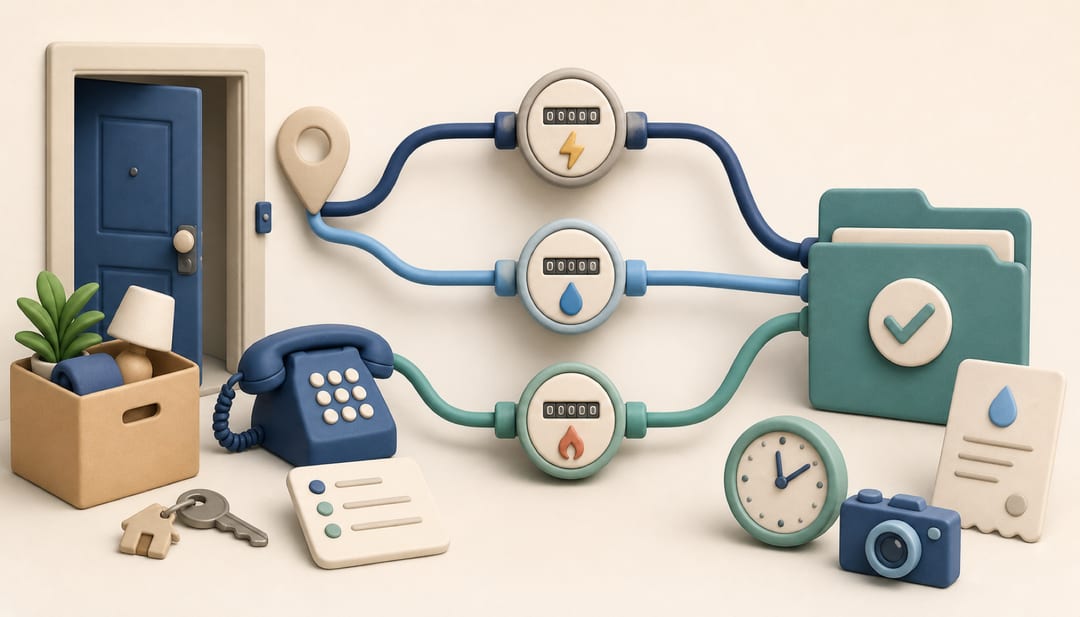
A utility move is not one vague “transfer.” It is a set of address-specific orders that must reconcile with the first bill, final bill, meter record, deposit, autopay, and any equipment return.
Quick answer: Make a separate row for electricity, natural gas, water, sewer, trash, and internet. Verify the provider for the full street address and unit. Tell each provider whether you need to start service, stop service, move the same account, or change the responsible customer. Read back both addresses and both dates. Keep the order numbers, written confirmations, safe meter records, access appointments, deposit terms, final-bill destination, refund method, autopay status, and equipment receipt. “You’re all set” is not a completion record.
Editorial note: This article is for general information only and does not constitute legal, financial, immigration, safety, or regulatory advice. Utility procedures and protections vary by service, provider, ownership structure, state, municipality, lease, tariff, and contract.
Put Safety Before the Account Call
Do not wait in a billing or moving-service queue when the problem is hazardous.
- If you suspect a natural-gas or pipeline leak, leave the area, avoid phones and electrical switches in the suspected leak area, and call 911 from a location well away from it. Follow emergency and utility instructions. PHMSA: Recognizing and Responding to Pipeline Emergencies
- Stay away from downed or damaged power lines, electrified water, fire, sparking equipment and immediate electrocution risks. Do not touch, move, drive over or attempt to restore utility equipment yourself.
- For active flooding, sewage exposure, structural danger or another immediate threat to life, use 911 and the relevant local emergency, utility, property-management and health channels as appropriate. Avoid floodwater. EPA: Flooding
- For an outage without immediate danger, use the provider's verified outage or emergency-service channel. An outage ticket is not the same as a start, stop or move order.
Pine can help with ordinary administrative calls and follow-up. It is not an emergency dispatcher, utility technician or substitute for 911.
“The Utilities” Are Not One Account
A single address can involve several owners, account holders, billing systems and regulators.
| Service | Who may provide or bill it | Move questions to answer |
|---|---|---|
| Electricity | Investor-owned, municipal/public or cooperative utility; sometimes a retail supplier plus a delivery utility | Who delivers power? Is a separate supplier involved? Can the tenant hold the account? Is access or a visit required? |
| Natural gas | Investor-owned or municipal gas utility; delivered propane or oil may be a separate supplier | Is the address connected? Is an in-person safety turn-on required? Who controls meter access? |
| Water | City, county, water district, private utility, HOA, landlord or billing company | Is the unit individually metered, submetered, master-metered or included? Can the tenant open the account? |
| Sewer or drainage | City, county, district, water utility or landlord allocation | Is it a separate account or a charge attached to water, property or rent? |
| Trash and recycling | Local government, contracted hauler, HOA, landlord or tenant-selected company | Is service automatic, owner-controlled or separately ordered? Are carts assigned to the address? |
| Internet, cable or phone | Private communications provider | Is the exact unit serviceable? What installation, promotion, billing-cycle and equipment-return rules apply? |
Ownership also affects escalation. A state public-utility commission may regulate an investor-owned electric or gas utility but not a municipal utility or cooperative. Water, sewer and trash are often governed locally. Internet and cable have different federal and state complaint routes. Do not send every dispute to the same agency.
Find the Real Provider for the Full Address
Do not rely only on a ZIP code, search advertisement or phone number forwarded by a stranger.
- Check the lease, closing packet, seller or landlord instructions, HOA materials, and a current official bill. Identify what is included, owner-controlled, tenant-controlled or billed through a third party.
- Ask the landlord, property manager, seller, closing agent, HOA or local government office for the provider's full name and official website.
- Verify the full street address and unit through the provider, city, county or state-regulator directory.
- Treat address-search tools as leads, not proof. Utility territories do not align perfectly with ZIP codes, and several companies can operate within one county. EIA: Utility Territory Data Limitations
- Start through the provider's official domain or a number printed on a known bill.
The FTC recommends independently contacting the utility through its official website or a number on the bill when an unexpected call or search result asks for payment or personal information. FTC: Scammers Pretend to Be Your Utility Company
Name the Transaction Correctly
“Transfer” can describe different actions. Ask the provider which workflow it means.
| Transaction | Required result | Proof to obtain |
|---|---|---|
| Start service | Open service for a named customer at a stated address and date | Start-order number, address, effective date, deposit or fee, access/appointment details |
| Stop service | End the current customer's responsibility at the old address and date | Stop-order number, final-read method, final-bill date/destination, refund method |
| Move within one provider | Stop at the old address and start at the new address, possibly within one provider workflow | Separate confirmation for each address and action |
| Change of responsibility | End one person's account and begin another person's responsibility | Old-holder stop proof and new-holder start proof, plus each party's authorization requirements |
A provider may not allow a simple person-to-person name change. PG&E, for example, generally requires the existing customer to stop service and the new responsible person to start a separate account, except in a limited surviving-spouse situation. That is one provider's workflow, not a national rule. PG&E: Start, Stop or Transfer Service
Use this read-back:
“Please read back the full old address and stop date, then the full new address and start date. Are these separate service orders, and what is the confirmation number for each?”
Build a One-Page Utility Move Sheet
Use one row per service and one explicit action per row.
| Field | Old address | New address |
|---|---|---|
| Provider and service type | ||
| Legal account holder | ||
| Full address and unit | ||
| Action | Stop / change responsibility | Start / change responsibility |
| Effective date | ||
| Who has possession and access | ||
| Meter or technician appointment | ||
| Deposit or fee | ||
| Confirmation number | ||
| Written confirmation received | ||
| First or final bill expected | Final: | First: |
Have the provider's verified number, current account number, account-holder name, old and new addresses, requested dates, forwarding address, phone and email, and relevant lease, closing or possession dates.
The provider may ask for identity verification, a government-issued ID, proof of occupancy or ownership, prior utility history, meter access, a gate code or appointment availability. Requirements vary.
Do not make a universal SSN assumption
The FTC says utilities may ask for information such as a Social Security number when checking credit. That does not mean every provider always requires one or that it is the only identity route. Ask:
“What identity alternatives do you accept if I do not have the requested number or cannot be verified online?”
A provider may offer manual review, an office visit, a deposit, a guarantor or another process, but no single alternative is nationally guaranteed. Never invent an SSN, use another person's identity or misstate who occupies or owns the property. FTC: Getting Utility Services—Why Your Credit Matters
Ask for the Deposit Rule, Not Just the Amount
Some providers may require a deposit or letter of guarantee based on new-customer status, credit, utility history, tariff or local rule. Deposit caps, calculation, interest, installments, waivers and refund timing differ.
Ask for:
- the amount and calculation;
- the rule, tariff or policy used;
- due date and payment method;
- refund, transfer or account-credit conditions;
- interest treatment;
- any prior-history, guarantor or other alternative; and
- whether a consumer report affected the decision.
If a consumer report was used, preserve any adverse-action or risk-based-pricing notice and dispute inaccurate information with the named reporting company and provider. The National Consumer Telecom & Utilities Exchange is one specialty reporting company that may contain participating telecom and utility account information. CFPB: NCTUE
Do not copy a deposit amount or cap from another state or provider. For example, California publishes particular deposit rules for utilities within CPUC jurisdiction; those figures are not national rules.
Coordinate the Two Addresses and Dates
Choose dates deliberately from your lease, closing or possession obligations and the provider's lead time. A short overlap can reduce the risk of arriving without service but may create double billing. A same-day handoff can reduce overlap but may fail if identity, access or technician requirements are incomplete.
There is no universal rule to start one day before and stop one day after a move. Ask whether the date means a calendar day, business day, technician window or end of a billing cycle.
Before hanging up, have the representative read back:
- full street number and name;
- apartment or unit;
- city, state and ZIP;
- account holder;
- start, stop or responsibility-change action;
- effective date; and
- meter or service identifier, if the provider uses one.
Do not post full addresses, account numbers or meter serials in public forums or unsecured screenshots.
Preserve Meter and Access Evidence Safely
If the meter is safely and lawfully visible, take a dated move-in or move-out photograph of the display and enough context to distinguish the property. Keep the original file. Ask whether the provider will use a smart-meter read, technician read, customer-submitted read or estimate.
A personal photo is supporting evidence, not an official read unless the provider accepts it. Follow the provider's submission method and keep the receipt. Never open sealed equipment, remove a meter, touch wiring or piping, enter a restricted area or trespass for a photo.
Also confirm:
- who must provide access;
- gate or building-entry procedure;
- technician appointment date and window;
- whether an adult must be present;
- what happens if access fails; and
- how completion will appear in the account.
Compare the new address's first bill and old address's final bill with the expected start/end dates and reads.
Branch for Landlord or Third-Party Billing
Before calling the underlying utility, determine whether the unit is individually metered, submetered, allocated through the landlord, master-metered or included in rent. Review the lease and utility addendum.
Ask for the billing entity, service period, meter reads if submetered, rate or allocation basis, fees, due date and dispute method. Report leaks or service problems promptly through the responsible property and utility channels.
Do not attempt to close a master account that is not yours. In Seattle, for example, tenants can establish electric accounts, while residential water, sewer and solid-waste accounts remain with the owner. Other cities differ. Seattle: New to the Area
Treat Internet Equipment as a Separate Ledger
Internet and cable moves add contract and equipment questions:
- Is the exact unit serviceable?
- Does the move create a new term, installation fee or promotional price?
- Is the old service ending immediately or at the billing-cycle boundary?
- Which modem, router, gateway, power supply, remote or accessory belongs to the provider?
- What is the authorized return method and deadline?
Photograph the devices and serial numbers, use the provider's authorized return channel, retain the drop-off or shipment receipt and tracking, and verify that the equipment is credited to the account. Keep the proof until the final bill is resolved.
Use the Right Phone Script
Start service
“I need to start [service] at [full address and unit] on [date]. What identity or occupancy documents are required? Is there a deposit or fee? Is meter access or a technician visit needed? What is the earliest confirmed activation date and order number?”
Stop service
“I need to stop my responsibility for [service] at [old address and unit] on [date]. How will the final read be determined? When and where will the final bill and any deposit or credit be sent? Please give me the stop-order number and written effective date.”
Move within one provider
“I need two linked actions: stop service at [old address] on [date], and start service at [new address] on [date]. Please read back both addresses and dates. Are there separate orders, deposits, appointments or access instructions?”
Change the responsible customer
“The current account holder is leaving and a different person will be responsible. Can the name be changed, or must the current holder stop and the new holder apply separately? What must each person do, and how can we coordinate the dates?”
Before a transfer
“Which department am I going to, what part of the request can it complete, and what is the current case or order number? Please add a note with the exact action, address and date.”
For a general transfer and read-back workflow, see When Customer Service Requires a Phone Call.
Do Not Hang Up Without the Closing Ledger
Ask for all applicable items:
- account holder and full service address;
- exact action and effective date;
- separate old- and new-address order numbers;
- identity or occupancy documents and secure submission route;
- deposit or fee amount, rule, due date and refund terms;
- meter-read method and access appointment;
- final bill date and destination;
- deposit or account-credit refund destination;
- autopay status after the final bill;
- equipment return method, deadline and receipt requirement;
- representative or department, timestamp and case number; and
- where written confirmation will appear.
Do not confuse stopping service, stopping autopay, paying the final bill and receiving a refund. They are separate ledger events. CFPB explains that stopping an automatic debit does not cancel the underlying service contract or amount owed. CFPB: How Do I Stop Automatic Payments?
Send a Written Recap
Subject: Confirmation requested — utility service order for
[service address]On [date, time and time zone], I spoke with [department or representative] about [service].
- Account holder: [name]
- Action: [start, stop, move or change of responsibility]
- Old address and stop date, if applicable: [address and date]
- New address and start date, if applicable: [address and date]
- Order or case number: [number]
- Deposit or fee: [amount, due date and stated rule]
- Meter or access step: [details]
- Final bill, refund or equipment step: [details]
- Promised update: [date and channel]
Please correct any inaccurate item and send written confirmation of the effective date and order status.
Do not include a full SSN, bank/card details, password or unnecessary identity document in an unsecured recap. For a complete evidence workflow, see How to Prove What Happened on a Customer-Service Call.
Verify the Real-World Result
The move is complete only when:
- the intended service is active at the new address;
- the old account has a documented stop date;
- account holder, unit and service address are correct;
- first and final bills use the expected dates and reads;
- deposits, credits, refunds and equipment have reconciled; and
- no unintended automatic payment, collection or open service order remains.
Moving out physically does not necessarily close an account. Unpaid utility bills sent to collection may appear on a credit report, and some participating providers report account information through specialty reporting companies. CFPB: Utility Bills and Credit Reports
If a phone cancellation is followed by continued charges, use the separate decision tree in Canceled by Phone but Still Being Charged? Build the Cancellation Record.
Protect Yourself From Utility Impersonation
An unexpected shutoff threat should trigger verification, not rushed payment.
- Do not use the caller's link, callback number, barcode, QR code or payment instructions.
- Hang up.
- Find the official number on a known bill, provider app or verified website.
- Call independently and ask whether the balance, notice, employee visit or service order is real.
- Pay only through a verified provider channel.
Gift cards, wires, cryptocurrency, payment apps and barcode-based cash demands are common scam signals. But do not assume a legitimate utility will never call or text; the safer rule is to reject unexpected pressure and verify independently. FTC: Utility Barcode Scam
Shutoff and Assistance Rules Are Local
There is no single national rule saying utilities cannot disconnect service in winter, extreme heat or when someone has medical equipment. Protections can depend on state, provider, weather, age, disability, certification, account status and program rules. A medical or life-support designation does not guarantee uninterrupted power during an outage.
For a threatened or completed shutoff, call the provider through a verified number and obtain the balance, notice date, shutoff date and case number. Ask about payment plans, hardship, medical or life-support certification, weather rules, disability and language access, third-party notification and reconnection options. Ask who must submit which form, where and by what deadline.
USA.gov links to state disconnection policies and energy-bill assistance. LIHEAP is administered through states, tribes and territories; eligibility, benefits and covered energy costs vary, and an online screening result is not approval. USA.gov: Get Help With Energy Bills · ACF: Find a Local LIHEAP Office
Treat a life-threatening outage or inability to operate essential medical equipment as an emergency and follow the person's emergency plan and 911 instructions. A utility assistance program is not an emergency-service substitute.
Escalate to the Agency That Actually Has Jurisdiction
Start with a documented provider complaint. Get the disputed amount or service order, case number, response date and written-submission channel. Do not assume a complaint automatically suspends payment or disconnection.
Then identify ownership:
- Investor-owned utility: state public-utility commission or consumer-affairs office may be appropriate.
- Municipal or public utility: city utility department, utility board, ombudsman or another local route may apply.
- Cooperative: member services, cooperative board or a state-specific authority may apply.
- Landlord or third-party biller: lease and local landlord-tenant or utility-billing rules may control.
- Internet, phone or TV: provider escalation and an FCC consumer complaint may apply.
- Impersonation: provider fraud team, FTC ReportFraud and state consumer office.
- Credit-report error: dispute with the reporting company and furnishing provider; keep the underlying account dispute separate.
A state commission does not necessarily regulate every public utility, cooperative, water district, internet provider or landlord bill. Confirm jurisdiction before filing.
Where Pine Fits
Open Pine to organize the providers, addresses, account holders, dates and documents for an ordinary utility move. Subject to the provider's authorization and identity rules, Pine can help prepare or coordinate routine calls, navigate transfers, capture order numbers and promised dates, request written confirmation, and maintain the follow-up timeline across several providers.
Pine cannot replace 911 or an emergency utility line, inspect or repair equipment, provide meter access, be present for a technician, impersonate an account holder, bypass verification, invent identity information, determine immigration eligibility, guarantee activation or a deposit waiver, make safety decisions, or decide whether a weather, medical or disconnection protection applies. Some tasks require the user, owner, tenant or authorized account holder to participate directly.
Frequently Asked Questions
Can I transfer utilities into another person's name?
Maybe, but “transfer” often means moving the same customer's service between addresses. A different responsible person may need a separate application while the old holder submits a stop order. Ask the provider which workflow applies and coordinate the dates.
Do I need an SSN to start utility service?
There is no universal answer. A provider may request an SSN for identity or credit review, but acceptable alternatives vary. Ask the verified provider about manual or alternative verification. Never use false or another person's information.
Can a utility require a deposit?
It may, depending on the service, tariff, provider, credit or utility history, and state/local rules. Ask for the amount, calculation, due date, refund or interest terms and alternatives in writing.
When should I stop service at my old home?
Choose the date from the lease, closing or possession obligation and provider lead time. Confirm it in writing. Moving out does not itself close the account, and no universal date formula applies.
Should I photograph the meter?
Only if it is safely and lawfully visible. A dated photo can support your records but is not an official read unless the provider accepts it. Never touch or enter restricted equipment.
Does stopping autopay close the utility account?
No. Close service with the provider, settle the final bill and manage payment authorization as separate steps.
Is winter shutoff always illegal?
No national rule supports that statement. State and provider protections differ. Contact the verified utility and correct state or local agency immediately to learn what applies.
Where do I complain if the account is wrong?
Open a documented provider complaint first. Then identify whether the service is investor-owned, municipal, cooperative, landlord-billed or communications-based so you can find the regulator or consumer office with jurisdiction.
Official Sources
- PHMSA: Recognizing and Responding to Pipeline Emergencies
- DOE: Utilities and Energy Providers 101
- FTC: Getting Utility Services—Why Your Credit Matters
- FTC: Scammers Pretend to Be Your Utility Company
- CFPB: Utility Bills and Credit Reports
- CFPB: How Do I Stop Automatic Payments?
- USA.gov: Get Help With Energy Bills
- FCC: Consumer Complaints
This article is for general information only and does not constitute legal, financial, immigration, safety, or regulatory advice. Provider procedures, deposits, account-holder rules, disconnection protections, assistance programs, regulator jurisdiction and available remedies vary by service, provider, ownership structure, state, municipality, lease, tariff and contract.