A private bath and separate entrance can make a room attractive, but they do not establish that it is an approved, safe or insurable rental.
Quick answer: A lock-off bedroom with an en-suite bath and no full kitchen may appeal to some short-stay guests. That does not answer whether it may be rented at a particular address. First confirm the approved use of the space, the local short- or medium-term rental category, the right to host under the lease or association documents, and whether the proposed exterior stair and locked connecting door satisfy the fire and building officials who have jurisdiction. Only after those gates pass should you test demand and price.
Editorial note: The source scenario did not identify a city or state. This guide therefore explains a U.S. due-diligence process rather than giving a location-specific legal conclusion. The scenario is anonymized and unverified. This is general information, not legal, building, fire-safety, insurance, tax or investment advice.
A Concrete Scenario
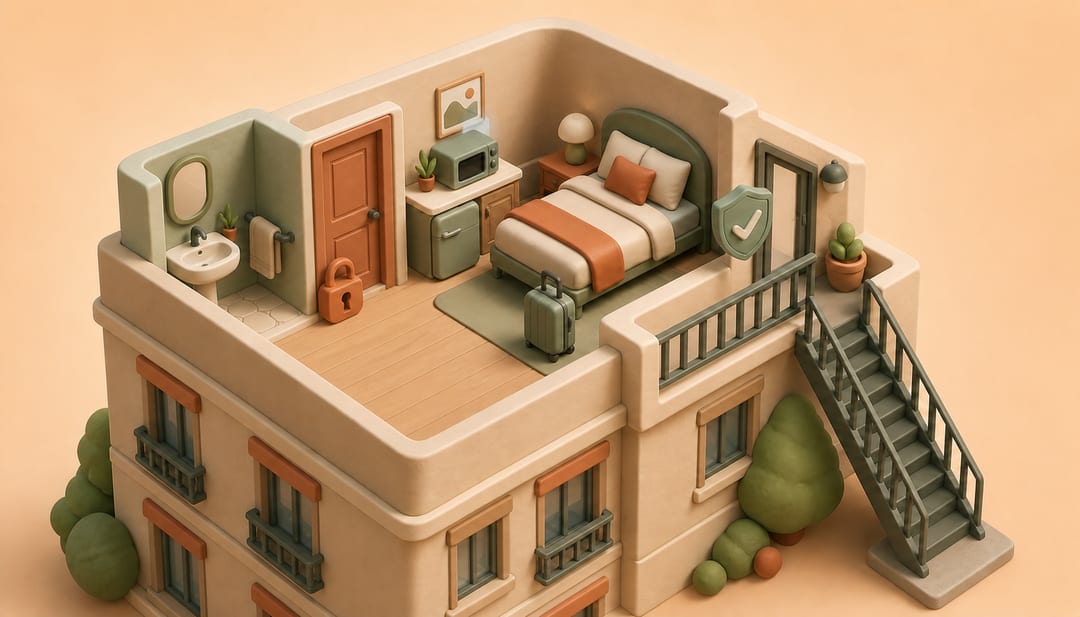
Consider a resident who wants to separate a primary bedroom from the rest of a third-floor apartment. The proposed guest space has:
- a bedroom of roughly 180 square feet;
- an en-suite bathroom and walk-in closet;
- a private entrance reached by an exterior balcony stair;
- no elevator;
- no access to the apartment's living room or kitchen;
- a mini-fridge, microwave, coffee maker and electric kettle; and
- an interior door to the main apartment that the resident plans to lock.
The building is near a hospital and a museum. The resident is considering both short and medium stays and wants to know whether guests will accept the stairs and lack of a kitchen.
Those are sensible market questions, but they come third. The first two questions are whether the resident has the right to offer the space and whether the physical arrangement is approved for the proposed occupancy.
Separate the Five Different Feasibility Questions
“It has a private entrance” compresses several independent issues into one phrase.
| Gate | What must be established | Evidence to collect | Stop condition |
|---|---|---|---|
| Legal control | The resident is allowed to host or sublet | Deed or lease, addenda, condo/co-op/HOA declaration and rules, lender terms if relevant | A lease, association rule or other binding document prohibits the use and no written approval is available |
| Land-use and rental category | The address and space qualify for the intended stay length | Parcel jurisdiction, zoning, certificate of occupancy or approved plans, local rental definition, license or permit decision | The use is prohibited, the space is unapproved or a required permit cannot be obtained |
| Life safety | The guest route, locks, alarms and sleeping room meet applicable requirements | Written building/fire guidance, approved plan, inspection records and qualified contractor findings | The only proposed route is not approved, a required safeguard is missing or the lock arrangement obstructs required egress |
| Insurance and risk | The exact paid-rental use is covered | Written insurer or broker confirmation, policy endorsement, building master-policy coordination | The carrier excludes the activity or coverage remains ambiguous |
| Product and economics | Enough suitable guests will book at a price that covers the full cost | Truly comparable listings, conservative net-income model and an operations plan | The model works only at peak pricing, near-perfect occupancy or zero value for the operator's time |
Passing one gate does not substitute for another. A business license does not prove that an exterior stair is approved. A compliant exit does not override a condo restriction. Tax collection does not legalize an otherwise prohibited rental.
“Private Room,” “Guest Suite” and “Dwelling Unit” Are Not Interchangeable
Marketing labels do not control the legal classification. Depending on the address and the actual layout, an official may treat the proposed space as part of one dwelling, a room rental, transient lodging, a separate dwelling unit, a boarding or rooming use, or an unapproved alteration.
The absence of a range or a full kitchen is not a reliable shortcut. Some local definitions focus on cooking facilities; others consider sanitation, food preparation, independent living, occupancy, stay length, access or the approved plan as a whole. A microwave, refrigerator and kettle may be ordinary guest amenities in one jurisdiction and relevant to a “kitchenette” or separate-unit analysis in another.
Even widely used building and fire codes are models until a state or local authority adopts and amends them. The applicable edition and enforcement path can differ, and a multifamily condo is not automatically governed by the one- and two-family residential code. The International Code Council's adoption overview is useful background, but the authority having jurisdiction must identify the rule for the actual building.
Local rental rules illustrate the range. New York City generally requires a host of a lawful stay under 30 days to remain in the same unit and give guests free, unobstructed access to every room and exit. Portland, Oregon has a permit category for one or two bedrooms in a qualifying primary residence. Neither rule answers the unknown-address scenario; together they show why host presence, guest access, number of rooms, stay length and permits cannot be inferred from the floor plan. See NYC's official host guidance and Portland's Type A permit guidance.
Before buying furniture, ask the planning or zoning department in writing:
- Which city, county or other authority controls this parcel?
- What use and number of dwelling units does the current certificate of occupancy or approved plan show?
- Is the proposed space considered a room within the resident's dwelling or a separate unit?
- Which rule applies to stays of fewer than 30 days, 30–89 days, and 90 days or more?
- Does owner occupancy change the result?
- Are registration, inspection, business-license, tax-account or local-contact requirements triggered?
- Would adding the proposed appliances or locking the connecting door require a permit or change of use?
Attach a simple floor plan and photographs to the inquiry. A phone answer based on “a private suite” may change when the official sees the exterior stair, third-floor location and connecting door.
Public Approval Does Not Override Private Restrictions
The proposed operator may not have the sole right to make this decision. If the resident rents the apartment, the lease may regulate subletting, paying guests, business use, alterations, keys and occupancy. If the unit is owned, a condo, co-op or HOA declaration may still restrict transient use, bedroom-by-bedroom rentals, minimum lease terms, added locks or a second cooking area.
The balcony, exterior stair, rear path, outside door and building systems may also be common or limited-common elements. That can make association approval and maintenance responsibility relevant even when the bedroom itself is inside the unit. Review the declaration, bylaws, rules, architectural process, master insurance, board minutes and any lease—not just a manager's informal answer.
Insurance is a separate gate. The National Association of Insurance Commissioners warns that many personal home policies were not designed for accidents involving short-term paying guests and advises owners to disclose the activity before listing. Give the carrier the exact room, exterior-stair route, stay lengths, host-presence pattern and appliance list. Retain the endorsement or written confirmation instead of treating a booking service's protection as a substitute for the unit policy and association master policy. See NAIC's home-sharing insurance guidance.
Finally, read the actual mortgage or security instrument rather than assuming an owner-occupied loan permits every rental configuration. Occupancy representations, insurance duties and rental provisions vary by document and loan type. Ask the servicer or a qualified adviser to interpret the real paperwork if the answer is unclear.
A Locked Connecting Door Is a Code Question, Not a Hosting Preference
There is no useful nationwide yes-or-no answer to “Can I lock the hallway door?” Building and fire codes are adopted and amended locally, and the applicable requirements depend on the building type, age, approved occupancy, number of units, floor level and renovation history.
Do not reduce the issue to “every room needs two doors.” A required means of egress, an exit-access route and an emergency escape and rescue opening are related but different concepts. A bedroom window, balcony and exterior stair do not automatically combine into an approved exit system. An outdoor stair that looks sturdy may be an accessory stair rather than a code-recognized egress component.
As a model-code principle, the 2021 International Building Code says an egress door generally must be openable from the egress side without a key, special knowledge or special effort. That is a useful question to take to the local official, not proof that this edition or provision governs the condo. See IBC §1010.2.
Ask the local building and fire officials to evaluate the actual plan, including:
- whether the balcony door and exterior stair are approved for this use;
- whether the sleeping room needs an emergency escape and rescue opening and whether the existing opening qualifies;
- whether the route remains usable from inside without a key, tool or special knowledge;
- whether the connecting door is part of a required path or fire-resistance assembly;
- which side of the connecting door may be locked and what hardware is permitted;
- whether guards, handrails, landings, lighting and stair dimensions meet the applicable standard;
- whether any door must be self-closing or fire-rated; and
- where smoke and carbon-monoxide alarms are required and how they must be interconnected.
If the officials say the interior door must remain available for emergencies, a house rule asking guests not to use it for ordinary access may help define privacy—but it cannot replace compliant hardware or an approved egress arrangement. Conversely, leaving an unapproved door unlocked does not correct every other life-safety issue.
The U.S. Fire Administration recommends identifying two ways out of every room in a household fire plan and keeping windows and doors clear. Treat that as emergency-planning guidance, not as a permit finding or a claim that every sleeping room must have two exterior doors. See USFA's two-ways-out guidance.
Treat the Exterior Stair as Both a Safety Feature and a Product Constraint
A third-floor walk-up can still attract guests. It also narrows the practical audience and increases the consequence of vague disclosure.
Describe the physical facts, not who should or should not book. A useful disclosure states:
- the exact floor;
- that there is no elevator;
- the approximate number of exterior steps or flights;
- whether the route is exposed to rain, snow or heat;
- whether luggage must be carried on the stairs;
- lighting, gate and handrail details; and
- that the same route is used for routine entry and exit.
Show the entire approach in photos, including the bottom landing, stair run, balcony and guest door. Repeat the fact before booking and in the arrival instructions. Do not hide it in a long amenities list, and do not label the property “accessible” unless the actual features support that representation.
Use objective features rather than statements about who should book. “Access requires climbing 34 exterior steps; there is no elevator” lets a traveler evaluate the space. “Only for young, fit guests” expresses a preference about people and may create fair-housing or consumer-protection risk. The applicable accessibility and fair-housing duties are fact-specific, but truthful, prominent disclosure is the safe starting point. See the FTC's advertising guidance and HUD's Fair Housing Act overview.
The owner also needs a maintenance routine. Record inspections of treads, fasteners, guards, handrails, lighting, drainage, ice or debris and door hardware. Establish who responds if a light fails or the path becomes slippery during a stay.
No Full Kitchen Can Work—For a Narrower Job to Be Done
Some travelers need a safe place to sleep, shower, work and make a simple breakfast. A private bathroom and independent entrance may matter more to them than a stove. Others—especially guests staying for weeks—will reject any room without a real sink and food-preparation area.
Proximity to a hospital or museum suggests possible demand; it does not prove it. The relevant comparison set is not every nearby hotel or entire apartment. Build a set of legal, genuinely comparable spaces with:
- a private bath and entrance;
- no full kitchen;
- the same walk-up burden;
- similar parking and transit access;
- comparable temperature control and workspace;
- the same stay-length rules; and
- similar cancellation flexibility and total guest price.
Review whether those spaces are actually available over several future date ranges. Separate asking price from collected revenue. If possible, ask likely guests or local housing coordinators what they require for three nights, two weeks and two months. The acceptable product may change sharply with length of stay.
Use plain language in the eventual listing:
Private bedroom suite with en-suite bathroom and exterior entrance. No access to a full kitchen or the main apartment. Amenities are limited to a mini-fridge, microwave, coffee maker and electric kettle. Access requires climbing [verified number] exterior stairs; there is no elevator.
Do not call it an apartment, studio or kitchenette unless that description is accurate and consistent with the approved use.
Small Appliances Create Their Own Review
Four countertop appliances in a bedroom do not create a full kitchen, but they do create electrical load, heat, spill, odor and cleaning questions.
Before installation:
- give the equipment list and wattage to a qualified electrician;
- confirm the receptacle locations, circuit capacity and any required protection;
- follow each manufacturer's clearance and ventilation instructions;
- do not make an extension cord or power strip the permanent power plan for a microwave, kettle or coffee maker;
- keep hot appliances away from bedding, curtains and combustible storage;
- provide a stable, cleanable counter rather than a dresser or closet shelf;
- define where guests may fill and wash cups without creating an unsanitary bathroom setup; and
- ask the insurer and building official whether the appliance package affects the permitted use or coverage.
If the only sink is in the bathroom, say so before booking. Disposable tableware may reduce washing, but it does not solve electrical safety, water access, food storage or waste handling.
USFA advises plugging a refrigerator directly into a wall outlet, avoiding overloaded outlets and power strips, and using extension cords only temporarily. It also advises using only one heat-producing appliance—such as a coffee maker or microwave—at an outlet at a time. Those recommendations do not determine the required circuit design; they show why the existing outlet count is not an electrical plan. See USFA's appliance and electrical fire-safety guidance.
Alarms and Separation Need Their Own Review
Locking a normal bedroom door does not create a fire-rated separation. If the use classification changes, an official may need to evaluate the wall and door assembly, penetrations, shared ducts, sprinkler coverage and whether alarms must communicate across both sides.
USFA recommends smoke alarms inside every bedroom, outside each sleeping area and on every level, with interconnected alarms so that one activation sounds them all. CPSC recommends carbon-monoxide alarms on every level and outside sleeping areas. Local law may impose different or additional requirements for placement, power source, interconnection, monitoring, testing and replacement, so ask the fire official to specify the exact arrangement. See USFA's smoke-alarm guidance, CPSC's carbon-monoxide guidance and USFA's short-term-rental fire-safety flyer.
Shared HVAC Needs a Boundary, Not Just an App
Giving a guest phone control over the thermostat for the entire apartment sounds convenient. It can also let one room determine temperature, humidity and energy use for everyone else, while exposing device or account access that was not designed for a rotating occupant.
Before promising “guest-controlled climate,” confirm:
- which equipment actually serves the suite;
- whether the room can maintain a safe, comfortable temperature with the connecting door closed;
- the temperature range and quiet-hour policy;
- who can change schedules and limits;
- what happens during a connectivity or equipment failure; and
- whether a separately controlled system is permitted and practical.
Advertise the control the guest truly has. “Central HVAC shared with the main apartment; guest may request adjustments” is less glamorous than “private climate control,” but it prevents a material mismatch.
Medium-Term Stays Are Not Automatically the Easy Category
Changing the minimum stay can move the arrangement outside one short-term-rental definition, but it may trigger a different licensing, lease or residential-tenancy framework. The boundaries vary. A 30-day booking is not a universal safe harbor, and calling someone a “guest” does not necessarily prevent tenant rights from arising.
For any recurring medium-stay plan, verify:
- the local short-term-rental definition and exemptions;
- whether rooming-house, lodging or general rental registration applies;
- the required agreement and disclosures;
- deposit, entry, repair and termination rules;
- whether the lack of kitchen access affects lawful occupancy;
- tax treatment at each stay length; and
- the process if the occupant does not leave on the agreed date.
Have a local attorney review the operating model and agreement before accepting longer stays. Do not use a short-stay house-rule document as a substitute for a legally appropriate rental agreement.
Build the Operating Plan Before the Listing
The suite shares a structure and probably some systems with the resident's home. A workable plan should answer:
| Operating issue | Decision to make before the first stay |
|---|---|
| Entry and privacy | Guest door, connecting-door hardware, keys or codes, lost-access process and host access in an emergency |
| Arrival | Exact exterior route, after-dark lighting, luggage instructions and weather contingency |
| Temperature | Actual control, permitted range, response time and equipment-failure plan |
| Water and food | Drinking-water source, cup and dish cleaning, permitted appliances and odor/waste rules |
| Trash | Container location, collection day, recycling and route that does not require unauthorized home access |
| Deliveries | Whether packages are allowed, the usable address and what happens to deliveries after checkout |
| Noise | Quiet hours, shared-wall expectations, alarms and escalation path |
| Connectivity | Network boundary, disclosed performance, outage plan and device-security practices |
| Cleaning | Linen flow, bathroom sanitation, appliance cleaning, pests and turnover inspection |
| Emergency response | Posted address, emergency contacts, alarm response, evacuation route and a local responsible person |
A locked interior door will not create acoustic separation. Test conversation, television, plumbing, doors and alarms from both sides before assuming that either household has meaningful privacy.
Model the Net Result, Not the Nightly Rate
Only model revenue after the permission and safety gates pass.
Annual collected accommodation revenue
= paid nights × average collected room revenue

Pre-tax operating cash
= collected revenue
− platform and payment charges
− cleaning, laundry and consumables
− utilities and internet
− licensing, registration and lodging taxes not charged through
− incremental insurance
− maintenance and safety inspections
− furniture and appliance replacement reserve
− refunds, damage and collection allowance
− management cost
− operator hours × chosen hourly value
− annualized setup and permitted-construction cost
Run at least three cases: conservative, base and downside. Reduce both rate and paid nights for the third-floor/no-kitchen constraint. Do not use the best nearby hotel rate, assume hospital proximity guarantees occupancy or value cleaning and messages at zero.
Compare the result with the value of privacy and uninterrupted use of the room. If the plan is attractive only before insurance, permits, owner labor and slower months, it is not yet feasible.
Rental income still needs tax review. IRS Publication 527 explains that payments received for use of property generally enter gross rental income and that expenses must be allocated when only part of a home is rented. Providing substantial services primarily for an occupant's convenience can also change the federal reporting path. Local lodging or sales taxes are separate address-level questions. See IRS Publication 527.
A Practical Go / No-Go Sequence
- Identify the legal operator. Confirm whether the resident owns the unit, rents it, or is subject to a co-op, condo or HOA regime.
- Resolve the exact jurisdiction. Do not rely only on the mailing city; confirm who controls zoning, building, fire, business licensing and lodging tax.
- Retrieve the property record. Obtain the certificate of occupancy, approved floor plan, permit history and any open violations.
- Get the use classification in writing. Show officials the floor plan, appliances, proposed stay lengths, exterior stair and locked connecting door.
- Resolve egress before privacy hardware. Have the building/fire authority and a qualified professional evaluate the room, balcony, stair, window, locks, alarms and separation.
- Clear private restrictions. Obtain any required written landlord, association, lender or co-owner approval.
- Bind the insurance. Describe the exact paid use, stay lengths, guest access and amenities; retain the endorsement or written coverage confirmation.
- Price the physical and operational work. Include permitted alterations, electrical work, stair maintenance, locks, alarms, furnishing, climate control and owner time.
- Validate only with legal comparables. Compare like-for-like rooms, not entire apartments or hotels with elevators and kitchens.
- Create the disclosure and response system. Finish the access guide, stair photos, emergency plan, house rules, cleaning checklist and records before accepting money.
The right answer may be “yes, with changes,” “only for a different stay length,” “only as a room inside the principal residence,” or “not at this address.” That is a better result than learning the classification from a complaint, denied claim or emergency.
Where Pine Fits
Open Pine to organize the lease or deed, association rules, approved plan, permit correspondence, insurance confirmation, appliance specifications, inspection photos, comparable-rental notes and cost model into one dated file. Pine can help separate confirmed permissions from open questions and prepare a concise inquiry for the relevant official or professional to review.
Pine cannot determine a property's legal use, approve an exit, inspect a stair, bind insurance, predict demand or replace a local lawyer, building official, fire official, electrician, tax professional or insurance professional.
Frequently Asked Questions
Is a private suite without a full kitchen still rentable?
It may be marketable to guests who prioritize privacy, location and a short stay over cooking. Its legality depends on local classification and the approved use, not on market interest. Validate demand only after the address passes the permission, safety and insurance gates.
Can I lock the door between the suite and the main apartment?
Possibly, but do not decide from another host's setup. An official needs to determine whether that door is part of a required egress route or fire-resistance assembly and what locking hardware is allowed. Privacy preferences cannot override an approved exit path.
Does every guest room need two exterior doors?
Not as a universal rule. Applicable codes distinguish means of egress from emergency escape and rescue openings, and requirements vary by building and jurisdiction. Ask the local authority to review the exact floor, window, balcony, stair and door arrangement.
Does removing the stove make the space legal?
No. Removing a stove may change one physical fact, but it does not erase an unapproved conversion, create a license or determine whether the room is part of one dwelling. Officials may also consider the microwave, refrigerator, sink, access and actual use.
Is a third-floor exterior stair a dealbreaker for guests?
It will be a dealbreaker for some and acceptable to others. State the floor, no-elevator condition and verified stair count prominently, show the route in photos, price against comparable walk-ups and maintain the path. Do not wait until arrival to disclose it.
Are 30-day stays easier than nightly bookings?
Not automatically. A longer minimum may change the short-term-rental rule, but rental licensing, residential-tenancy law, insurance and tax obligations may replace it. Verify every proposed stay band in the exact jurisdiction.
Should guests control the whole apartment's smart thermostat?
Only if the shared-system consequences and account security are acceptable and the listing describes the control accurately. A dedicated, permitted climate solution is clearer; otherwise set a reasonable range and response process instead of promising independent control.
Official Sources
- International Code Council: Introduction to Building Codes
- New York City Office of Special Enforcement: Information for Hosts
- City of Portland: Type A Accessory Short-Term Rental Permits
- International Building Code §1010.2: Door Operations
- U.S. Fire Administration: Smoke Alarms
- U.S. Fire Administration: Short-Term Rental Fire Safety
- U.S. Fire Administration: Appliance and Electrical Fire Safety
- U.S. Consumer Product Safety Commission: Carbon-Monoxide Alarms
- National Association of Insurance Commissioners: Home-Sharing Insurance
- Federal Trade Commission: Advertising FAQs
- U.S. Department of Housing and Urban Development: Fair Housing Act Overview
- Internal Revenue Service: Publication 527, Residential Rental Property
This article provides general information, not legal, building, fire-safety, insurance, tax or investment advice. Rules, classifications and remedies depend on the facts, governing documents and jurisdiction.