An old refund does not disappear merely because you moved. It may have been transferred to a state unclaimed-property program that will hold it until the rightful owner proves a claim.
A California resident recently searched the state's unclaimed-property database and found two records connected to dental-insurance overpayments. The records appeared to be moving from the insurer into state custody. The discovery was not a jackpot, but it raised a useful question:
How much money do people lose track of simply because a check went to an old address, an account went inactive or a company could no longer reach them?
The comments that followed contained the usual mix of excitement and confusion. Some people reported finding hundreds or thousands of dollars. Others worried that a government form asking for a Social Security number must be a scam. Several did not know which state to search, whether an old address would receive the check or why the result did not show a dollar value.
Those are the right questions. Searching is easy. Claiming safely requires more care.
Quick answer: Search every state where you have lived, worked or operated a business, starting from the official state-program directory maintained by the National Association of Unclaimed Property Administrators. State searches and direct claims are free. A search result is only a possible match; the state may require identity, Social Security number, current-address and old-address evidence before approving payment. Never send sensitive documents through an unexpected text, social-media message or ordinary email. Federal unclaimed funds use separate databases and are not all covered by a state search.
Editorial note: The opening example is an anonymized summary of user-provided material. Pine has not verified the records, amounts, ownership or claim outcome. Social-media comments are not used as proof of payment. This article relies on official government and state-program sources and provides general information, not legal or tax advice.
What Is Unclaimed Property?
Unclaimed property is generally financial property that a business or other holder owes to someone but cannot deliver because the owner stopped communicating, did not cash a payment or could no longer be located.
Common examples include:
- inactive bank accounts;
- uncashed payroll, cashier's, dividend or refund checks;
- insurance proceeds and premium refunds;
- stocks, bonds, mutual funds and dividends;
- utility and other account deposits;
- overpayments and rebates;
- trust or escrow funds; and
- some contents of safe-deposit boxes.
It does not mean the state is giving away abandoned houses or land. California's program, for example, covers financial assets and certain tangible safe-deposit-box contents—not real estate. California State Controller: About Unclaimed Property
After a legally defined period without owner activity or successful contact, the holder may report and transfer the property to the appropriate state. The dormancy period depends on the asset. California wages may become reportable after about one year, many bank and insurance assets after about three years, money orders after seven years and traveler's checks after fifteen years. “Everything goes to the state after three years” is therefore an inaccurate shortcut. California State Controller: Holder Reporting
Once California takes custody, it holds the property until the rightful owner or heir makes a valid claim. There is no California filing deadline for the owner to recover it.
Search and Claim Are Two Different Tasks
A common misunderstanding is that finding a familiar name means the money is ready to withdraw. It does not.
| Stage | What happens | What it proves |
|---|---|---|
| Search | You enter a name, business name, city, ZIP code or property ID | A record may match you or your business |
| Claim | You identify your relationship to the owner and submit supporting evidence | You have a legal right to receive the property |
| Review | The state compares your documents with the holder's report | The state can approve, request more information or deny the claim |
| Payment or transfer | The state returns cash, securities or property according to its process | The approved asset reaches the verified owner |
Two people may have the same name. A result may belong to a deceased relative, a dissolved company or a co-owner. The reported address may be incomplete. The original company may not have supplied a Social Security number. The claim process exists to resolve those uncertainties.
Step 1: Build Your State and Name History
Do not search only the state where you currently live.
Make a short inventory of:
- every state where you have lived;
- states where you worked remotely or received payroll;
- states where you attended school;
- states where you maintained banking, insurance, brokerage or utility accounts;
- states where you owned or operated a business;
- prior legal names, maiden names, initials and common spelling variations; and
- former business names and entity names.
Most unclaimed property is held by state programs, but the correct state may be connected to the holder's records and your last known address—not simply your current residence.
Use the NAUPA official state-program directory to reach the correct government search site. NAUPA also operates MissingMoney.com, which can search participating programs across multiple states. MissingMoney is a useful first pass, but it does not replace checking every relevant state program.
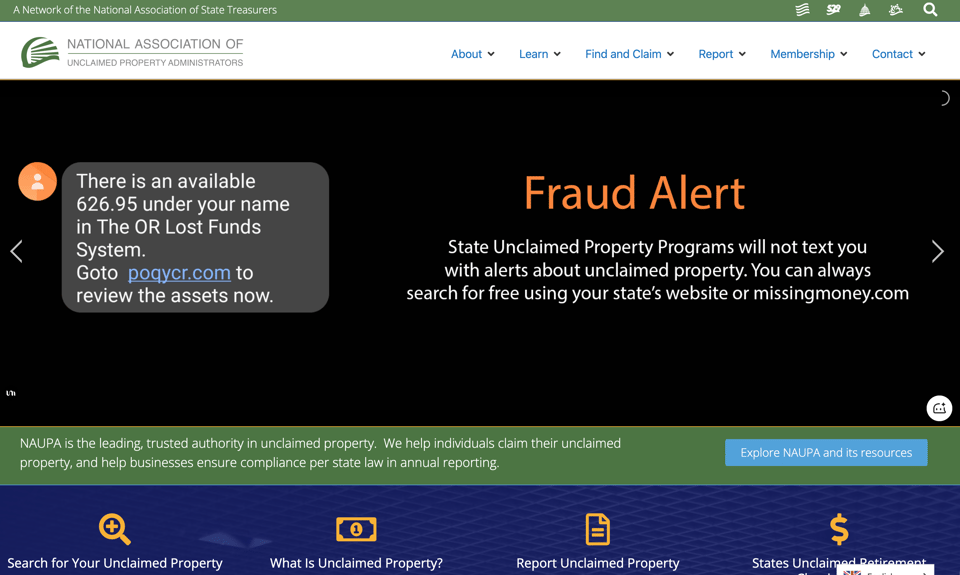
NAUPA's official site highlights a common scam pattern: an unsolicited text claims money is waiting and sends the recipient to an unfamiliar domain. Open unclaimed.org directly and use its state-program directory instead of following the message link.
A safe search sequence
- Open
unclaimed.orgyourself rather than clicking a promotional message. - Select the relevant state from the official directory.
- Search your full legal name.
- Repeat with prior names, initials and business names.
- Add a former city or ZIP code to narrow common-name results.
- Save the official property ID, holder name and reported address for a plausible match.
- Continue only through the state's official claim flow.
You do not need to search every stranger who shares your surname. The useful signal is a combination of name, former address, company or asset type that connects the record to you.
Step 2: Search Federal Programs Separately
There is no single database containing every form of unclaimed money in the United States.
State programs cover most unclaimed property, but federal agencies maintain separate searches for categories such as:
- unpaid wages;
- pensions;
- VA life-insurance funds;
- FHA mortgage refunds;
- failed-bank or failed-credit-union funds;
- SEC enforcement distributions;
- bankruptcy funds;
- IRS refunds; and
- matured savings bonds.
USAGov's unclaimed-money guide routes each category to the relevant federal agency. If a state search returns nothing, that does not rule out a federal payment.
Step 3: Understand the California Search Result
California's official entry point is ClaimIt.ca.gov. The service is free and is operated by the California State Controller's Office.
The search page accepts a last name or business name, or a Property ID. First name, city and ZIP code can narrow the result. A possible owner then selects the record, identifies the relationship to the named owner and begins the claim.
What if the property is still “in transit”?
Sometimes the company has reported the asset but has not completed the transfer to the state. During that pre-escheat period, the original insurer, bank, employer or other holder may still be able to return it directly.
If an official notice identifies the holder and says the property has not yet transferred:
- verify the notice through the holder's independently located contact information;
- ask whether the holder can reissue or return the payment;
- keep the notice and the response; and
- if the transfer completes, search the state database again and file through the state.
Missing a pre-transfer deadline does not make the property vanish. Once California receives it, the state continues to hold it for the owner.
Why might the result not show an amount?
Do not rely on social-media screenshots or old tutorials that promise an exact balance. California's current site may withhold the property value at the search stage. A match can still be worth investigating, but the record itself may not reveal whether it is twenty dollars, two hundred dollars or a noncash security.
Step 4: Prepare an Ownership Evidence Packet
For a straightforward electronic claim, the official form may ask for a name, Social Security number, date of birth and address. More complicated claims require supporting documents.
Create one folder for each record and label it with the state and Property ID. The common evidence categories are:
Identity
- driver's license or state photo ID;
- passport or another accepted government ID;
- Social Security or ITIN evidence if requested; and
- date-of-birth information.
Current contact information
- current mailing address;
- recent bank, utility, tax or other accepted address evidence; and
- reliable phone and email contact details.
Connection to the reported address or account
- an old lease, mortgage statement or property-tax document;
- utility, bank or credit-card statements;
- W-2, pay stub or tax records;
- policy, account or brokerage statements;
- invoices, receipts or correspondence from the holder; or
- other documents tying you to the reported address and asset.
Claim administration
- Property ID and Claim ID;
- holder name;
- screenshots or PDFs of the official record;
- submitted forms;
- document-upload confirmations;
- state requests for more information; and
- a dated follow-up log.
If the paperwork is spread across email, cloud drives and old devices, open Pine to organize the Property ID, old-address evidence, identity documents, holder correspondence and next action in one place. Pine can help you maintain the record; it cannot approve the claim or accelerate a state agency's review.
Different Owners Need Different Evidence
Claiming your own property
The state is trying to connect the present applicant with the original holder record. A current ID alone may not prove ownership when the record lists an address from fifteen years ago. Old-address and account evidence often becomes the decisive link.
Claiming for a deceased relative
An heir cannot claim merely because the record contains a family surname. California may require the owner's certified death certificate, documents identifying the applicant, proof connecting the deceased owner to the reported address and legal evidence of the applicant's authority or inheritance rights.
Depending on the estate, that evidence may include a will, trust, court appointment, declaration, table of heirship, birth certificate, marriage certificate or other relationship records. California State Controller: Heir Filing Instructions
Claiming for a business
A corporation, LLC, partnership or sole proprietorship must prove the entity's identity and the signer's authority. That may require entity formation or governance records, an IRS-issued FEIN confirmation, current and former business-address evidence and documents covering a merger, sale or dissolution.
Do not file a business record as if it were personal property merely because you own the company.
Claiming jointly owned property
Each owner may need to sign and establish their share. If one co-owner has died, the claim may also require death and inheritance documents. Safe-deposit-box contents can involve an additional release authorizing delivery to one recipient.
Is It Safe to Enter a Social Security Number?
The answer depends on where you are entering it.
California uses Social Security information as an important identity-matching tool in its secure claim process. A request for SSN is therefore not automatically evidence of fraud. But the existence of a legitimate government requirement does not make every form, email or caller legitimate.
Use this rule:
Start from the official state directory, navigate to the claim yourself and submit sensitive information only through the verified government claim flow or a specifically required official document channel.
Do not send a Social Security card, passport or bank statement through:
- an unsolicited text message;
- social-media direct messages;
- a caller's improvised upload link;
- an ordinary email that has not been independently verified; or
- a site reached only through a paid ad or postcard.
California's ordinary contact form specifically warns users not to include Social Security numbers in a general message. Sensitive information belongs in the secure claim process, not in a casual inquiry. California State Controller: General Inquiries
Red Flags for Unclaimed-Money Scams
Official state searches and direct claims are free. You do not need to pay a lawyer, investigator, “asset locator” or heir finder simply to search your name and file a normal claim.
Be cautious when someone:
- demands an upfront processing or release fee;
- says the money will expire within hours;
- asks for payment by gift card, cryptocurrency or wire;
- sends a shortened or misspelled link;
- requests SSN or bank credentials by phone, text or email;
- guarantees a payment amount before the state verifies ownership; or
- discourages you from contacting the state directly.
Private finders can operate legally and charge fees, particularly in complex heir or business cases. But paying a finder is a commercial choice, not a prerequisite. NAUPA confirms that searching official state databases is free. NAUPA: Can I Really Search for Free?
California also warns about official-looking letters, postcards and unexpected calls. At the same time, a notice you did not initiate is not automatically fake: the state may conduct proactive outreach. Verify the Claim ID by opening ClaimIt.ca.gov independently or calling the number published on the Controller's official site. California State Controller: Consumer Fraud Alerts
How Long Does a California Claim Take?
Timing begins when the state has the complete claim package, not when you first find the name.
California says:
- simple owner claims involving cash may take roughly 30–60 days after complete documentation;
- heir, business, multiple-owner and other complex claims may take up to 180 days for review; and
- securities claims can take longer because corporate actions, share quantities and transfer-agent records must be reconciled.
These are processing ranges, not promises. Missing old-address evidence, an unsigned form or an unclear ownership chain can cause a request for more information. California State Controller: Contact the Unclaimed Property Division
Use the Claim ID to monitor status and keep every upload confirmation. If the state asks for an original document, follow the specific instruction rather than uploading another scan.
How Does California Pay an Approved Claim?
For ordinary cash claims, California currently issues a state warrant—a paper check—sent to the current mailing address entered in the approved claim. The Controller says it does not offer direct deposit for these payments. Securities that have not been sold may follow a different transfer process. California State Controller: Payment FAQ
This is why the address in the application matters. The payment is not supposed to be mailed automatically to the stale address displayed in the search record.
The state does not pay interest for the period it held the property. It also does not withhold tax from the payment, but “no state withholding” does not mean every recovered asset is tax-free. The tax treatment can depend on whether the original property was wages, interest, dividends, securities proceeds, insurance money, an after-tax deposit or another type of asset. Keep the holder and asset records and ask a tax professional if the amount or category is material. IRS: Taxable Income
A 20-Minute Unclaimed-Property Audit
There is no government rule requiring people to search every three years. A better routine is event-based.
Run a search after:
- moving to a new state;
- changing a legal name;
- leaving an employer;
- closing a bank, brokerage, insurance or utility account;
- settling a relative's estate;
- dissolving or selling a business; or
- discovering that important mail went to an old address.
The audit checklist
- [ ] List every relevant state.
- [ ] Search current and prior names.
- [ ] Search business and entity names.
- [ ] Review NAUPA/MissingMoney results.
- [ ] Open each matching state program directly.
- [ ] Record Property ID, holder and reported address.
- [ ] Search relevant federal programs through USAGov.
- [ ] Gather current ID and old-address evidence.
- [ ] Submit sensitive information only through an official flow.
- [ ] Save Claim ID, uploads, status and follow-up dates.
- [ ] Preserve the original asset type for possible tax reporting.
Frequently Asked Questions
Is ClaimIt.ca.gov legitimate?
Yes. It is the official unclaimed-property service of the California State Controller's Office. Open it directly or reach it through the Controller's government website rather than an unsolicited link.
Does the search show how much money I will receive?
Not necessarily. California's current search may not disclose the property value. Even when a record contains a value category, the approved amount can depend on ownership shares, securities activity, offsets or supporting evidence.
Do I need a Property ID to search?
No. California lets users begin with a last name or business name. A Property ID is useful when a notice or prior search already supplied one.
Can I claim if I no longer live in California?
Potentially, yes. The important questions are whether the record belongs to you and whether you can prove the claim—not whether California is your current residence. Search every relevant state.
Can someone without an SSN claim property?
The required evidence depends on the record and claimant. California's owner instructions provide alternative documentation paths for some foreign applicants without an SSN or ITIN. Do not assume the claim is impossible; follow the state instructions for the specific case.
Can an heir claim a deceased person's property?
Yes, if the heir or estate representative proves the owner's death, the property's connection to the owner and the claimant's legal authority or inheritance rights. The document burden is higher than for a simple owner claim.
Will the check go to the old address shown in the record?
For an approved California cash claim, the state says the paper warrant is sent to the current mailing address provided in the claim.
Does unclaimed property expire?
California holds transferred property until it is claimed; there is no owner filing deadline. Dormancy periods determine when a holder reports property—not when the owner's right expires.
Is recovered unclaimed property taxable?
It depends on what the property originally represented. California does not withhold tax from the payment, but that does not decide the federal or state tax treatment.
The Real Work Starts After the Search Result
Finding a name in a database can take a minute. Proving that an old refund, account or security belongs to you may require years-old addresses, account records, identity documents and a disciplined follow-up trail.
That is why the safest workflow is also the least dramatic:
- enter through an official state or federal source;
- separate a possible match from an approved claim;
- build the evidence before uploading sensitive documents;
- keep every Claim ID and request in one record; and
- refuse pressure to pay a finder for a task the state offers for free.
If you have already found a possible match, use Pine to organize the holder, Property ID, old-address evidence, identity documents, correspondence and next step. A clean record will not change the state's eligibility rules, but it can prevent a legitimate claim from stalling because the proof is scattered.
This article provides general educational information. Claim procedures, required evidence, payment methods and tax treatment vary by jurisdiction and asset. Follow the current instructions on the relevant government website.