
The most dangerous part of a remote apartment application may be the gap between paying money and knowing whether you can actually move in.
The application moved quickly—until the applicant paid.
In a user-shared account reviewed for this article, a renter applying to a California apartment from abroad paid an application fee and a holding deposit, completed a video identity check, and sent financial and identity documents. The leasing office said a lengthy lease should arrive before the weekend. The planned move-in date was only days away.
Then the replies stopped.
Emails went unanswered. Calls reached voicemail. The renter had already booked international travel and needed the lease for other time-sensitive arrangements. The lease eventually arrived while the renter was on the plane, and the move-in worked out.
That ending does not make the process safe.
The real problem was not simply slow customer service. It was that money had changed hands while the applicant still could not answer five basic questions:
- Has the application actually been approved?
- Which unit is being held, and until when?
- Under what conditions can the holding deposit be kept or refunded?
- When will both parties complete the lease?
- Who has confirmed the move-in date and key pickup?
Quick answer: A holding deposit may reserve a unit for a stated period. It is not the lease, and it does not by itself give you the right to move in. Before treating an apartment as secured, get the unit, holding period, approval status, refund rules, lease timing, and key pickup plan in writing. The exact result depends on the agreement, the facts, and applicable state and local law.
Editorial note: The opening scenario is an anonymized summary of user-provided material. Identifying details and social-media comments have not been reproduced. This article provides general information, not legal advice.
The Risky Gap Between “We Received Your Payment” and “You Can Move In”
Rental applications contain several separate milestones. They may happen quickly, overlap, or be described casually on the phone, but they are not interchangeable.
| Stage | What it usually means | What it does not prove |
|---|---|---|
| Application submitted | The property has information to review | That screening has started or the applicant is approved |
| Application screening fee paid | The applicant paid for authorized screening work | That the unit is reserved |
| Holding deposit paid | A particular unit may be held under an agreement | That the applicant has a lease or a right to occupy |
| Application approved | The property is willing to move toward tenancy, subject to remaining conditions | That both parties have completed the lease |
| Lease sent or signed by applicant | Contract documents are in circulation | That management has countersigned or confirmed move-in |
| Move-in and key pickup confirmed | The operational handoff has been arranged | That the unit's condition and every balance have been verified |
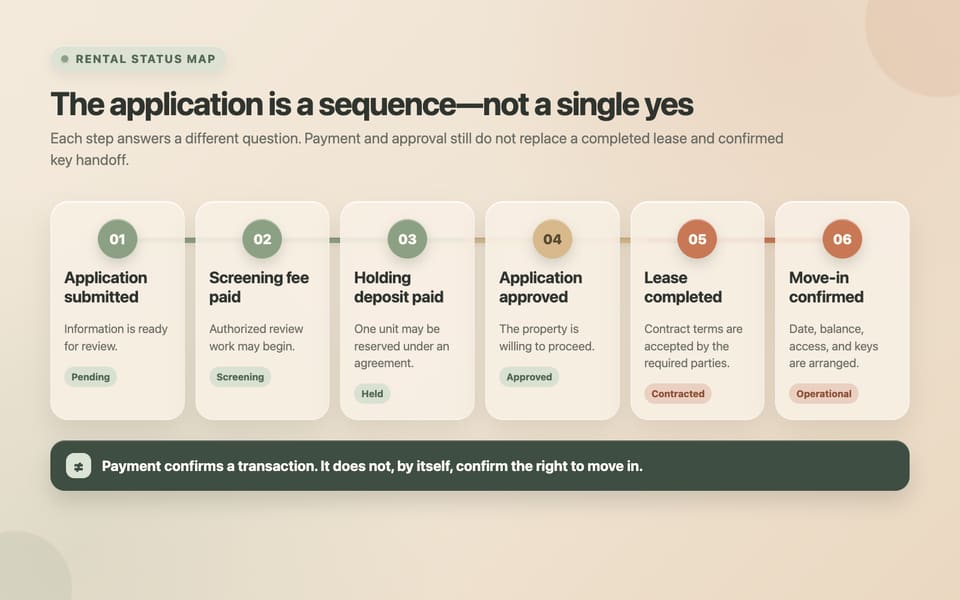
Figure 1. A rental application moves through separate milestones; payment and approval do not replace a completed lease and confirmed key handoff.
California's Department of Real Estate describes a rental application as different from a rental agreement: the application is used to decide whether to rent to someone. The same official guide says a holding deposit merely guarantees that the landlord will not rent the unit to another person for a stated period; it does not give the applicant the right to move in. California DRE: Looking for a Rental Unit
That distinction is the center of the problem. A friendly call, successful video check, payment confirmation, or verbal promise that a lease is coming may all be encouraging. None answers every question that a signed agreement and written move-in confirmation are meant to answer.
Stop Calling Every Payment “the Deposit”
Three different payments are often compressed into one word. That makes it harder to understand both the application status and the refund rules.
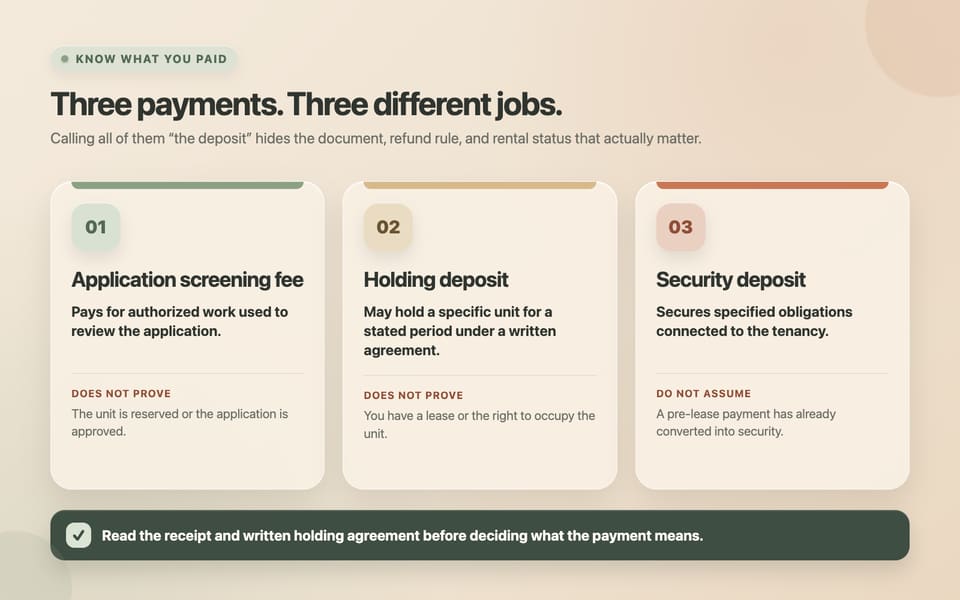
Figure 2. Screening fees, holding deposits, and security deposits perform different jobs and should not be treated as interchangeable.
Application screening fee
An application screening fee pays for work such as reference checks, tenant screening, or obtaining a consumer credit report. It is not a fee for reserving the apartment, and California law expressly separates it from a security deposit.
California Civil Code § 1950.6, as amended effective January 1, 2026, regulates when this fee may be collected, how applications are considered, when certain refunds must be made, and what records the applicant must receive. Among other things, the statute requires an itemized receipt and requires the landlord or agent to return amounts not used for authorized screening purposes. If a consumer credit report is obtained after an applicant pays the screening fee, the statute requires a copy to be provided to the applicant within seven days after the landlord or agent receives it. California Civil Code § 1950.6
The statute now permits two different compliant screening processes. Under one, completed applications are considered in order against written criteria and applicants are charged only when their application is actually considered; an inadvertently collected fee for an application that is not considered must be refunded within seven days, subject to the alternative described in the law. Under the other, the entire screening fee is returned to any applicant not selected, within the earlier of the statutory time periods. This is why “my application was rejected, so the application fee must always be refunded” is too broad.
Do not rely on an old article's fixed dollar maximum. The statutory base amount can be adjusted for inflation, and an official, current annual figure should be verified before quoting it.
Holding deposit
A holding deposit is intended to take a particular available unit off the market for a stated period while an application is processed—or, after approval and signing, while the future tenant waits to move in.
The California DRE guide says the parties commonly sign a holding-deposit agreement governing what happens next. If the application is not approved, the guide says the holding deposit should be returned. If the application is approved but the applicant does not sign the rental agreement, the holding agreement may allow the landlord to retain some or all of it. After signing, the agreement may direct the money toward first month's rent, a security deposit, or a refund. California DRE: Holding Deposit
The written holding agreement therefore matters more than the label in a payment portal.
Before—or immediately after—paying, ask for a document that identifies:
- the exact unit and address being held;
- the beginning and end of the holding period;
- whether the application is pending, conditionally approved, or approved;
- every remaining condition;
- what happens if the application is denied;
- what may be retained if the applicant declines or misses a deadline;
- what happens if management cannot deliver the unit on the promised date;
- whether the payment becomes rent, security, or a refund after signing;
- who has authority to make these commitments for the owner or management company.
There is no safe universal sentence saying every California holding deposit is always refundable—or never refundable. The agreement and facts control many practical questions.
Security deposit
A security deposit is tied to the tenancy and protects against specified losses such as unpaid rent, damage beyond ordinary wear and tear, and permitted cleaning costs. It is governed by a different statute, California Civil Code § 1950.5. That law also says a lease or rental agreement may not characterize security as nonrefundable. California Civil Code § 1950.5
Do not assume a pre-lease holding deposit has already become a security deposit merely because someone said it would convert later. Confirm the conversion in writing and identify the event that triggers it.
Is the Leasing Office's Silence Normal—or a Red Flag?
There is no statewide rule requiring every California leasing office to answer an email or send a proposed lease within 24, 48, or 72 hours after an application. A delay is not automatically illegal, and a busy office is not automatically a scam.
But “this is normal in America” is not a risk-management plan.
The better test is whether the applicant can independently verify the transaction and obtain specific written answers.
| Slow but potentially manageable | More serious warning sign |
|---|---|
| The office identifies the current screening step | The office cannot say whether screening has begun |
| Missing documents are listed clearly | New document requests arrive through unverified personal accounts |
| The unit and holding period are stated in writing | No written holding agreement or exact unit is provided |
| Management gives a realistic next-update time | Repeated promises pass without any written status |
| Payment went through the verified property system | Payment is redirected to an individual, wire, gift card, crypto, or unfamiliar account |
| A named backup contact can access the file | Only one person appears to know anything, and no supervisor or company channel works |
| The move-in date is described as pending | Staff continues to imply certainty while refusing to confirm move-in or key pickup |
A high Google rating does not resolve these questions. Reviews may describe the building, amenities, maintenance, or past tenants' experiences. They do not prove that the person requesting your documents is authorized, that the specific unit is being held, or that your application has been approved.
Research both the property and the management company. Use the phone number and domain on the company's own website—not only the contact information from a listing or forwarded email.
What to Do in the First 24 Hours After a Missed Lease Promise
This is a practical workflow, not a legal deadline.
1. Build one clean timeline
Record:
- the unit and advertised availability date;
- when the application was submitted;
- every fee and deposit paid;
- the payment method and receipt;
- documents requested and how they were submitted;
- every approval or conditional-approval statement;
- promised lease and move-in dates;
- emails, calls, messages, and unanswered follow-ups.
The objective is not to create a long complaint. It is to make the unresolved questions impossible to miss.
2. Stop asking only “Any update?”
Ask numbered questions that can be answered individually:
- Has my application been approved, conditionally approved, or not yet reviewed?
- Which unit is being held for me, and when does the holding period end?
- Are any documents or screening steps still outstanding?
- When will the lease be sent, and who must sign it?
- Is the planned move-in date confirmed?
- Who will provide the keys, and where?
- What happens to the holding deposit if the unit is not available by that date?
3. Verify the contact independently
The Federal Trade Commission warns that rental scammers copy genuine listings, replace the contact details, and collect fees, deposits, rent, or sensitive personal information. It recommends finding the rental company's website independently, confirming that the property is listed there, and using verified company contact information. FTC: Rental Listing Scams
For a large apartment community, call the published main office number and ask whether the employee, unit, application portal, and payment instructions are genuine. For a private rental, verification may require checking ownership records and the representative's authority.
4. Get the holding terms and receipt
If you paid a holding deposit without receiving the agreement, request it immediately. Ask management to identify the refund and retention clauses rather than summarizing them on a call.
If you paid an application screening fee, request the itemized receipt required by § 1950.6 and, when applicable, the copy of the consumer credit report.
5. Protect identity documents without assuming every request is fraudulent
A legitimate rental application may require identity and financial information. California's DRE guide notes that an applicant who cannot provide a Social Security number or driver's license may be able to provide government-issued photo identification such as a passport or foreign driver's license for identity verification. It also explains that a landlord may request documents to verify identity and financial qualifications while California law generally restricts inquiries into immigration or citizenship status, subject to specific housing-program exceptions. California DRE: Rental Application
The safer question is not simply “Did they ask for a passport?” It is:
- Did you independently verify the company and recipient?
- Does the request match a stated screening purpose?
- Are you using the property's verified portal or another approved secure channel?
- Do you know what document is required and whether a less sensitive alternative is accepted?
- Have you preserved a record of what you submitted and when?
Do not send a second copy of sensitive material to a new email address merely because an urgent message tells you to.
6. Start a reversible backup plan
If move-in is close, reserve a hotel, short-term rental, or other lawful temporary option with a cancellation policy you understand. The backup should cover enough time to inspect the unit, receive the completed lease, and solve key pickup—not merely the first night after landing.
A backup reservation is not an admission that the application has failed. It is protection against the cost of being wrong.
A Follow-Up Email That Forces the Important Questions Into Writing
Use the agreement's notice method when one exists. For an ordinary status request, adapt this template:
Subject: Written confirmation needed for [unit] and [move-in date]
Hi [name],
I am scheduled to move in on [date], but I have not yet received the lease or written confirmation that the unit will be available. I submitted my application on [date], paid [application fee / holding deposit] on [date], and completed the requested verification on [date].
Please confirm in writing by [reasonable time and time zone]:
- whether my application is approved, conditionally approved, or still pending;
- the exact unit being held and the end of the holding period;
- whether any documents or screening steps remain outstanding;
- when the lease will be sent and who must sign it;
- whether the [date] move-in and key pickup are confirmed; and
- how the holding deposit will be handled if the unit is not available by the planned move-in date.
If you are unavailable, please identify another team member who can access the application and provide these confirmations.
Thank you, [name]
Keep the tone factual. Do not accuse the office of fraud merely because it is slow, and do not admit a contractual breach you have not verified. The purpose is to create an accurate record and obtain decision-grade information.
A Practical Countdown When the Move-In Date Is Close
These timeframes are planning thresholds, not California legal response deadlines.
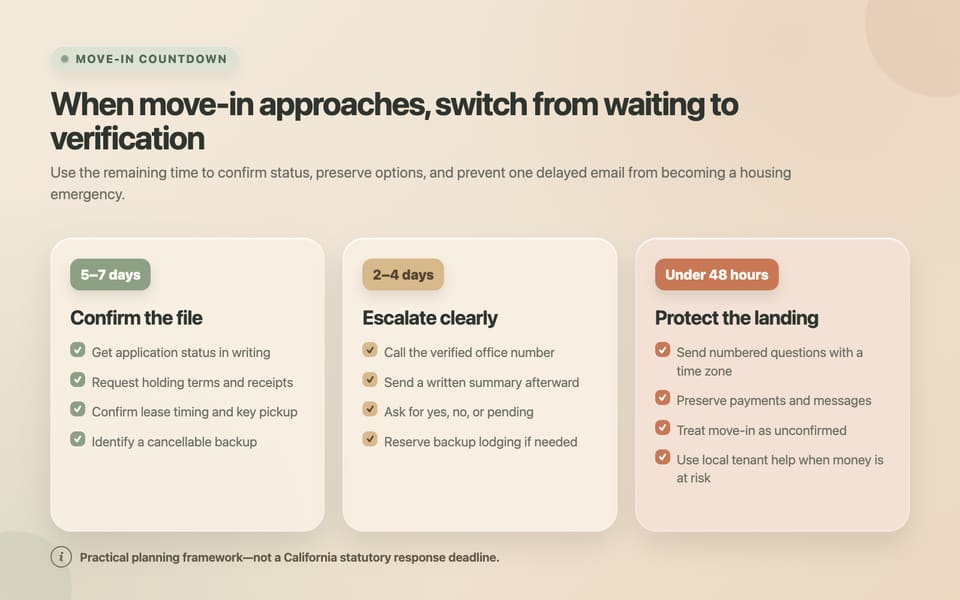
Figure 3. A practical escalation framework for protecting the move-in—not a statutory response deadline.
Five to seven days before move-in
- Confirm the application status and remaining conditions in writing.
- Obtain the holding-deposit agreement and payment receipts.
- Ask when the lease will be sent and whether management must countersign.
- Confirm the unit, rent, deposit balance, insurance requirements, utilities, and key pickup.
- Independently verify the property and contact details.
- Identify a cancellable temporary-housing option.
Two to four days before move-in
- Call the verified office number and send a written summary afterward.
- Escalate to the property manager or management company's public contact.
- Ask for an explicit yes, no, or pending answer on the planned move-in date.
- Reserve the backup if losing it would leave you without safe lodging.
- Do not ship essential belongings directly to a unit that has not been confirmed.
Less than 48 hours before move-in
- Send the numbered status request with a specific response time and time zone.
- Preserve the complete payment and communication record.
- Treat the apartment as operationally unconfirmed until the lease, move-in, and key plan are resolved.
- If significant money is at risk or management will not explain the holding terms, contact a local tenant resource or attorney.
Will Walking Away Hurt Your Credit?
The comments under remote-rental stories often treat this as a yes-or-no question. It is not.
Tenant screening reports may contain credit information, rental history, eviction records, employment verification, criminal-history information, and a risk score or recommendation. A rental application may involve a hard inquiry depending on the screening method; ask the property or screening provider what kind of inquiry it will use. CFPB: What Is a Tenant Screening Report?
The official sources reviewed for this article do not say that declining to sign a lease after approval automatically creates a credit-score penalty. But that does not mean every exit is consequence-free. There may already have been an inquiry, the holding agreement may permit retention of money, or a later billing dispute could create a separate problem.
If a landlord denies the application, requires a co-signer, charges higher rent, or demands a larger deposit because of information in a tenant-screening report, federal law may require an adverse-action notice identifying the reporting company and explaining the right to obtain a free copy and dispute errors. FTC: Tenant Background Checks and Your Rights, CFPB: Review Your Rental Background Check
Ask:
- Was a consumer or tenant-screening report ordered?
- Was the inquiry hard or soft?
- Which company produced the report?
- Has any adverse decision or conditional approval been made?
- Does the holding agreement impose a financial consequence for declining?
Do not rely on a comment saying “it will ruin your credit” or “nothing can happen.” Identify the actual report, agreement, and money involved.
Special Risks When Applying From Outside the United States
Remote applicants face an information disadvantage. They cannot easily visit the office, inspect the unit, compare the person on the call with the person at the property, or fix a failed key handoff without emergency lodging.
International students and scholars may also be asked for alternative proof of identity or finances. UC Davis advises that housing applications may involve documents such as bank statements or sponsor letters and, in some cases, immigration-related school documents. It also warns applicants to verify that the recipient is trustworthy before sharing sensitive information and provides resources for short-term and off-campus housing. UC Davis SISS: Housing Resources, UC Davis SISS: Tips on Renting
Use a remote-rental checklist:
- verify the property on the management company's own website;
- call the publicly listed office number;
- request a live video tour or send a trusted local person when possible;
- confirm the employee's role and company email domain;
- keep payment inside the verified property system;
- ask why each sensitive document is needed and which alternatives are accepted;
- confirm the exact unit, not only the floor plan;
- budget for a temporary stay and secure luggage and parking arrangements;
- do not make enrollment, shipping, travel, or address-dependent plans rely on an unsigned lease alone.
Remote renting is not automatically illegitimate. It simply requires stronger verification and a larger contingency margin.
When to Keep Following Up—and When to Protect Your Exit
Continue the process when the office can provide a verifiable status, the written holding terms are clear, the payment destination is legitimate, and the delay still leaves a workable move-in plan.
Pause and obtain local advice before sending more money when:
- the property or representative cannot be independently verified;
- the office refuses to identify the unit or holding period;
- no one will provide the holding agreement or receipt;
- payment instructions abruptly move outside the verified system;
- the lease contains terms that materially differ from the advertised or approved terms;
- management cannot confirm the unit will be available but continues demanding nonrefundable payments;
- the planned move-in is imminent and there is still no written approval, lease path, or key plan.
Walking away may affect the holding deposit depending on the agreement. Read it before sending a cancellation message, and get advice when the amount or consequences are significant.
Davis and UC Davis Resources
Applicants connected to UC Davis do not have to rely only on leasing-office answers or social-media comments.
- UC Davis SISS Housing Resources includes off-campus and short-term housing guidance for international students and scholars.
- UC Davis Housing Resources Directory collects campus, transition, and community-housing resources.
- City of Davis Rental Resources Program provides local renter information and contact routes.
- City of Davis Tenant Resources lists local support and legal-resource options.
These resources are specific to Davis. Other California cities may have additional rental rules, registration systems, tenant offices, or legal-aid programs.
Where Pine Can Help
Pine can help turn a scattered application into a clean, actionable case file:
- organize the application, payment, document, and communication timeline;
- separate what has been promised from what has been confirmed;
- identify missing documents and unanswered questions;
- draft a focused follow-up email or call outline;
- prepare an escalation summary for the property manager;
- build a move-in and backup-housing checklist;
- keep official sources and local resources attached to the right question.
Open Pine to organize your rental application and next steps →
Pine does not decide whether a holding deposit is legally refundable, interpret disputed contract language as your lawyer, or guarantee that a property will deliver possession. When money, housing, discrimination, identity theft, or an imminent move-in failure is at stake, use the organized record to get qualified local help faster.
The Real Lesson
The applicant in the opening story eventually received the lease and moved in. That is a good outcome. It is not a workflow to copy.
A slow office is not automatically a scam, and a successful payment is not a move-in guarantee. The risk is the gap between what you have paid and what has actually been confirmed in writing.
The goal is not to send more follow-ups. It is to replace uncertainty with a verified status, written terms, a named owner of the next step, and a backup plan that keeps one delayed email from becoming a housing emergency.
Sources and Scope
Primary sources used for this article:
- California Department of Real Estate — Looking for a Rental Unit
- California Civil Code § 1950.6 — Application Screening Fees
- California Civil Code § 1950.5 — Security Deposits
- California Civil Code § 1962 — Rental Agreement Copies and Disclosures
- Federal Trade Commission — Rental Listing Scams
- Federal Trade Commission — Tenant Background Checks and Your Rights
- Consumer Financial Protection Bureau — What Is a Tenant Screening Report?
- Consumer Financial Protection Bureau — Review Your Rental Background Check
- UC Davis Services for International Students and Scholars — Housing Resources
- UC Davis SISS — Tips on Renting
- City of Davis — Rental Resources Program
- City of Davis — Tenant Resources
Holding-deposit outcomes depend on the written agreement, the application's status, the transaction's facts, and applicable state and local law. The practical countdown in this article is not a statutory response deadline. Sources were reviewed on August 5, 2026. This article provides general information and is not legal advice.