
An “unauthorized occupant” warning exposes the private-contract layer that most short-term rental guides miss.
The letter never says “Airbnb.” It does not have to.
In a user-shared example reviewed for this article, a property manager alleged that an additional person was living in the home without being named on the lease. The notice pointed to a guest-days limit, told the additional occupant to leave, set a deadline to contact management, and warned that an inspection and possible eviction could follow.
The online discussion around the letter focused on whether the property manager would really enforce it. That is the wrong first question.
The letter does not prove that the tenant was operating a short-term rental, had a city permit, or was already in an eviction case. It reveals a broader blind spot: people often check city rules before checking the private agreement that controls who may stay in the home.
The better question is:
Which permission layer has failed: city law, the permit, the lease, the building rules, or the facts of who is actually living in the unit?
Most short-term rental guides stop after city registration, taxes, and safety rules. But a city can allow short-term rentals without giving a tenant permission to sublet. A city can register a host without deciding a private lease dispute. And a guest can become an alleged “occupant” under a lease even when no booking platform is involved.
That distinction matters before you list a rented home—and even more after a lease-violation letter arrives.
Quick answer: A short-term rental permit, registration, or business license does not automatically override a lease, HOA rule, condominium declaration, affordable-housing restriction, or other private agreement. The exact effect depends on the jurisdiction and the documents governing the property. If you have received a notice, identify what the notice actually is, find the provision it cites, and check the deadline before assuming that city approval protects you.
Editorial note: The opening scenario is an anonymized summary of user-provided material. Identifying details and social-media comments have not been reproduced. This article provides general information, not legal advice.
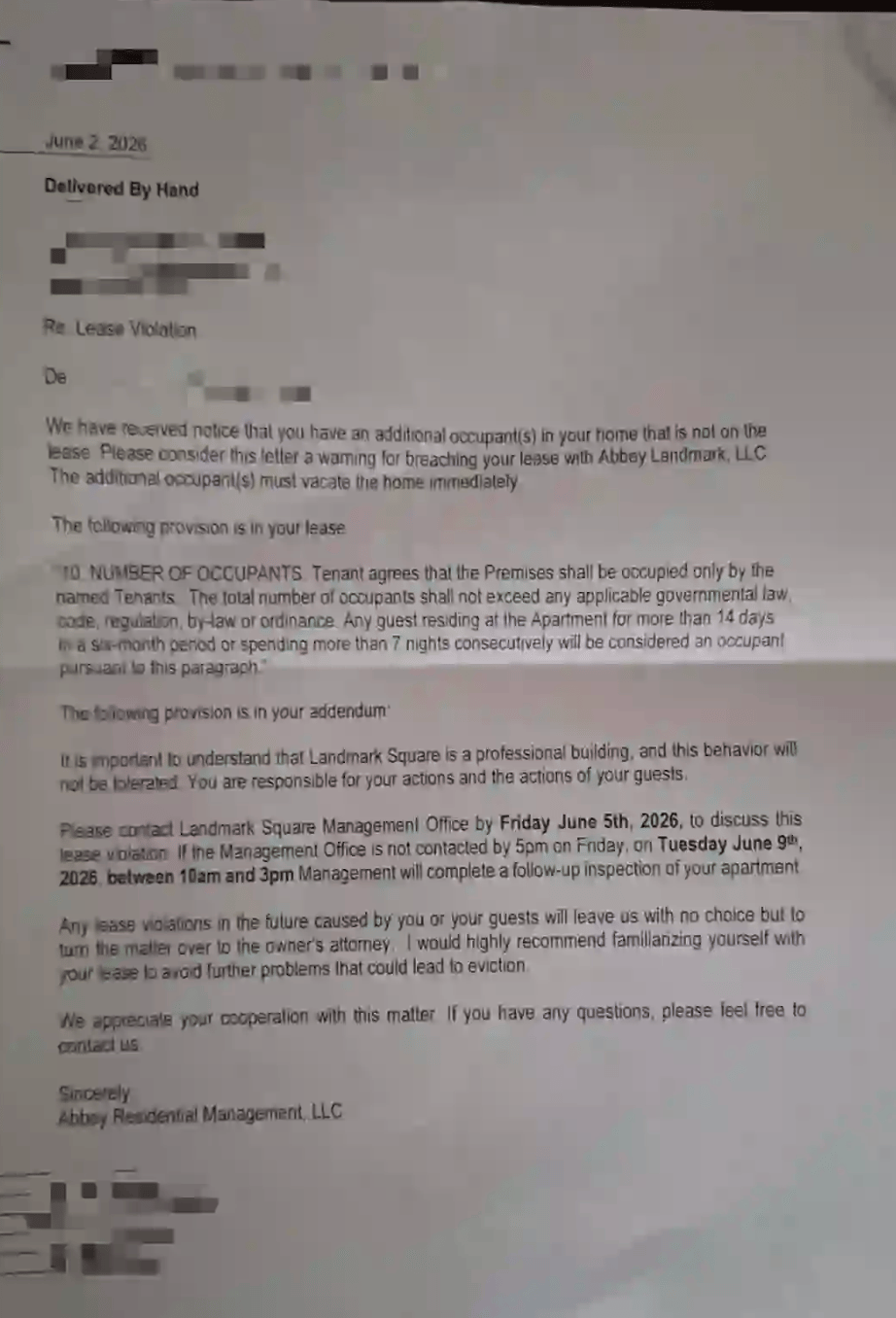
An anonymized example of an occupancy-related lease-violation notice. Details have been blurred; its wording and deadlines are specific to this example and should not be treated as a universal template.
One Property Can Be Governed by Several Different “Yes or No” Systems
Short-term rental legality is rarely one switch. It is a stack of separate questions.
| Layer | What it asks | Typical evidence |
|---|---|---|
| State and local law | Is this type of short-term rental allowed at this location? | Statute, ordinance, zoning, host-presence and stay-length rules |
| Permit and tax compliance | Has the required host, property, tax, safety, or business registration been completed? | Permit, registration number, tax account, inspection or notice records |
| Private restrictions | Does the owner, lease, HOA, condo declaration, or housing program allow it? | Lease, addenda, HOA bylaws, CC&Rs, affordable-housing agreement |
| Occupancy facts | Who is actually living there, for how long, under what arrangement, and while whom is present? | Booking records, messages, keys, mail, payment, travel and residence records |
| Notice and enforcement | What has been alleged, what must happen next, and by when? | Warning, cure notice, notice to quit, inspection notice, court papers |
Passing one layer does not answer the others.
San Francisco makes that separation unusually explicit. Its Office of Short-Term Rentals says that a landlord–tenant lease is a private agreement and that the office will not enforce lease prohibitions, HOA bylaws, or CC&Rs through the city’s application review. In other words, the city may decide whether an applicant satisfies its short-term rental rules while leaving the landlord and tenant to resolve the private contract separately. San Francisco Planning: FAQs on Short-Term Rentals
New York City uses a different model. A host applying for registration must certify that a lease or other agreement does not prohibit short-term rentals, and building owners can ask to place prohibited buildings on the city’s list. The city also restricts the type of stay itself: the permanent occupant must stay in the unit with no more than two paying guests. NYC Office of Special Enforcement: Tips for Hosting a Legal Short-Term Rental
Los Angeles takes a third approach: a tenant applying for Home-Sharing registration must obtain the property owner’s notarized authorization. Los Angeles City Planning: Home-Sharing
Portland supplies perhaps the clearest warning against treating a city application as the whole answer. Its city permit process does not require an HOA signature for a declared condominium, but the same official page tells applicants to review the HOA bylaws, codes, covenants, and restrictions that may still apply. Portland Permitting & Development: Read Before You Apply
These cities do not create a universal national rule. They demonstrate why “I have a city registration” is not a complete answer.
A Permit Answers a Public-Law Question. Your Lease Answers a Contract Question.
A city permit usually addresses the city’s concerns: zoning, safety, taxes, local contacts, host residency, neighbor notice, or operating limits. It does not necessarily decide whether the person applying has promised a landlord not to sublet, host paying guests, or allow another person to occupy the unit.
That is why tenants should treat the lease as a separate compliance source, not an attachment to check after listing.
Search the lease and every addendum for terms such as:
occupancyandauthorized occupants;guestsand any day or night limits;assignmentandsubletting;short-term rental,vacation rental, or specific booking platforms;commercial useorbusiness activity;keys, access devices, and building security;notice,inspection,default,cure, andtermination;- HOA, condominium, affordable-housing, or program rules incorporated into the lease.
Do not assume that a guest limit from one online example applies to your home. A clause allowing a guest for 7, 14, or 30 days is a contract term, not a nationwide definition. State law, local law, subsidized-housing rules, and the wording of the agreement may change the analysis.
“Guest,” “Occupant,” and “Subtenant” Are Not Interchangeable Labels
The hardest part of an additional-occupant dispute is often not the label. It is the underlying facts.
A property manager may look at questions such as:
- How many consecutive or total nights has the person stayed?
- Do they keep clothing, furniture, or other belongings in the home?
- Do they receive mail or use the address on records?
- Do they have a key, fob, parking pass, or unrestricted access?
- Do they pay rent, utilities, or anything else in exchange for staying?
- Does the named tenant continue to live in the unit?
- Was the stay advertised or booked through a platform?
- Was management asked to add or screen the person?
These facts may matter, but there is no single national checklist that automatically turns a guest into a tenant or unauthorized occupant. The controlling definitions and consequences can come from several places at once.
Official definitions show why the internet’s search for one magic number fails. Portland’s transient-lodging code distinguishes a guest from someone occupying under a monthly or fixed-term lease for that specific code chapter. Washington’s residential-landlord statute defines a tenant by the right to occupy under a rental agreement. New York City’s “fewer than 30 days” line answers yet another question: whether a stay falls within its short-term-rental registration law. Those are three different legal questions, not three competing answers to when every guest becomes an occupant. Portland City Code § 6.09.010, Washington RCW 59.18.030, NYC Office of Special Enforcement
That is also why proof of address can cut both ways. It might help establish that someone lives elsewhere. It might also establish that they have made the rental their home. Before sending sensitive documents, ask what fact management is requesting you to prove, what the lease requires, and whether the deadline demands an immediate response.
Never fabricate an address, backdate an agreement, delete booking records, or ask someone to give a false explanation. A weak situation can become much worse when the evidence no longer matches the story.
Decode the Paper Before You Decide How Serious It Is
“Lease violation letter” is not one standardized legal document. The heading, requested action, deadline, and governing law matter.
| What the document may be | What it generally signals | What to locate immediately |
|---|---|---|
| Warning or management letter | Management is documenting an alleged breach and asking for contact or correction | Cited lease clause, requested action, response date, inspection language |
| Cure or “perform covenant” notice | The sender says the breach can be corrected within a formal deadline | Exact cure, deadline calculation, delivery method, proof of compliance |
| Notice to quit or vacate | The sender is demanding that someone leave or the tenancy end | Whether a cure is offered, stated legal basis, move-out date, local response options |
| Inspection notice | Management intends to enter or verify conditions | Entry date and time, stated purpose, access rule, local notice requirements |
| Summons or court papers | A legal case may already have been filed | Court, case number, hearing or answer deadline, legal-help contact |
California’s court system, for example, distinguishes a notice to fix a correctable lease problem from a notice requiring a tenant to move for a serious alleged violation. The state’s self-help guide also warns that local rules can add requirements. California Courts: Types of Eviction Notices for Tenants
Washington illustrates the variation even more sharply. Its current statute provides at least 10 days to remedy a substantial breach of a material lease term, while other grounds in the same statute follow different notice routes. Washington RCW 59.18.650
The point is not to compare California’s deadline with Washington’s and choose the more convenient one. The point is that an online comment from another state cannot tell you what your document means.
What to Do in the First 24 Hours
1. Preserve the complete notice
Save every page, envelope, email, portal message, photograph, and attachment. Record when and how it arrived. Do not crop out the sender, date, cited paragraph, requested action, or deadline in your working copy.
2. Write down the allegation in one sentence
For example:
Management alleges that a person who is not named on the lease has stayed long enough to violate paragraph 10 and must leave before the stated follow-up date.
This separates what the notice actually alleges from assumptions made in comments or conversations.
3. Match the allegation to the governing documents
Find the quoted paragraph in the signed lease—not just in the notice. Then check addenda, renewals, roommate approvals, subletting provisions, HOA rules, and written permissions.
Look for differences between:
- what the notice quotes;
- what the signed document says;
- what management previously approved in writing;
- what has actually happened.
4. Identify everyone’s role
Write down whether each person is the:
- property owner;
- named tenant;
- approved occupant;
- proposed roommate;
- subtenant;
- short-term paying guest;
- nonpaying guest;
- caregiver or live-in aide;
- property manager or HOA representative.
The same person can be described differently by different parties. Your goal is to capture the facts and the source of each label.
5. Build a neutral timeline
Include:
- when the person first stayed;
- nights present and absent;
- whether payment or another form of consideration was involved;
- when management first contacted you;
- previous permission requests or conversations;
- every deadline and proposed inspection.
A precise timeline is more useful than a long emotional account.
6. Ask what would resolve the issue
If it is safe to contact management directly, ask in writing:
- Is this a warning, a formal cure notice, or a termination notice?
- Which signed provision is allegedly violated?
- What exact action would management accept as a cure?
- Can the person apply to become an approved occupant or roommate?
- What documents are requested, and why?
- Is an inspection scheduled, and under which notice provision?
- Will management confirm in writing when the issue is closed?
Do not admit facts you have not verified. Do not make threats. The objective is to clarify the route and preserve a clean record.
7. Escalate early when the home itself is at risk
Seek jurisdiction-specific help promptly if:
- the document demands move-out rather than correction;
- court papers or a sheriff’s notice have arrived;
- the deadline is short or unclear;
- management threatens lockout, utility shutoff, or removal of belongings;
- the alleged occupant is a caregiver, live-in aide, family member connected to a disability, or someone covered by another housing protection;
- the unit is subsidized, rent-regulated, student, employer-provided, or otherwise governed by special rules;
- the accusation is false and management refuses to review evidence.
USA.gov directs renters to state tenant-rights agencies and affordable legal help. The Legal Services Corporation funds civil legal-aid organizations serving every U.S. state and territory.
A Disability-Related Need May Change the Conversation
An apparent occupancy violation can sometimes involve a live-in aide, caregiver, or other disability-related need. That does not automatically decide the dispute, but it can create rights and procedures that an ordinary guest discussion misses.
HUD and the Department of Justice explain that the Fair Housing Act may require a housing provider to make a reasonable exception to a rule, policy, practice, or service when necessary for a person with a disability to use and enjoy a dwelling. A request does not need to use the exact phrase “reasonable accommodation,” although supporting information may be requested when the need is not obvious. HUD–DOJ Joint Statement on Reasonable Accommodations
If that may apply, describe the needed exception and its disability-related purpose without publicly posting medical records or sending more information than the proper process requires. Housing-program rules can add another layer, so obtain specific guidance.
What Not to Learn From the Comment Section
The most dangerous advice under an occupancy-warning post is often the most confident:
- “Property managers usually ignore this.”
- “Just say the person is visiting.”
- “A permit means they cannot stop you.”
- “Use a different proof of address.”
- “Wait and see whether they inspect.”
None of those statements identifies the lease, the jurisdiction, the notice type, or the evidence. They turn a document problem into a credibility problem.
Community posts are valuable because they reveal the question. They are not a substitute for reading the document that controls the answer.
The Better Pre-Listing Test
Before putting a rented home or apartment on a short-term rental platform, answer all of these:
Public rules
- Does the state or city allow this type of rental?
- Must the host be the owner, a tenant, or a permanent resident?
- Must the host remain present?
- Is the property type eligible?
Registration and operations
- Is a permit, tax account, business registration, inspection, or neighbor notice required?
- Are there night, guest, bedroom, or listing limits?
- Does the platform need a valid registration number?
Private permission
- Does the lease expressly allow or prohibit short-term renting?
- Is the landlord’s written permission required?
- Do HOA or condominium rules impose a minimum stay?
- Is the unit subject to affordable-housing, rent-regulation, mortgage, insurance, or program restrictions?
Evidence
- Can you document primary residence, ownership, landlord consent, insurance, and the required registrations?
- Does the planned listing match the permitted unit, rooms, host-presence model, and guest count?
If one answer is unknown, that is not a reason to guess. It is the next compliance task.
Where Pine Can Help
Pine can help turn a confusing notice or pre-listing question into an organized review:
- identify the document type and deadlines stated on its face;
- extract the lease provisions and private restrictions that need confirmation;
- separate city requirements from landlord, HOA, and housing-program rules;
- build a timeline and evidence checklist;
- prepare focused questions or a draft response for review;
- link the property and issue to the relevant official sources.
Open Pine to organize your notice and next steps →
Pine does not replace a lawyer or decide a disputed person’s legal status. When eviction, housing discrimination, or another high-risk issue is involved, the useful outcome is often a cleaner case file and a faster route to qualified local help.
The Real Lesson
The lease-violation letter is not interesting because one property manager objected to one additional occupant.
It is interesting because it exposes the blind spot in most short-term rental compliance advice:
Government permission tells you what the government allows. It does not necessarily tell you what you promised a landlord, an HOA, a housing program, or the people who share control of the property.
The strongest compliance plan checks both—and records the evidence before the listing goes live, not after the warning arrives.
Sources and Scope
Primary sources used for this article:
- San Francisco Planning — FAQs on Short-Term Rentals
- San Francisco Planning — Become a Certified Host
- NYC Office of Special Enforcement — Tips for Hosting a Legal Short-Term Rental
- New York City Local Law 18 of 2022
- Los Angeles City Planning — Home-Sharing
- Portland Permitting & Development — Read Before You Apply
- Portland City Code § 6.09.010
- Washington Legislature — RCW 59.18.030
- Washington Legislature — RCW 59.18.650
- California Courts — Types of Eviction Notices for Tenants
- USA.gov — How to File a Complaint Against a Landlord
- Legal Services Corporation — What Is Legal Aid?
- HUD–DOJ Joint Statement on Reasonable Accommodations Under the Fair Housing Act
Rules vary by state, city, housing type, lease, and facts. Sources were reviewed on August 5, 2026. This article is general information and is not legal advice.