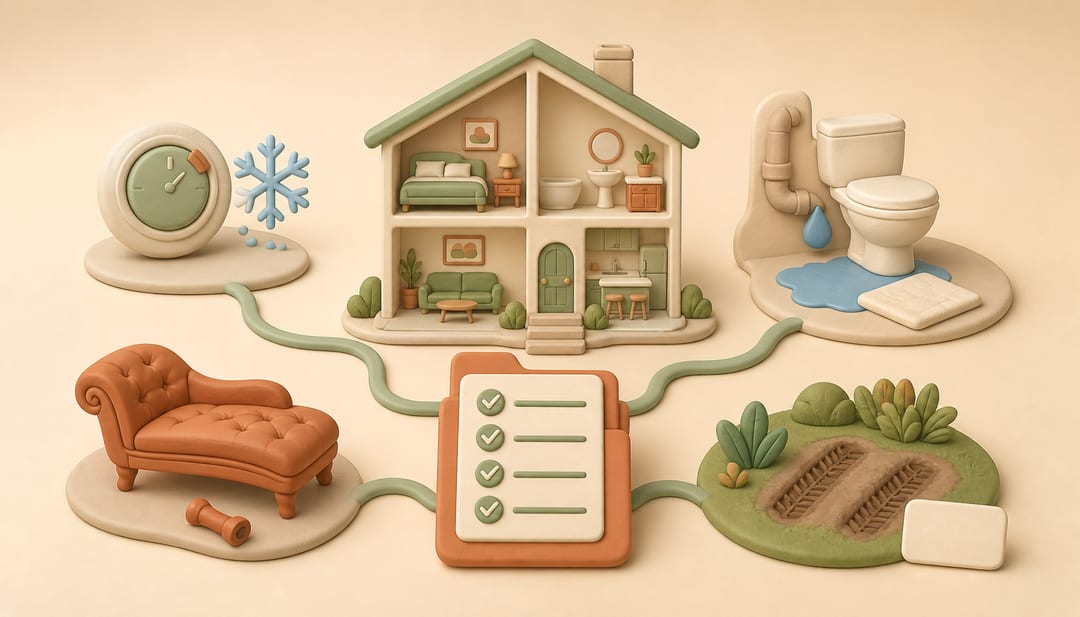
A cold house, an overflowing toilet, a broken vintage chair and an HOA damage notice can arrive during the same reservation. The remote host's first job is not to decide what the guest owes. It is to stop the loss, preserve evidence and separate four different cases that may have four different responsible parties.
A first-time host moved from the Seattle area to Texas but kept the family home as a fallback. Rather than leave it empty, the owner furnished it for short stays and hired a local management company to prepare the property, communicate with guests and handle problems on site.
The setup consumed weeks. The house was cleaned, repaired and staged. The owner bought additional furnishings, including a distinctive vintage chaise lounge, and watched remotely as the listing went live.
The first guests were a couple traveling with a young child. Within hours, they reported that the house was freezing. The thermostat's target appeared to be around 13°C, or 55°F. The owner raised it remotely, apologized and tried to guide the guests through the system. The guests then repeatedly raised the target to approximately 35°C, apparently believing that a much higher setting would heat the home faster.
By the next morning, an upstairs toilet had overflowed. Water reached the tiled bathroom and nearby carpet. The toilet seat had also broken. Before the short stay ended, the guests reported that their child had collided with the vintage chaise and broken a leg. Then the HOA contacted the owner with a new allegation: a guest vehicle had entered a landscaped area beside the driveway and left two holes.
The owner was worried about the house, the costs and the first review—but did not have one clean answer to the question, “Who pays?”
That is because this was never one damage claim.
Quick answer: When property damage or a service failure occurs during a short-term rental stay, first protect people and stop the loss. Send a qualified local person, keep communication factual, preserve original photos and device records, and obtain written vendor findings. Then create separate files for the service failure, water event, each damaged item and any HOA claim. Determine causation and cost only after the immediate response. Notify the platform and insurer early, because their deadlines may expire before every repair is complete.
Editorial note: The opening scenario is an anonymized account based on user-provided material and has not been independently verified. The booking platform, property boundaries, insurance policy and exact legal jurisdiction are unknown. This article provides general information, not legal or insurance advice, and does not determine that any guest, host, manager or association was responsible.
The First Mistake Is Treating Every Problem as “Guest Damage”
One reservation can produce several operational and legal tracks. Combining them into a single emotional bill makes even the strongest part of the claim harder to review.
| Event | Initial classification | What is still unknown |
|---|---|---|
| Guests arrive to a cold house | Service and property-management issue | Whether the system worked, the actual room temperature and who completed the pre-arrival check |
| Guests set the thermostat very high | Guest instruction and system-usage issue | Whether the setting caused damage or merely made the system run longer |
| Toilet overflows onto carpet | Safety, mitigation and water-damage event | Where the blockage was, what caused it and whether a fixture or pipe defect contributed |
| Toilet seat breaks | Asset-condition dispute | Age, installation, prior condition, break pattern and whether the failure was ordinary wear or misuse |
| Child reportedly breaks a chaise leg | Guest-attributed physical damage | The chair's prior condition, repairability, market value and amount of recoverable loss |
| HOA reports landscape damage | Third-party or common-area claim | Which vehicle caused it, who owns the area, what rule applies and what repair cost was actually incurred |
| Host fears a bad review | Platform-governance issue | Whether a future review violates the platform's removal policy |
The host should not use the same message, evidence or reimbursement theory for every row. A guest's acknowledgment that a child hit a chair may help connect that reservation to the broken chair. It does not prove that the guest caused a plumbing obstruction, that the toilet seat was sound, or that the management company tested the heat.
The useful rule is:
Stabilize first. Preserve second. Classify third. Price the claim fourth.
The First 60 Minutes: Stop the Loss Before Debating Fault
The first hour of an active-stay incident should be procedural. A remote owner cannot safely diagnose a toilet overflow, electrical exposure or heating failure through an irritated text exchange.
1. Protect people and isolate the affected area
Ask whether anyone is injured and whether water is near electrical outlets, appliances, stairs or other hazards. Tell the guests to stop using the affected toilet. If they can safely close the fixture's shutoff valve without entering contaminated water or moving electrical equipment, provide simple instructions. Otherwise, keep them away and send local help.
A toilet overflow should be treated as potentially contaminated until a qualified person assesses it. Do not tell guests to solve the problem by spreading towels, running an ordinary fan or repeatedly flushing.
2. Dispatch the local response team
The local contact or property manager should arrive or send the appropriate vendor. Depending on the incident, that may include a plumber, water-mitigation company, HVAC technician or electrician.
Seattle's short-term-rental rules illustrate why “I hired a manager” is not the same as “I transferred every duty.” Inside Seattle city limits, the owner remains the operator even when a management company handles the listing and day-to-day work; the operator license is issued in the owner's name. Operators also have licensing, local-contact, safety and insurance obligations. The exact requirements depend on the property and location. Seattle: Short-Term Rentals, Seattle Department of Construction and Inspections: Short-Term Rentals
The practical lesson applies beyond Seattle: a management agreement should say who answers after-hours calls, how quickly someone must arrive, which vendors can be dispatched without owner approval, what the manager may spend in an emergency and who preserves the evidence.
3. Create a contemporaneous incident record
Keep the initial conversation on the booking platform when possible. If the situation requires a phone call, send a short platform message afterward:
Thank you for reporting this. For safety, please stop using the upstairs toilet and keep everyone away from the wet area. I am arranging local assistance now. Please do not move or discard any affected items. If it is safe to do so, send one wide video showing the bathroom and the path of the water, followed by close photos of the toilet, floor and carpet. We are focused first on stopping the water and making the space safe; we will review the cause and costs after inspection.
This message does four things without accusing anyone: it confirms receipt, reduces further loss, requests useful evidence and keeps responsibility open.
4. Notify without waiting for the final invoice
An initial notification is not the same as a final demand. If the booking platform, insurer, property manager or HOA has a short notice period, open the incident and save the case number. Waiting for every wall, carpet and chair invoice can cause a procedural deadline to pass.
A Toilet Overflow Starts a Mitigation Clock
The U.S. Environmental Protection Agency advises drying water-damaged materials and areas within 24–48 hours where possible to reduce mold risk. Carpet, padding and the material underneath must all be considered; a dry-looking surface does not prove that the assembly below is dry. The EPA's ordinary drying guidance is not a substitute for professional handling when water may contain sewage or other contaminants. EPA: Flooded Home, EPA: Mold Course Chapter 3
For a toilet overflow, preserve two connected but separate records.
The mitigation record
Document:
- when the overflow was reported;
- when the fixture stopped running;
- where the water traveled;
- which flooring, baseboards, walls, ceilings or contents were affected;
- the water-mitigation company's arrival time;
- moisture readings and a moisture map;
- extraction, removal, drying and sanitation work;
- daily or final drying readings; and
- every item removed or discarded, with photos and the reason.
The owner has a duty to act reasonably to prevent the loss from becoming larger. That generally means emergency work should not be delayed while the host and guest argue about a clog.
The causation record
Ask the plumber to state in writing:
- the location of the obstruction;
- the material found, if identifiable;
- the condition of the toilet, trap and relevant drain line;
- whether there were signs of an existing defect, restricted line or improper installation;
- what work cleared the blockage; and
- whether the available evidence supports a probable cause.
“We only used toilet paper” and “the guests clogged it” are competing statements, not technical findings. The repair invoice may show that work occurred without establishing who caused it.
Keep the costs separate: emergency plumbing, extraction and drying, demolition, reconstruction, extra cleaning, damaged contents and any confirmed booking-income loss are different categories. Different insurance provisions or platform terms may apply to each one.
No Heat Is a Service Failure Until the Evidence Says Otherwise
A low thermostat target may show a missed handoff, but it is not the same thing as a measured indoor temperature or a code violation.
Seattle's housing code requires permanent, properly operating heating facilities capable of maintaining minimum temperatures under specified outdoor conditions. When the outdoor temperature is at least 24°F, the system generally must be capable of maintaining at least 68°F in habitable rooms, bathrooms and toilet rooms; different standards apply in more extreme cold and when the owner supplies heat. The actual provision and property facts should be checked before drawing a legal conclusion. Seattle Municipal Code 22.206.090: Heat
A remote host should preserve:
- the manager's pre-arrival checklist;
- actual room-temperature readings, not only the target setting;
- outside temperature and time;
- thermostat history and HVAC run status;
- system type and recent service history;
- the guest's first report; and
- every response and site visit.
If a manager was supposed to warm and inspect the property but did not, that is a potential service-performance issue between owner and manager. It should not be buried inside a claim against the guest.
Setting a conventional thermostat far above the desired temperature also usually does not make a house warm faster; it tends to make the equipment run until the higher target is reached. Heat pumps and multistage systems can behave differently, including using auxiliary heat. The better prevention is a short, system-specific guide, sensible temperature limits and a pre-arrival test—not an accusation that a guest “doesn't know how houses work.” Google Nest: Learn About Time-to-Temperature, Google Nest: Learn About Auxiliary Heat
A Broken Toilet Seat Is Not Automatically Chargeable
The timing is suspicious: an item worked before check-in and broke during the stay. But timing alone does not separate accidental damage from ordinary wear, faulty installation or a brittle component at the end of its useful life.
Before charging the guest, collect:
- a pre-stay photo that shows the seat and fasteners clearly;
- model, material and approximate age;
- purchase or installation record, if available;
- photos of the break surfaces and all loose pieces;
- the guest's factual description of what happened; and
- a technician's view on whether the failure pattern indicates looseness, fatigue, defect or force.
Then ask what the actual loss is. If an inexpensive, aging seat can be replaced like-for-like, a demand for an upgraded fixture plus unrelated labor is difficult to defend. If the seat was recently installed and the physical evidence shows impact damage, the claim is stronger.
The same method applies to small appliances, blinds, handles, dishes and other frequently replaced short-term-rental items. The host needs a condition record, cause, appropriate remedy and supportable amount—not merely proof that the item was found broken.
The Vintage Chaise Tests the Host's Valuation System
The chair presents a different issue. A guest reportedly disclosed that a child ran into it and a leg broke. That statement can be relevant to causation, but it does not establish the amount owed.
For an ordinary chair, a host might compare a repair estimate with the cost of a substantially similar replacement. A vintage or antique item requires more care:
- Photograph the entire chair and the detached leg before moving anything.
- Preserve every fragment, fastener and piece of upholstery.
- Do not glue the leg or attempt a cosmetic repair before an expert evaluates it.
- Collect the bill of sale, marketplace listing, maker information, provenance and prior photos.
- Obtain a written furniture-restoration assessment.
- Ask whether the chair can be structurally and cosmetically restored, and whether repair changes its market value.
- If replacement is proposed, document why a genuinely comparable item is available and appropriate.
Airbnb's 2026 Host Damage Protection Terms classify antique furniture within “Fine Arts and Valuables.” The terms do not mean antique furniture is always excluded or always paid at a host's preferred replacement price. Eligibility and calculation can depend on ownership, prior condition, repairability, like-kind-and-quality replacement and recognized professional valuation. The terms also require legitimate, verifiable evidence and preservation of damaged property. Airbnb: 2026 Host Damage Protection Terms
The broader design lesson is uncomfortable but useful: a high-turnover rental is not a museum. If an item is sentimental, difficult to value, structurally delicate or impossible to replace, the owner should either remove it, schedule it appropriately under insurance, or accept that the property's commercial use may expose it to loss that a platform process cannot fully solve.
The HOA Landscaping Notice Is a Separate Third-Party File
An HOA message that says a guest vehicle damaged landscaping should be taken seriously. It should not be treated as a final judgment.
Ask the association for:
- the covenant, declaration provision or rule allegedly violated;
- date, time and exact location;
- photos, video, access records, witness statement or vehicle information;
- the ownership and maintenance boundary for the damaged area;
- the pre-incident condition;
- the fine schedule, if a fine is proposed;
- repair estimate, paid invoice or other loss calculation;
- any insurance proceeds or deductible involved; and
- the notice, hearing, response and appeal procedure.
Washington association law is unusually important to describe carefully because the applicable chapter can depend on the type and age of the community and whether an older community opted into a newer statute. Under the Washington Uniform Common Interest Ownership Act, for example, certain owner-specific assessments for damage caused by an owner, tenant, guest, invitee or occupant require conditions in the declaration plus notice and an opportunity for a hearing; an assessment is limited by the association's incurred expense and insurance proceeds. Older HOAs or condominiums may fall under different chapters with their own governing-document, fine and procedure rules. RCW 64.90.480: Assessments, RCW 64.90.360: Applicability, RCW 64.38.020: HOA Powers
Three tracks may now exist:
- the association's claim against the owner;
- the owner's possible recovery from the guest; and
- the HOA's, owner's or platform's potential insurance process.
The owner may need to respond to the HOA even if the guest was driving. Conversely, an HOA allegation does not automatically establish a platform-covered loss. Airbnb's current terms contain eligibility limits for real property owned by another party and outside the host's control. Common landscaping should therefore be documented and analyzed, not added automatically to a guest's bill.
Platform Deadlines Are Not Safety Deadlines
The source story does not identify the booking platform. The following rules are examples, not facts about that stay.
Airbnb example
Airbnb's public Host Damage Protection page currently tells hosts to document the issue and file a reimbursement request within 14 days of the responsible guest's checkout. It also says supporting documentation must be submitted within 14 days of the damage or loss if the host wants Airbnb Support involved. Airbnb's February 2026 legal terms contain a related two-stage process: seek payment from the responsible guest and notify Airbnb within 14 days after checkout, then submit the Host Damage Protection payment request and required evidence within 30 days after checkout. Because help pages, reservation flows and legal terms can frame deadlines differently, start immediately and comply with the shortest deadline displayed for the reservation. Airbnb: Host Damage Protection, Airbnb: 2026 Host Damage Protection Terms
Those terms identify the guest as the primary person responsible for eligible loss and ask for evidence such as the event's time, cause and origin; photos or video; item details and prior condition; ownership proof; and repair or replacement estimates. Host Damage Protection is a contractual guarantee, not the host's own insurance policy.
Vrbo example
Vrbo's official guidance says a host generally has 14 days after checkout to assess damage and file a damage-deposit claim. Written communication and supporting evidence should remain in Vrbo's secure messaging system. The deposit method, limit and any third-party property-damage plan can change the available process. Vrbo also warns hosts to assess carefully before making a claim because the workflow may permit only one withholding action. Vrbo: File a Damage Deposit Claim, Vrbo: How Damage Deposits Work
Neither platform's deadline means a host should wait until checkout to stop water or inspect a safety issue. The emergency clock starts when the incident is discovered. The reimbursement clock is a separate administrative deadline.
The Five-Star Review Trap
The owner in the opening account worried that confronting the first guests would lead to a poor review. That pressure is real: early reviews can affect a new listing's reputation. But it is dangerous to let review anxiety control incident response.
Keep three decisions independent:
- Service recovery: What should the host do because the house was cold or the stay was disrupted?
- Damage recovery: What supported amount, if any, should be requested for each incident?
- Review: What truthful, policy-compliant review should each party later leave?
Do not offer to waive a claim for five stars. Do not threaten a bad review if the guest refuses to pay. Airbnb's Reviews Policy prohibits manipulating reviews through threats, incentives, pressure or an exchange of value. Its retaliatory-review standard is narrower than “the guest reviewed me badly after I filed a claim”; a review that discusses the facts or legitimacy of a Resolution Center or AirCover dispute is not automatically removable. Airbnb: Reviews Policy
A strong damage file should stand on evidence even if the guest leaves a one-star review. A good service-recovery decision should be defensible even if no review is ever posted.
Who Owns Which Part of the Response?
| Party | Appropriate responsibility | What should not be delegated to them |
|---|---|---|
| Guest | Report promptly, stop using affected equipment, preserve the scene, allow authorized access and provide a factual account | Determine contamination class, legal fault, insurance coverage or antique value |
| Local contact or property manager | Attend, dispatch vendors, document the scene, provide the pre-arrival record and coordinate access | Decide every claim from verbal impressions or hide a missed handoff |
| Host or operator | Maintain the licensing, insurance, emergency plan, evidence process and deadlines; make the final business decision | Assume hiring a manager transferred every regulatory and claim obligation |
| Plumber, mitigation company, HVAC technician or furniture restorer | Diagnose technical cause, scope, repair options and cost | Decide platform coverage or legal liability |
| HOA | Cite its governing documents, follow its procedure and substantiate a common-area loss | Treat an accusation as proof of every fact and amount |
| Booking platform | Apply the reservation's current terms to a submitted reimbursement request | Act as universal property insurance or guarantee full recovery |
| Insurer | Investigate under the actual policy, value covered loss and apply deductibles and exclusions | Promise coverage before receiving timely notice and reviewing the policy |
The host's incident log should show each party's arrival, observation, decision and document. A long group text is not a substitute.
Make Sure the Insurance Matches the Business
Washington requires qualifying short-term-rental operators to maintain primary liability insurance of at least $1 million or transact through a platform providing equal or greater primary liability coverage. Seattle has related operator requirements. Liability insurance, however, is designed primarily around claims by other people. It does not automatically cover the owner's chair, plumbing, carpet, lost bookings or an HOA landscape bill. RCW 64.37: Short-Term Rentals, Seattle Municipal Code Chapter 6.600
The Washington Office of the Insurance Commissioner and the National Association of Insurance Commissioners both warn that ordinary personal homeowners coverage may not be designed for home-sharing or other business activity. A host may need a commercial policy, landlord policy, short-term-rental endorsement or another specialized arrangement. Washington OIC: Insurance and Your Home Business, NAIC: Renting Out Your Home? You Need Insurance Coverage
Before the next booking, ask the broker or carrier in writing about:
- building and contents coverage during paid stays;
- guest-caused and accidental water damage;
- sewer or drain backup exclusions;
- mold limits;
- business-income interruption;
- antique, vintage or high-value furnishings;
- HOA or common-area claims;
- deductibles and valuation method;
- damage caused or worsened by a property manager;
- notice and mitigation duties; and
- how platform protection interacts with the policy.
Save the answers with the policy and declarations page. “The platform has protection” is not a coverage analysis.
Build Four Claim-Ready Files Instead of One Complaint
For the opening scenario, the cleanest structure would be:
File 1: Guest stay and service delivery
- reservation and named guests;
- listing, house rules and thermostat instructions;
- pre-arrival checklist;
- actual temperature and system records;
- guest messages and response times;
- manager's site report; and
- any refund or service-recovery decision.
File 2: Water and plumbing
- incident timeline;
- wide-to-close photos and original video;
- plumber's causation report;
- water-category and moisture documentation;
- mitigation and repair invoices;
- discarded-material record; and
- insurance and platform notices.
File 3: Contents and fixtures
- separate subfile for the toilet seat and chaise;
- pre-stay condition;
- guest account;
- model, age, ownership and value;
- preserved broken pieces;
- repair, restoration and replacement options; and
- supported amount requested.
File 4: HOA and exterior
- HOA notice and cited rule;
- evidence identifying the vehicle and location;
- ownership and maintenance boundary;
- repair invoice, insurance credit and fine schedule;
- hearing or appeal deadline; and
- separate recovery analysis against the guest or other party.
Track the source of every reimbursement. The host should not recover the same dollar twice from a guest, platform, insurer and association process.
This is also where Pine can help. A remote host can organize reservation terms, check-in photos, thermostat history, guest messages, vendor reports, repair estimates, the HOA notice and the insurance policy into a single chronology, while keeping the four evidence packets distinct. Pine can also help identify missing documents and prepare factual drafts for the guest, manager, association or insurer. It does not diagnose contaminated water, value antiques, interpret an insurance policy conclusively or decide legal liability.
The Best Prevention Is an Operations System
The lesson is not “never rent to a family” or “screen out guests with children.” Familial status is protected under federal fair-housing law in housing transactions, and personal identity is a poor substitute for operational controls. The better response is to make the property, instructions and local team more resilient.
Use a pre-arrival readiness check
The local representative should verify and record:
- actual indoor temperature and HVAC operation;
- hot and cold water;
- a test flush of each toilet, with no slow drain or active leak;
- sinks, disposal and visible plumbing;
- smoke and carbon-monoxide alarms;
- intact furniture and fixture photos;
- access codes and emergency instructions;
- exterior and parking condition; and
- the time the check was completed.
Give the manager measurable authority
Write response standards into the management agreement. For example: acknowledge an urgent issue within 10 minutes, dispatch within 20 minutes, attend within a defined local window, spend up to an approved emergency amount, upload original evidence and provide a written incident report by the next morning.
Design the furnishings for commercial use
Favor durable, replaceable furniture with known purchase records. Photograph high-use items between stays. Remove sentimental or structurally delicate pieces. If a high-value item stays, maintain an appraisal, confirm coverage and establish how it should be inspected.
Make parking and HOA boundaries obvious
Provide a simple parking diagram. Mark areas that are difficult to see in snow or at night. Confirm that the HOA permits the intended short-term-rental use independently of city licensing. Save current governing documents, insurance contacts and violation procedures before the first guest arrives.
Test the economics against a bad week
Short-term-rental income is not gross nightly revenue. A realistic model includes setup, management, cleaning, insurance, utilities, furnishing depreciation, platform fees, HOA exposure, emergency vendors, downtime and owner attention. One difficult first stay does not prove the strategy can never work. It may prove that the original model priced revenue but not operational risk.
A Practical First-24-Hour Checklist
During the first hour
- Protect people and isolate the affected area.
- Stop the source if it can be done safely.
- Send the local contact and qualified vendor.
- Keep a neutral written record on the platform.
- Capture wide, medium and close evidence before cleanup.
- Preserve broken items and original digital files.
- Open initial platform, insurance and HOA records where required.
Within 24 hours
- Obtain written technical findings.
- Build a timestamped chronology.
- Separate service failure from alleged guest damage.
- Create an individual file for every damaged item or area.
- Record the pre-stay condition and all people with access.
- Collect mitigation, repair and restoration estimates.
- Calendar the shortest platform, insurance and HOA deadline.
- Decide what service recovery is appropriate without trading it for a review.
Within 24–48 hours
- Continue professional drying and moisture checks.
- Document any demolition or discarded materials.
- Confirm whether the property remains safe and habitable.
- Reassess upcoming bookings using actual repair timing.
- Update the guest, platform, insurer and association with verified facts.
After checkout
- Complete an independent condition inspection before the next guest.
- Finalize supported amounts rather than estimates based on frustration.
- Submit each platform or insurance package within its current deadline.
- Reconcile all payments and credits.
- Conduct a manager postmortem and revise the readiness checklist.
Frequently Asked Questions
What should a host do when a short-term rental guest causes water damage?
Protect people, stop the source, send qualified local help, preserve the scene and notify the relevant platform and insurer. Treat responsibility as unproven until a plumber or restoration professional documents the cause and scope. Do not delay mitigation while negotiating payment.
Can a host charge a guest for a clogged toilet?
Possibly, if the agreement and applicable rules permit it and the evidence reasonably connects the guest's conduct to the blockage. A plumber's findings, the fixture's prior condition, guest messages and an itemized invoice are more useful than an assumption based only on timing.
How quickly should water-damaged carpet be dried?
EPA guidance generally recommends drying wet materials within 24–48 hours where possible to reduce mold risk. Carpet padding and the material underneath also require attention. A toilet overflow may be contaminated, so a qualified mitigation provider should determine the appropriate method.
Can a host charge for a broken toilet seat?
Only a supportable loss should be requested. Document the seat's age, installation, prior condition, break pattern and replacement cost. Normal wear, a defect or poor installation may be the owner's responsibility even when the failure appeared during a stay.
What if a guest admits that their child broke furniture?
Preserve the message because it may support causation, but still document the item's prior condition, ownership, repairability and value. The guest's statement does not decide whether the host should receive repair cost, depreciated value, restoration cost or another amount.
Does Airbnb cover antique furniture damaged by a guest?
Airbnb's February 2026 terms treat antique furniture as Fine Arts and Valuables and impose special eligibility and valuation considerations. Coverage is not automatic. The host may need ownership records, prior-condition evidence, professional appraisal and a restoration or comparable-replacement analysis. The terms in effect for the request control.
How long does a host have to file an Airbnb damage claim?
Airbnb's current public guidance uses a 14-day post-checkout reimbursement step, while its 2026 legal terms also describe a 30-day deadline for the Host Damage Protection payment request and evidence after the guest-notification step. Begin immediately and follow the shortest deadline shown for that reservation and incident.
How long does a Vrbo host have to make a damage-deposit claim?
Vrbo's current help guidance generally gives hosts 14 days after checkout to assess and file. The exact process depends on the booking's deposit method and any third-party plan, so review the reservation-specific terms before acting.
Can an HOA charge an owner for damage caused by a short-term-rental guest?
It may be able to, depending on the applicable state statute and the community's declaration, rules, ownership boundary and procedure. The owner should request the evidence, loss calculation, fine schedule and hearing rights. The owner may separately seek recovery from the guest, platform or insurer.
Is a property manager responsible if the heat was not on before check-in?
That depends on the management agreement, assigned pre-arrival duties, system condition and evidence. A missed checklist can support a service-performance claim against the manager, but a thermostat target alone does not prove the actual temperature, a code violation or the party responsible.
Does homeowners insurance cover short-term-rental guest damage?
Not necessarily. Ordinary personal homeowners policies may exclude or limit business and home-sharing activity. Hosts should disclose the use to their insurer and obtain written confirmation about building, contents, water, business-income and liability coverage.
Can a host waive a damage claim in exchange for a five-star review?
That is a bad practice and may violate platform review rules. Service recovery, damage reimbursement and reviews should remain independent. Use factual communications and the platform's formal process.
Should a vacation rental include antiques or irreplaceable furniture?
Only if the host understands the operational and insurance risk. Durable, documented and replaceable furnishings are generally easier to manage. If a valuable item remains, obtain a current appraisal, confirm coverage and preserve condition evidence.
The Real Lesson of a Chaotic First Stay
The opening host did not experience one disaster. The host experienced a weak handoff, a possible plumbing emergency, two asset questions, a common-area allegation and a powerful fear of the first negative review.
Those problems feel overwhelming when they arrive in one message thread. They become manageable when divided into separate decisions with owners, evidence and deadlines.
Remote hosting can work, but it is not passive. The owner needs a local emergency response, a property designed for turnover, insurance that matches the use and a record system that can explain what happened without relying on memory or anger.
If an active stay is already becoming complicated, open Pine to organize the incident before sending a claim or demand. Build the timeline, separate the losses, identify missing proof and keep the service-recovery conversation independent from the damage file.
For damage found only after checkout, see our companion guide: Checkout Photos Looked Clean. The Room Wasn't: A Short-Term Rental Damage Evidence Guide.