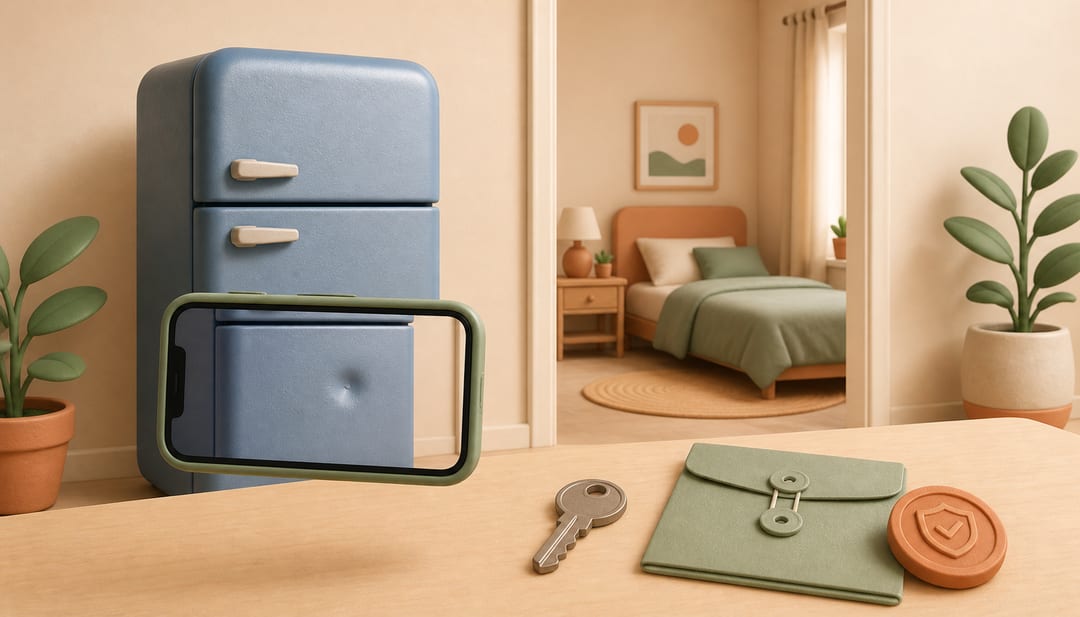
A strong deposit claim is not built around how spotless you believe the apartment was. It is built around surrender, the applicable state deadline, the landlord’s itemization, matched condition evidence and a damages calculation the court can audit.
A former tenant described cleaning a rental thoroughly before move-out. During the inspection, the landlord allegedly pointed to what appeared to be a dead mosquito near a window as proof that the unit was not clean enough. A later dispute developed over the keys and the deposit. The tenant documented the move-out, says she waited about a month, filed a court claim and eventually accepted a settlement that returned the deposit.
The story attracted hundreds of comments. Some advice was useful: keep the lease, photograph everything, prove the key handoff and use small claims court when a written demand fails. Other advice was risky or plainly wrong: block the landlord’s car, assume the police can order a deposit refund, stop paying the final month’s rent, threaten a tax report, or automatically demand twice the deposit in every state.
Quick answer: If a former landlord has not returned your security deposit, first prove when you surrendered possession and where the refund should be sent. Then check the law for the state—and sometimes city—where the rental is located. Preserve move-in and move-out evidence, compare every deduction with the lease and itemized receipts, send a dated written demand, and file in the correct small claims or civil court if the dispute remains unresolved. Call the police for an immediate safety, threat, trespass or lockout issue—not to decide whether a cleaning deduction is lawful.
Editorial note: The opening scenario is an anonymized summary of user-provided social-media material. Pine has not independently verified the property, state, deposit amount, police interaction, court filing or settlement. This article provides general information, not legal advice.
Start With the State, Not the Social-Media Story
There is no single U.S. rule that gives every landlord 30 days, every tenant double damages, or every small claims court the same dollar limit.
The first page of your file should identify:
- the state and city where the rental is located;
- the type of rental and whether a special housing program applies;
- the date possession was surrendered;
- the date and method used to return keys or access devices;
- the date a forwarding address was provided;
- the deposit amount;
- the amount returned, if any;
- the date and contents of any itemized deduction statement; and
- the exact defendant named in the lease and property records.
If any of those fields is blank, fill it before calculating damages.
Four States Show Why the Deadline Must Be Checked
This comparison is a starting point, not a substitute for checking the current law that applies to your tenancy.
| State | Basic return or notice rule | Important condition | Potential remedy is not automatic |
|---|---|---|---|
| California | Generally, within 21 days after move-out, the landlord must return the deposit or send the balance with an itemized statement. Deductions over $125 generally require supporting invoices or receipts; landlord-performed work needs a description, time and reasonable rate. |
Cleaning is limited to what is reasonably necessary to restore the unit to its move-in level of cleanliness. Beginning in 2025, state law also added landlord photo requirements around qualifying move-out deductions. | A judge may award the deposit plus up to twice the deposit as damages for bad-faith retention. The multiplier is not guaranteed merely because the tenant disagrees with a charge. |
| New York | For many non-regulated units, the landlord generally has 14 days after the tenant vacates to return the deposit and provide an itemized statement for any amount retained. Missing the itemization deadline can forfeit the right to keep the deposit. | Rent-regulated and other specialized housing can require separate analysis. New York also provides a pre-move-out inspection opportunity in the situations covered by the rule. | A deliberate violation may support damages of up to twice the deposit. “May” is not “automatically will.” |
| Texas | Generally, the landlord must refund the deposit by the 30th day after surrender. The landlord’s duty to refund or itemize is suspended until the tenant gives a written forwarding address, although the tenant does not forfeit the deposit by initially omitting it. | The landlord may deduct only amounts the tenant is legally liable for under the lease or because of a breach, and not normal wear and tear. | Bad-faith retention can create liability for $100, three times the portion wrongfully withheld and reasonable attorney’s fees. The landlord bears the burden of proving the retained amount was reasonable. |
| Florida | If the landlord makes no claim, the deposit is generally due within 15 days after termination. If the landlord intends to claim against it, the landlord generally has 30 days to send the statutory notice by an authorized method; the tenant generally has 15 days after receipt to object in writing. | A late claim notice can forfeit the right to set off the deposit, although the landlord may still sue separately for damages after returning it. Early-move-out notice and address rules can matter. | The prevailing party in a deposit lawsuit may be entitled to court costs and a reasonable attorney’s fee. That makes an unsupported lawsuit—or unsupported defense—more consequential. |
Official starting points include the California Courts security-deposit guide, the New York Attorney General’s residential tenants’ rights guide, Texas Property Code Chapter 92 and Florida Statutes §83.49.
Local ordinances, subsidized-housing rules and the lease may add obligations. They generally should not be used to erase a nonwaivable state protection.
What Can a Landlord Usually Deduct?
The labels vary by state, but common lawful categories include:
- unpaid rent or another amount legally due under the lease;
- repair of tenant-caused damage beyond ordinary wear;
- cleaning that is legally chargeable and actually necessary; and
- another lease-authorized charge permitted by applicable law.
The difficult word is necessary.
A landlord’s preference for a full turnover does not automatically make every turnover cost the departing tenant’s responsibility. Repainting an old wall, replacing worn carpet, upgrading an appliance, or hiring a preferred cleaner at an unexplained price may require analysis of move-in condition, age, useful life, causation and reasonableness.
Ordinary wear is not damage
Faded paint, lightly worn flooring and deterioration from ordinary intended use are different from a large unauthorized hole, a burn, a broken fixture or an excessive stain caused during the tenancy. The line is factual, so matched photographs matter more than adjectives such as “filthy” or “perfect.”
A tiny piece of debris does not prove an arbitrary cleaning fee
Suppose the landlord finds dust in one corner, a dead insect on a windowsill or a mark that can be wiped away in seconds. That observation may show the unit was not literally sterile. It does not, by itself, establish that a large cleaning deduction is permitted, necessary or reasonable.
Ask four questions:
- What did the same area look like at move-in?
- What cleaning was actually performed?
- What did that work cost, and where is the invoice, receipt or labor calculation?
- Does state law and the lease allow that cost to be shifted to the tenant?
A fixed “cleaning fee” printed in a lease is not a nationwide trump card. Its enforceability and its relationship to a refundable security deposit depend on the governing law and facts.
Build an Evidence File Before Sending Accusations
The best evidence packet lets a neutral person reconstruct the tenancy without scrolling through months of messages.
| Exhibit group | What to include | What it helps prove |
|---|---|---|
| Lease and money | Signed lease, addenda, deposit receipt, payment ledger | Deposit amount, tenant duties, correct landlord or entity |
| Move-in condition | Checklist, dated photos, video, maintenance requests | Baseline condition and pre-existing defects |
| Move-out condition | Wide shots, close-ups, a continuous walkthrough, cleaning receipts | Condition at surrender and work completed by the tenant |
| Surrender | Move-out notice, key receipt, lockbox record, time-stamped message, forwarding address | When possession ended and when the deadline began or became enforceable |
| Landlord accounting | Refund, check envelope, itemized statement, estimates, invoices, receipts, photographs | Timing, basis and reasonableness of deductions |
| Communications | Inspection requests, repair messages, settlement offers, demand letter and delivery proof | Notice, disputed facts and attempted resolution |
| Court preparation | Timeline, damages worksheet, defendant information, filing and service records | A claim the court can administer |
Preserve original files and metadata. Work from copies when highlighting or adding captions. Back up the evidence somewhere other than the phone used to record it.
Photos should be systematic:
- Start at the exterior or unit number without exposing it publicly.
- Record one continuous walkthrough to establish layout and timing.
- Take wide photographs of every room.
- Take close photographs of disputed areas with context and scale.
- Capture the inside of appliances, cabinets, closets and plumbing areas.
- Photograph meters or utility status if relevant.
- Record the key and access-device handoff separately.
If you record a conversation rather than only the premises, check the consent law that applies or obtain express consent. Recording rules are not uniform across the United States.
Return the Keys Without Creating a New Dispute
Possession and key return can determine when the deposit clock starts. Treat the handoff like a transaction.
Use one of these methods:
- an in-person handoff with a signed receipt listing every key, fob and opener;
- a documented lockbox process authorized in writing;
- tracked delivery if the landlord agrees that it is acceptable; or
- another lease-compliant method confirmed in the message thread.
Send a same-day message:
I surrendered possession of
[property]and returned[number and type of keys/access devices]by[method]at[time]on[date]. My forwarding address for the security-deposit accounting and refund is[address]. Please confirm receipt.
Do not block the landlord’s vehicle, physically prevent anyone from leaving, damage property or create a confrontation. Those acts can produce safety and legal problems unrelated to the deposit. If there is an immediate threat, assault, trespass, unlawful lockout or other urgent safety issue, contact the appropriate emergency or local authority and move to a safe location.
The Police Do Not Decide a Cleaning Deduction
A police officer may respond when a handoff escalates, keep the peace, document an incident, or address conduct that may be criminal. That does not turn the officer into the judge of a deposit accounting.
Whether the landlord may retain $300 for cleaning usually depends on the lease, state law, evidence and—if unresolved—a civil court. A police report may document a separate event. It ordinarily does not award the deposit, calculate statutory damages or replace a demand letter and lawsuit.
Use the right channel for the right problem:
| Problem | Appropriate first channel |
|---|---|
| Immediate danger, threat, assault or active unlawful conduct | Emergency or local law-enforcement channel, as appropriate |
| Access, lockout or key dispute | Written documentation plus local tenant-help or legal channel; emergency help if safety is at risk |
| Deposit missing after the legal deadline | Written demand, regulator or attorney-general complaint where available, and court |
| Disputed cleaning or damage deduction | Evidence comparison, written objection, settlement or court |
Send a Focused Demand Letter
Do not begin with “You are a thief” or a threat to expose the landlord online. Begin with the dates, the governing rule and the exact amount requested.
Subject: Security deposit demand for [rental address]

I rented the property at [address] under the lease dated [date]. I paid a
security deposit of $[amount]. I surrendered possession and returned all
keys/access devices on [date]. I provided my forwarding address on [date].

As of [date], I have received [no refund / a refund of $___ / an itemized
statement dated ___]. I dispute the following deductions:

1. [Deduction and amount] — [brief factual reason, with exhibit reference]
2. [Deduction and amount] — [brief factual reason, with exhibit reference]

Under [state statute or official rule], the applicable deadline and
itemization requirements are [brief statement]. Based on the attached
ledger, I request payment of $[amount] by [reasonable date] to [mailing
address or agreed payment method].

Please send any documents you contend support the deductions, including
invoices, receipts, photographs, labor descriptions and payment records.
If we cannot resolve the dispute by the date above, I will consider the
available complaint and court remedies.

This letter is an attempt to resolve the dispute. It does not waive any
rights or remedies.
Attach only the clearest documents at this stage and keep a full copy of what was sent. Use a delivery method that creates reliable proof. Some court processes or statutes may require a particular notice method, so verify local instructions before relying on email alone.
Calculate the Claim Without Inventing a Multiplier
Start with a damages worksheet:
| Line | Amount |
|---|---|
| Security deposit paid | $___ |
| Deposit already returned | -$___ |
| Lawful deductions the tenant accepts | -$___ |
| Principal deposit amount disputed | $___ |
| Statutory damages legally supported | $___ |
| Filing, service or other recoverable costs | $___ |
| Interest, if authorized and calculated correctly | $___ |
| Total requested | $___ |
Do not write “double damages” simply because a social-media post did. California’s additional damages depend on bad faith. New York’s enhanced remedy depends on a deliberate violation. Texas uses a different formula for bad-faith retention. Florida has its own notice and prevailing-party framework.
The demand must also fit the court’s monetary limit. As of this review:
- an individual generally may seek up to
$12,500in California small claims court; - New York City Small Claims Court hears money claims up to
$10,000, while limits differ in other New York local courts; - Texas Justice Court small claims jurisdiction generally extends to
$20,000, subject to the court rules; and - Florida Small Claims Rules generally cover civil money or property claims not exceeding
$8,000, excluding costs, interest and attorney’s fees.
Court limits, filing rules, venue and service can change. Use the current official page for the specific court rather than choosing a courthouse from a search result.
A Practical Small Claims Sequence
1. Identify the correct defendant
Use the lease, payment instructions, business registration, property records and state entity search. The property manager, owner and LLC may not be interchangeable. A judgment against the wrong name can be hard to enforce.
2. Choose the correct court and venue
Confirm the court’s money limit, county or precinct rules, filing method, fees and service procedure. Some claims may belong in another civil division if the requested amount exceeds the small claims ceiling.
3. File a concise claim
State the deposit paid, surrender date, applicable deadline, amount returned, disputed deductions and requested remedy. The complaint is not the place to paste every argument or insult.
4. Complete service exactly as required
Filing does not necessarily mean the defendant has been served. Monitor the case docket and keep service records.
5. Prepare a judge-friendly packet
Bring a one-page timeline, damages worksheet, exhibit index and copies in the format the court requests. Match every factual sentence to an exhibit number.
6. Treat settlement as a written transaction
If the landlord offers to pay after receiving court papers, settlement may save both sides time. Put the amount, payment date, method, release scope, confidentiality terms if any, court-filing responsibility and treatment of costs in writing.
Do not dismiss the case merely because someone promises to pay. Confirm cleared funds and the signed agreement, then file the correct dismissal document. Avoid accepting language that releases unrelated claims unless you understand it.
7. Understand that a judgment may still require collection
Winning a case does not always cause money to appear automatically. Depending on the jurisdiction, the winner may need to locate assets, use an enforcement officer, garnish eligible funds, record a lien or use another lawful collection method. Budget the time and fees before filing.
Do Not Turn the Final Month’s Rent Into Self-Help
“Just use the deposit as last month’s rent” is dangerous general advice.
Security deposits and rent are legally distinct. The lease or state law may expressly prohibit the tenant from withholding final rent on the theory that the deposit will cover it. Texas, for example, creates potential enhanced liability for a tenant who does so in bad faith. In other states, withholding rent can create a nonpayment claim, late fees or damage to an otherwise clean deposit case.
If the landlord expressly agrees in writing to apply the deposit to final rent, preserve that agreement. Otherwise, pay rent as required and pursue the deposit through the deposit process.
Keep Tax Reporting Separate From the Deposit Dispute
Rental income generally must be reported whether it is paid by check, electronic transfer or cash. The IRS provides rental-income guidance and accepts reports of suspected tax violations through Form 3949-A and its authorized reporting channels.
That does not make a tax report a bargaining chip for a private deposit claim.
If you have truthful, specific information about a suspected tax violation, use the official process and keep it separate from settlement communications. Do not say, “Return my deposit or I will report you.” Conditioning silence or a report on payment can create serious legal risk, and the exact law depends on the jurisdiction. A deposit demand should succeed or fail on the deposit facts.
Where Pine Can Help
Deposit disputes often begin with good evidence scattered across five places: the lease in email, move-in photos on an old phone, move-out video in cloud storage, text messages in screenshots and the landlord’s deductions in a PDF.
Open Pine with those records. Pine can help you:
- extract the lease parties, deposit amount and notice terms;
- build a surrender, key-return and forwarding-address timeline;
- compare move-in and move-out evidence room by room;
- turn deductions, receipts and objections into an auditable ledger;
- identify the state-specific questions that still require an official source or lawyer; and
- prepare a concise demand or exhibit index for review.
Pine does not decide who is telling the truth or guarantee recovery. It helps turn a chaotic dispute into a file that a landlord, mediator, regulator, lawyer or court can understand.
Frequently Asked Questions
Can my landlord keep the whole deposit for cleaning?
Possibly, but only if the governing law and lease allow the deductions and the amount is supported. A landlord usually needs more than a general statement that the unit was “dirty.” Compare the move-in baseline, work actually performed, invoices or labor records, and whether the cleaning was ordinary turnover or necessary because of the tenant’s condition.
Is one dead insect or a little dust enough to charge a full cleaning fee?
Not by itself. It may prove that one spot was not perfectly clean, but it does not automatically prove that a large cleaning job was necessary or reasonably priced. Ask for the itemized charge and supporting records, then apply the state rule.
Do I have to give my forwarding address?
You should give it promptly in writing and keep proof. In Texas, the landlord’s refund and itemization duty is suspended until a written forwarding address is provided. Other states also use the address for required notices. You can use a reliable mailing address that protects your privacy if permitted.
Should I call the police if my deposit is not returned?
Not simply to collect the deposit. A withheld deposit is generally resolved through written demand, a regulator or attorney-general complaint where available, and civil court. Call the appropriate authority for an immediate safety, threat, trespass, lockout or other urgent issue.
Can I sue for twice or three times my deposit?
Only when the applicable statute and evidence support that remedy. The formulas and mental-state requirements differ by state. Ask for the principal deposit first, then calculate statutory damages from the correct law rather than copying another tenant’s demand.
Can I post the landlord’s name, address or messages online?
Public posting can expose private information, complicate settlement and create defamation or harassment risk. Preserve the records for the proper recipient—court, regulator, lawyer or insurer—and redact unnecessary personal information. Focus public discussion on the process, not doxxing an individual.
What if the landlord offers a settlement after being served?
Evaluate the amount, time, evidence, court costs and collection risk. Put the settlement in writing, understand the release, confirm cleared payment, and complete the court dismissal correctly. A settlement is not proof that every original allegation was true; it is a negotiated end to the dispute.
Official Sources
- California Courts: Guide to Security Deposits in California
- California Legislature: AB 2801 and Civil Code §1950.5 Photo Requirements
- New York Attorney General: Residential Tenants’ Rights Guide
- New York City Courts: Small Claims Court Legal Information
- New York Courts: Small Claims Court Limits Outside New York City
- Texas Legislature: Property Code Chapter 92
- Texas Law Help: Security Deposits
- Texas Courts: Texas Rules of Civil Procedure, Effective July 1, 2026
- Florida Legislature: Florida Statutes §83.49
- Supreme Court of Florida: Florida Small Claims Rules
- USA.gov: Tenant Rights and Housing Complaints
- IRS: Rental Income and Expenses
- IRS: About Form 3949-A
This article provides general information, not legal advice. Deposit deadlines, deductions, recording rules, court limits and remedies depend on the jurisdiction, housing type, lease and facts. Verify current official rules or consult a qualified local lawyer before acting.