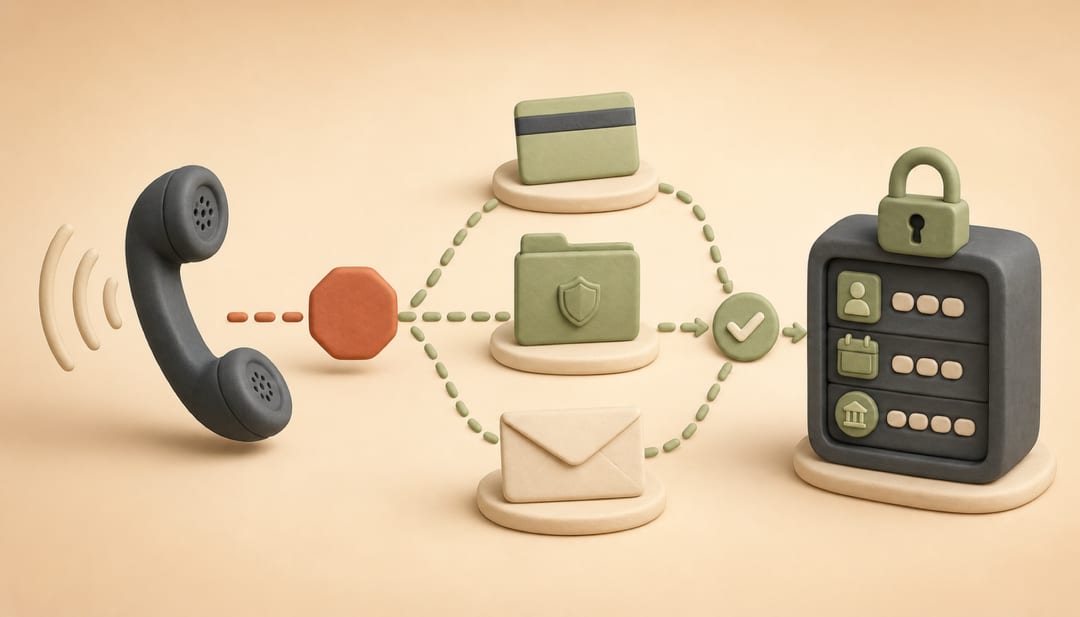
Do not decide whether an unexpected caller is trustworthy while the caller controls the channel. Preserve the claim, end the call, and ask the real institution to find the issue in its own system.
Quick answer: An unexpected call may be legitimate, but caller ID, an employee name, a case number, or the caller’s knowledge of your address or partial account details is not enough to prove identity. Ask only for the claimed organization, department, general reason, non-sensitive reference number, and stated deadline. Then end the call. Open the organization’s official app or website, use the number on a recent statement or the back of your card, or find the agency through its official
.govpage. Ask the institution to locate the alleged issue in its own system. Only after reaching that independently verified channel should you complete the institution’s authentication process and disclose information required for the specific task.
Editorial note: This article uses a generalized scenario derived from user-provided community material. It does not reproduce identifying details or treat social-media comments as verified facts. This article provides general information, not legal, medical, tax, financial, cybersecurity, or emergency advice.
A Familiar Number Is Not an Authentication Method
Imagine that your phone displays the name of your bank. The caller says a suspicious transfer is pending, knows your name and the last four digits of your card, and sends a six-digit code while you are on the line. The caller says the code will stop the transfer.
Every detail feels connected. None proves that the person speaking is the bank.
The displayed number can be spoofed. Personal and account information may have been stolen, purchased, exposed in a breach, or gathered from public sources. A code sent by the real bank may mean that someone is trying to enter your account—not that the caller is a bank employee. The Federal Trade Commission advises consumers to end unexpected calls about money at risk and contact the institution through a source they already know is correct. The Federal Communications Commission likewise warns that caller ID information can be manipulated. FTC: Unexpected Calls About Money at Risk · FCC: Unwanted Calls and Texts
The safe response is not to debate the caller or solve the alleged emergency inside the inbound call. Record the claim, hang up, and ask the institution you reach independently whether the issue exists.
There Is No Single “Safe Incoming Call” Signal
Treat every apparent trust signal as a clue to cross-check, not proof.
| What looks reassuring | Why it is not enough | How to use it safely |
|---|---|---|
| A familiar caller-ID name or number | Caller ID can be spoofed, including government and local numbers | Save the call log, but contact the organization through an independently sourced number |
| The caller knows your name, address, provider, or last four digits | Scammers may already possess personal or account data | Do not confirm additional facts; ask the official institution to locate the issue |
| An employee name, badge number, or ID | A real official’s name can be copied, and an ID can be invented | Put it in your notes, then ask the official institution whether that employee and contact exist |
| A case or reference number | A caller can invent one | Use it only as a lookup key after you contact the institution independently |
| An official-looking text, PDF, letter, or photo ID | Documents and images can be fabricated | Preserve it; compare it with an official notice library, secure portal, or verified agency contact |
| A transfer to another “department” | A transfer inside the same inbound call remains inside a channel controlled by the original caller | End the call and start a new contact through the institution’s official route |
| A real one-time code arrives | The caller may have triggered the code while trying to access your account | Never read it to an unexpected caller; use codes only in an authenticated flow you initiated |
The Social Security Administration’s Office of the Inspector General specifically warns that caller ID, official names, documents, and badges can be used as props. SSA OIG: Identify the Scam
Use a Second Channel to Verify the First
A practical rule is:
Channel A creates the claim. Channel B verifies the claim.
Channel A may be an inbound call, voicemail, text, email, or letter. Channel B should be something you access independently:
- the official app already installed on your device;
- the organization’s website opened from a known bookmark or a domain you checked independently;
- the number on the back of a card;
- the number on a recent statement or trusted prior correspondence;
- an existing secure account portal; or
- an agency contact page on an official
.govdomain.
Do not use the callback number supplied by the caller merely because it sounds professional. Do not use a link in the unexpected message to “verify” the same message. Be cautious with sponsored search results: confirm the domain and institution before calling or entering information.
The FDIC and Office of the Comptroller of the Currency recommend using familiar, independently obtained bank channels such as the card-back number, official website, online banking, or mobile app. FDIC: Bank Impersonation Scams and Fake Banks · OCC: Credit and Debit Card Fraud
The four events are different
Do not collapse the process into one word such as “verified.”
- Authenticate the channel: You independently reached the real organization.
- Locate the issue: The organization found the alleged alert, notice, claim, appointment, or case in its own system.
- Authenticate yourself: You completed the organization’s legitimate customer-verification process.
- Complete the task: The action, deadline, payment, appointment, account change, or written result was confirmed.
A secure portal may corroborate the issue without proving who made the original call. A case number may match a real matter even if the inbound caller was an impersonator. Keep those questions separate.
What to Ask Before Ending the Inbound Call
You can preserve a potentially important matter without sharing sensitive information.
Ask for:
- the claimed organization and department;
- the general purpose of the call;
- the type of case, claim, notice, appointment, or alert;
- a non-sensitive reference number;
- the caller’s stated name or ID for your log only;
- the claimed deadline and consequence; and
- where the issue should appear in the official portal or in writing.
Then say:
“I do not verify personal or account information on an unexpected inbound call. I will contact the organization through its official channel.”
If the caller demands a password, PIN, one-time code, security answer, remote access, cash withdrawal, wire, cryptocurrency, gift card, payment-app transfer, secrecy, or money moved to a “safe” account, do not continue. End the call and contact the real institution. FTC and CFPB guidance identifies urgency, secrecy, unusual payment methods, and demands to move money as recurring scam patterns. CFPB: Classic Warning Signs of Fraud and Scams
Do not let “verification” delay an actual emergency. For an immediate threat to life, safety, or property, contact 911 or the relevant official emergency channel independently from a safe place. Do not send money through a stranger who claims to be routing the emergency.
Use a Disclosure Ladder
The safest amount of information depends on the verified institution and task. The goal is not to refuse all verification forever. It is to avoid giving a stranger the information needed to impersonate you.
| Level | Examples | Default response to an unexpected inbound caller |
|---|---|---|
| 0. Routing details | Claimed institution, department, general issue, non-sensitive case label | Collect for your log; do not treat as identity proof |
| 1. Ordinary identifiers | Full name, mailing address, date of birth, phone, email | Avoid confirming more than necessary; verify the institution first |
| 2. Account identifiers | Full account/card/member/policy/claim number, Medicare number, full SSN | Do not provide on the unexpected call; use only in the verified institution’s process |
| 3. Authentication secrets | Password, PIN, OTP, security answer, recovery code | Never give to an unexpected caller or place in a reusable call brief |
| 4. Account or device control | Remote access, money movement, cash, wire, crypto, gift cards, payment-app transfer | Stop, hang up, and contact the real institution immediately |
After independently reaching the organization, ask:
“What information is required for this task? Can you use a partial identifier, an in-app prompt, a mailed notice, or another verification method?”
A legitimate organization may need personal information to authenticate you. There is no single national verification script that every bank, insurer, medical office, or agency must use. The safe distinction is between disclosing information to an unexpected caller and completing task-specific verification after you independently reached the real organization.
Cross-Check the Reference Without Retelling the Story
Do not begin the callback by feeding the official representative every detail the inbound caller gave you. First test whether the institution can find the matter in its own system.
Use this script:
“I received an unexpected call claiming to be from your
[department]. Can you check for an outbound contact around[date and time]or locate reference[number]and tell me whether there is a real issue on my account?”
Then ask:
- What account, claim, notice, transaction, or appointment does the system associate with it?
- Which department owns it?
- What is the verified deadline and consequence?
- Where can I see the same issue in my secure portal or in writing?
- What information is required from me now?
- What case number and written confirmation will document the next step?
Interpret the result carefully:
- Exact internal match: The underlying issue is corroborated. That still does not prove the original caller’s identity.
- No match: Do not disclose more to help the representative reconstruct the caller’s story. Use the institution’s fraud-reporting route if appropriate.
- Partial or ambiguous match: Ask for a written notice, secure portal message, or escalation within the independently reached institution.
- Real issue, suspicious caller: Handle the legitimate account issue and the impersonation attempt as separate incidents.
Once you have a verified outbound task, use When Customer Service Requires a Phone Call to prepare the call and survive transfers without losing the objective.
Phone, Voicemail, Letter, and Portal Prove Different Things
| Artifact | What it can show | What it does not prove |
|---|---|---|
| Live inbound call | Someone reached your number and made a claim | Identity, authority, accuracy, or legitimacy |
| Voicemail | The exact message, time, and callback number left | That the callback number is official |
| Caller ID or call log | Which number appeared and when | Who controlled the call |
| Mailed letter | The written notice, address, number, and claimed deadline | Authenticity from appearance alone |
| Text or email | The exact message and links sent | Sender identity from a display name or link label |
| Secure portal opened independently | The organization’s authenticated account displays an issue or task | That the original caller was genuine; not every valid notice necessarily appears online |
| Case number | A verified institution may match it to an internal record | Legitimacy by itself |
| Written confirmation after callback | What the verified institution acknowledged or promised | That the promised action is already complete |
Preserve the original artifact, but open the portal or official website independently. Never publish unredacted SSNs, full dates of birth, account or Medicare numbers, card numbers, OTPs, passwords, security answers, medical details, or recovery codes in a complaint screenshot or social post.
If the Caller Says They Are From Your Bank
Banks and card issuers can make real fraud calls, so “a bank will never call” is not a safe rule. The better rule is that the inbound caller does not get to authenticate themselves through caller ID, account knowledge, or a code they triggered.
- Do not approve a transfer or move money to a “safe” account.
- Do not share a verification code or grant remote access.
- End the inbound call.
- Open the official bank app or website, or call the number on the back of the card or a recent statement.
- Ask the fraud department to identify any alert visible in its own system.
- Review transactions in the authenticated account.
- If information or money was exposed, ask the institution immediately to secure the affected account or card.
Use this sentence:
“I will not move money or share a code on an inbound call. I will contact the bank through the number on my card.”
If the Caller Says They Are From a Medical Office, Insurer, or Medicare
A provider or insurer may call about an appointment, referral, prior authorization, claim, bill, care coordination, or records request. Ask for the organization, department, administrative task, and general deadline without discussing detailed health information. Then call the number on the member card, provider’s official website, existing patient portal, or prior trusted paperwork.
Ask the verified organization whether it initiated the contact and what authentication it requires. Request that the outcome appear as an appointment confirmation, portal message, explanation of benefits, claim record, or written notice.
HIPAA does not prescribe one universal phone-verification form. HHS says covered entities must take reasonable steps to verify identity for access requests, while the method can depend on the context and the organization’s process. HHS: Right to Access Health Information
Medicare advises people to protect their Medicare number like a credit card and to independently call 1-800-MEDICARE when an unknown caller asks for it. Medicare and plans can make limited legitimate calls, including contacts after a person joined a plan, reported fraud, left a message, or gave permission. Do not turn this into the false rule that every Medicare call is fraudulent. Medicare: Your Medicare Card · Medicare: Reporting Fraud and Abuse
If the institution confirms a real appointment, claim, referral, prior authorization, pharmacy, or coverage task, continue with How to Prepare for a Medical Office or Health-Insurance Phone Call.
If the Caller Says They Are From Social Security or the IRS
Avoid two misleading slogans: “government agencies never call” and “the IRS never calls.” Real agencies describe limited outbound-call circumstances.
SSA OIG says Social Security mainly calls people who recently applied for a benefit, already receive payments and need a record update, or requested a call. Arrest threats, demands for immediate payment, secrecy, and threats to suspend an SSN are scam signals. Use ssa.gov, a personal my Social Security account, or SSA’s published contact route to verify the benefit, application, payment, or record issue. SSA OIG: Identify the Scam · SSA: my Social Security
The IRS says it or an authorized private collection agency may call about an account matter. The agency normally contacts a taxpayer first by mail, but limited exceptions and follow-up calls exist. Note the claimed tax period and notice type without giving financial data, then search the notice number on IRS.gov, check the secure IRS Online Account, and use an official IRS contact. Not every valid notice appears online, so portal absence alone is not conclusive. IRS: How to Know It’s the IRS · IRS: Understanding Your Notice or Letter
Verification is not permission to miss a real deadline. If the independently verified agency confirms a response, payment, appeal, identity-verification, benefit, or tax deadline, follow the official instructions or seek qualified help promptly.
What to Do if You Already Shared Information, Access, or Money
Act quickly through official channels. No single recovery step guarantees that loss will be prevented or reversed.
| What was exposed | Immediate action | What to preserve |
|---|---|---|
| SSN or identity data | Use IdentityTheft.gov for a tailored recovery plan; consider a credit freeze or fraud alert based on the facts | Exactly what was shared, when, messages, account changes, and report numbers |
| Username and password | Change the password through the real account; change it anywhere it was reused | Login alerts, password-change confirmation, and unknown sessions or devices |
| One-time or security code | Contact the institution immediately through the official app, site, or number; secure the account and review activity | Code time, alert, related transaction, account changes, and official case number |
| Card or bank information | Contact the issuer or bank through the card-back number, official app, or website; report affected transactions | Statements, alerts, replacement or account actions, and dispute confirmation |
| Medicare or medical identity information | Contact Medicare, the affected plan, and providers through official channels; review claims and statements | Claims, EOBs, Medicare Summary Notices, and caller details |
| Remote computer access | Disconnect the session; use trusted security software; update and scan the device; change passwords from a safe device when appropriate | Remote software, timestamps, messages, scan results, and account changes |
| Phone-number control | Contact the mobile carrier, regain control, change the carrier password, and review financial accounts | Carrier case, SIM/eSIM changes, alerts, and unauthorized activity |
| Money sent | Contact the bank, issuer, app, wire provider, gift-card company, or delivery service immediately and ask whether the transaction can be stopped or reversed | Receipt, recipient data, transaction ID, communications, and report number |
A credit freeze and a fraud alert are different tools. The FTC explains that a freeze generally blocks prospective creditors from accessing the credit file and remains until lifted; the consumer contacts all three nationwide bureaus. A fraud alert tells businesses to verify identity before extending new credit, and contacting one nationwide bureau triggers notice to the other two. Neither prevents every form of identity theft or misuse of an existing account. FTC: Credit Freezes and Fraud Alerts
Reporting and account security are separate. Report the incident through the institution’s fraud team and the appropriate official route, such as ReportFraud.ftc.gov, SSA OIG, the IRS reporting page, Medicare, or the FCC, depending on the incident. A report documents the event and may help identify patterns; it does not guarantee recovery.
Build a Verification Record
Keep:
- the inbound call log and displayed number;
- voicemail, text, email, attachment, or envelope;
- the exact urgency, secrecy, payment, remote-access, or code request;
- claimed organization, department, employee name or ID, and reference number;
- the independent official channel you used;
- date, time, representative, and department reached through that channel;
- whether the institution’s system matched the issue;
- the official case number, portal notice, or written confirmation;
- exactly what information, access, code, or payment was exposed; and
- every containment action and report number with timestamps.
Once the real institution acknowledges the issue or promises an action, use How to Prove What Happened on a Customer-Service Call to turn that verified contact into a follow-up record.
Where Pine Fits
Open Pine with the caller’s claimed organization, general reason, non-sensitive reference number, date, and a redacted notice. Pine can help locate the institution’s official public contact route, prepare the verification questions, make or organize a permitted outbound customer-service contact, and keep the follow-up timeline.
Do not upload passwords, PINs, one-time codes, security answers, recovery codes, full Social Security numbers, full card or bank-account numbers, or unnecessary medical details. Pine cannot authenticate an inbound caller from caller ID, voice, personal facts, an employee ID, or a reference number alone. It does not replace the institution’s secure authentication process, fraud team, emergency services, a lawyer, tax professional, medical professional, or financial adviser—and it cannot guarantee recovery or a particular outcome.
Frequently Asked Questions
If caller ID shows the company’s real number, is the call safe?
No. Caller ID can be spoofed. Save the call log, but contact the organization through its official app or website, a recent statement, the back of the card, or an official agency page.
What if the caller knows my full name, address, or last four digits?
That still does not authenticate the caller. Personal and account details can be stolen, purchased, leaked, or gathered elsewhere. Do not confirm additional information until the real institution locates the issue in its own system.
Is a case number proof the caller is legitimate?
No. It is a lookup key. Call through an independently verified official channel and ask the organization to locate the number and describe the associated issue from its own record.
Should I call the number left in a voicemail?
Not merely because it is in the voicemail. Preserve the message, then obtain the contact number from the official app or website, a recent statement, the back of the card, or the agency’s official contact page.
Is a letter safer than a phone call?
A letter creates a useful written artifact, but official-looking mail can be fabricated. Match the notice with an official notice library, secure portal where available, or published agency contact. Do not assume that portal absence alone proves a notice is fake.
Can a legitimate institution ask identity questions by phone?
Yes, especially after you call an official number independently. Verification methods vary by institution and task. The safer distinction is between providing task-required information through a verified channel and disclosing it to an unexpected caller.
Can I ever read a one-time code to a caller?
Do not give an OTP or account-verification code to an unexpected caller. The FTC warns that the code may let the caller access or take over the account. Enter a code only into the genuine institution’s authenticated flow when you initiated or independently verified the transaction. FTC: Verification Codes
What if the caller says my account or benefits will close today?
Write down the claimed deadline, end the call, and verify immediately through the official institution. Do not allow urgency to force disclosure, payment, or device access, but do not ignore a deadline the real institution confirms.
I already shared my SSN. What should I do?
Use IdentityTheft.gov for a recovery plan tailored to the information and incident, contact affected institutions, and consider a credit freeze or fraud alert. Preserve exactly what was shared, when, and with whom. FTC: What to Do if You Were Scammed
Official Sources
- FTC: How to Handle Unexpected Calls That Claim Your Money Is at Risk
- FTC: What’s a Verification Code and Why Would Someone Ask Me for It?
- FTC: What to Do if You Were Scammed
- FCC: Unwanted Calls and Texts
- FDIC: Bank Impersonation Scams and Fake Banks
- OCC: Credit and Debit Card Fraud
- SSA OIG: Identify the Scam
- IRS: How to Know It’s the IRS
- HHS: Individuals’ Right to Access Health Information
- Medicare: Reporting Fraud and Abuse
- Pine Security
This article provides general information, not legal, medical, tax, financial, cybersecurity, or emergency advice. Authentication methods, deadlines, reporting channels, recovery options, and available remedies depend on the institution, incident, contract, account, program, jurisdiction, and current official guidance.