A quiet lobby, a new building and a five-minute model-unit tour do not predict what you will hear in the apartment where you sleep. Test the exact unit, at the times and operating conditions that matter, and price the exit terms before you sign.
Quick answer: Visit the exact apartment—not only the model—more than once and at different times. Stand silently with the HVAC, bathroom fan, refrigerator and windows in different states. Map the unit against roads, rail lines, loading areas, trash equipment, elevators, garage doors, pools, rooftop mechanical systems and neighboring walls. Get the unit number, orientation, quiet-hour policy, complaint process, transfer terms, buyout terms and sublet or assignment rules in writing. If the property cannot identify your unit yet, the lease should say how assignment works and what happens if the assigned location materially differs from what you inspected. Noise law, habitability, early termination and rent remedies vary by state and city; do not assume an annoying unit creates a nationwide right to cancel.
Editorial note: This article uses an anonymized summary of user-provided community material. We did not inspect the apartment, measure the noise, review the lease or verify the reported conversations. It provides general U.S. information, not legal, medical, engineering or acoustic advice. Lease rights and noise standards depend on the property, contract, state and locality.
A Familiar Noise Trap
An experienced renter described leaving an apartment after a month of unsuccessful noise complaints. The move required new tours, packing, cleaning and a second moving company, while the deposit outcome remained uncertain. Looking back, the renter identified a long list of risks that ordinary tours had not revealed: a road-facing unit, common-area activity, mechanical equipment above the ceiling, a heat pump near the bedroom, plumbing sounds and unpredictable neighbor noise.
The comment thread added more rules of thumb. Ask people walking nearby. Prefer new construction. Look at the residents’ cars. Visit at night. Listen to the refrigerator in a studio.
Some of those ideas can produce leads. None is a reliable substitute for checking the actual unit. A resident in another wing may have no experience with your rooftop fan. A new building can still have a garage gate below the bedroom. A quiet evening visit may miss weekday trash pickup. A demographic guess based on cars is neither a sound measurement nor a fair housing standard.
The useful question is not “Is this a good building?” It is:
What sound reaches this bedroom, through which path, under which operating condition and at which time?
Noise Is a Unit-Level Problem
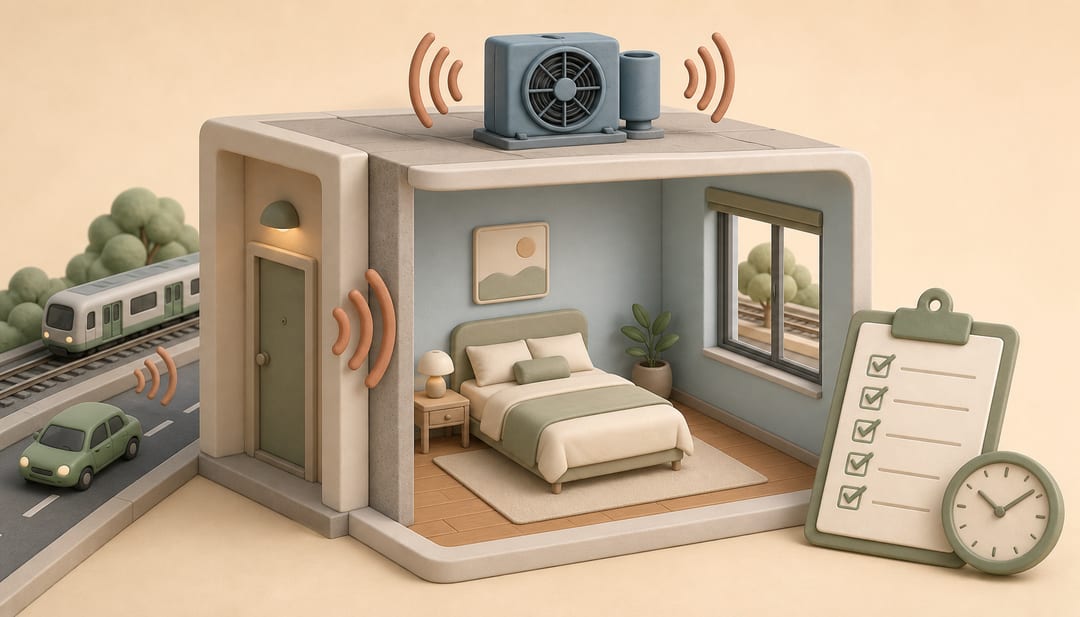
Two apartments with the same floor plan and rent can have completely different sound exposure.
| Unit relationship | Possible source | What to inspect |
|---|---|---|
| Exterior wall or window | Arterial road, intersection braking, train, aircraft, nightlife, loading or construction | View direction, window seals, balcony, traffic cycle and scheduled activity |
| Ceiling or roof | Rooftop HVAC, exhaust fan, pump, elevator equipment or footsteps | Equipment location, vibration, operating cycle and access panels |
| Floor below | Garage door, loading dock, gym, lobby, retail, trash room or mechanical space | What occupies the space directly below and when it operates |
| Shared wall | Neighboring bedroom, TV wall, stairwell, elevator or utility riser | Wall layout, outlets, doors, hallway traffic and impact sounds |
| Interior equipment | Heat pump, air handler, forced ventilation, refrigerator, dishwasher or plumbing | Startup, shutdown, cycling, fan speeds, compressor vibration and drain noise |
| Amenity side | Pool, barbecue area, dog run, playground or package room | Hours, gates, furniture movement, events and enforcement process |
“Top floor” may reduce footsteps from above but increase exposure to rooftop equipment. “First floor” may eliminate downstairs-neighbor concerns but add lobby, garage, gate or walkway noise. “Courtyard facing” may reduce traffic and amplify voices or amenity activity. Treat every label as a tradeoff, not a promise.
Start With a Map, Then Verify It in Person
Before the tour, place the building and proposed unit on a simple source map.
Outside the property
Check for:
- highways and multilane roads;
- intersections, bus stops and delivery zones;
- active rail lines and grade crossings;
- airport flight paths;
- hospitals, fire stations and late-night venues;
- construction permits or vacant development parcels;
- stadiums, schools and event facilities; and
- snow-removal, landscaping or waste-collection routes where relevant.
The U.S. Department of Transportation’s Bureau of Transportation Statistics publishes a National Transportation Noise Map for transportation-noise context. Its currently displayed national layers use 2022 aviation and rail data and a 2023 road layer. BTS describes simplified modeling intended for national trends and cautions against using it to evaluate one location or time. The model can miss shielding from barriers, terrain or rows of buildings, while annual averages can conceal individual events and seasonal or hourly patterns. Use it as a planning screen, not a verdict on a bedroom.
For airport exposure, check the FAA’s directory of available airport Noise Exposure Maps and the relevant airport operator. Participation and map dates vary. FAA’s DNL contours summarize cumulative exposure and apply a nighttime weighting; they do not show the peak, timing or indoor effect of one flyover. For rail, use the Federal Railroad Administration’s GIS resources to identify lines, yards and crossings, then verify current service. Even a designated railroad quiet zone does not promise a horn-free home or eliminate rolling, braking, idling, switching and vibration.
Inside the property
Ask for a floor and site plan that locates:
- the exact unit and bedroom;
- elevators, stairs and corridor doors;
- trash chutes, compactors and loading areas;
- garage entrances and security gates;
- fitness, pool, barbecue, lounge and pet areas;
- laundry and package rooms;
- retail or commercial spaces;
- boiler, electrical and mechanical rooms; and
- roof fans, condensers, pumps and exhaust outlets.
Do not accept “the unit is on the quiet side” without locating these items.
Use the Three-Visit Noise Test
One tour shows one moment. Ask to inspect the exact unit at least three times when practical.
Visit 1: the operational tour
During the leasing-office visit:
- stand silently in the bedroom for several minutes;
- close the front door and interior doors;
- listen with the windows closed, then open;
- ask to operate the HVAC through a normal cycle;
- run the bathroom fan and, where permitted, the kitchen exhaust;
- listen near the refrigerator, utility closet, vents and plumbing wall;
- walk the hallway, stairwell, trash area and garage route; and
- note vibration through the floor, wall and headboard location—not just airborne sound.
Do not unplug, open, move or disassemble building equipment. Ask maintenance to operate anything that is not an ordinary resident control.
Visit 2: the busy window
Return during the time most likely to activate external and common-area sources. Depending on the property, that may be weekday rush hour, school pickup, trash collection, evening gym use, pool hours or a weekend event.
If the leasing office will not provide access, listen from lawful public or common areas and record what you could not verify. Do not trespass or follow residents through controlled doors.
Visit 3: the sleep window
Visit the surrounding public area during the hours when you expect to sleep or work. Observe traffic, doors, voices, lighting, venue activity and building equipment audible from outside. You may not be able to enter the unit late at night; that uncertainty belongs in the decision.
If the property allows only one short daytime model-unit tour, you are not buying proof of quiet. You are accepting an untested variable.
A 20-Minute Exact-Unit Listening Protocol
Use a timer and divide the visit into four phases.
| Phase | Condition | What to note |
|---|---|---|
| 0–5 minutes | Everything off; windows closed | Baseline hum, footsteps, voices, doors, plumbing and vibration |
| 5–10 minutes | HVAC or heat pump operating | Startup, fan, compressor, cycling, vent whistle and low-frequency vibration |
| 10–15 minutes | Windows open, then closed | Traffic, rail, aircraft, outdoor voices and how much the window changes them |
| 15–20 minutes | Bathroom/kitchen fans and water fixtures where permitted | Exhaust vibration, pipe knock, drain sound and sound transfer between rooms |
In a studio, repeat the quiet phase beside the refrigerator because its compressor may be close to the bed. Listen long enough to observe a cycle if possible, but do not assume a silent 20 minutes proves the appliance will remain silent overnight.
A phone reading is a screening note, not legal proof
The National Institute for Occupational Safety and Health offers a tested Sound Level Meter app for iOS. NIOSH reports approximately ±2 dBA laboratory performance under its tested conditions and says a calibrated external microphone is needed for performance associated with a Type 2 instrument. It does not offer an Android version because device and microphone variation prevents consistent verification. The app was designed for workplace sound evaluation, not residential code enforcement. A consumer phone reading can help you compare locations and identify a pattern; it should not be described as a compliance test, professional acoustic survey or proof of a lease violation.
Record the operating condition and qualitative character—hum, impact, rattle, horn, voice, cycling—not only one number.
If the Exact Unit Is Not Yet Assigned
Student housing and some large properties assign the bedroom, unit or roommates after the resident signs. That is a material risk for a noise-sensitive renter.
Before signing, ask:
- When will the exact building, floor, unit and bedroom be assigned?
- Can the resident rank or exclude road-facing, rail-facing, amenity-facing, elevator-adjacent, first-floor or top-mechanical-floor locations?
- Is the preference binding or only a request?
- What happens if the assigned unit differs from the model or selected attributes?
- Is a pre-move inspection of the assigned unit allowed?
- Can the resident decline the assignment, and what fee or rent remains due?
- What is the room-transfer process, availability rule and fee?
- Can the property reassign roommates or bedrooms during the term?
- Does the agreement contain a buyout, replacement-tenant, sublet or assignment option?
Room transfer and lease buyout are not universal U.S. rights. They are often contract terms, negotiated options or local remedies. “We usually help” is not the same as an addendum describing eligibility, price, timing and release from future rent.
The U.S. Department of Education explains that a covered postsecondary school providing housing to nondisabled students must provide comparable, convenient and accessible housing to students with disabilities at the same cost. That federal accessibility duty does not itself create a universal dorm-cancellation or refund right. U.S. Department of Education: Students With Disabilities Preparing for Postsecondary Education
Put the Noise-Relevant Promises in Writing
Ask the leasing office to confirm:
- the exact unit number and floor-plan orientation;
- the spaces above, below and beside it;
- whether roof or mechanical equipment serves that stack;
- whether any mandatory ventilation runs continuously or on a schedule;
- property quiet hours and the enforcement process;
- known construction or major equipment work, subject to lawful disclosure limits;
- the process for maintenance inspection of recurring mechanical noise;
- transfer eligibility, fee and rent reset;
- buyout amount and notice;
- sublet, assignment or replacement-tenant rules;
- whether concessions must be repaid after an early exit; and
- which terms survive a roommate or unit reassignment.
The property may not be able to disclose another resident’s private information or promise that neighbors will never make ordinary living sounds. Ask about the system and physical unit, not the identity or protected characteristics of the people nearby.
Federal consumer-protection law can treat materially misleading advertising claims or omissions as deceptive, but an FTC complaint does not automatically cancel an individual lease. Preserve the exact representation and have state-specific contract and consumer remedies reviewed. FTC: Advertising and Marketing Basics
Suggested pre-signing message
Before I sign, please confirm that the offered apartment is unit [number], with [orientation], and identify what is directly above, below and beside the bedroom. Please also send the written quiet-hours policy, mechanical-noise maintenance process, unit-transfer terms, buyout terms and sublet or assignment rules. If the exact unit is not yet assigned, please identify which location preferences are binding, when I can inspect the assigned unit and what options apply if it materially differs from the unit or location represented during leasing.
Do not ask the agent to promise “complete silence.” Ask for verifiable facts and contract terms.
New Construction Is Not a Noise Warranty
Building age can affect windows, equipment and assemblies, but “new,” “luxury,” “renovated” and “concrete” do not describe the sound path in one bedroom.
A new property may have:
- efficient but frequently cycling mechanical systems;
- rooftop equipment over top-floor units;
- garage or access-control equipment below;
- lightweight interior partitions;
- unfinished nearby phases; or
- amenity spaces designed for frequent use.
An older property may have poor windows and creaky floors—or a quiet masonry location with no active amenities. A renovation may improve finishes without changing the wall, floor or facade assembly.
Building and noise codes are adopted and enforced locally. Passing an inspection does not create a nationwide guarantee that a noise-sensitive resident will find the unit comfortable. If sound performance is decisive, consider an independent acoustic professional before committing to an expensive or inflexible lease.
After Move-In: Identify the Source Before Demanding a Remedy
“The apartment is noisy” is difficult to investigate. Build a source log.
| Log field | Example |
|---|---|
| Date and time | Tuesday, 1:10–1:42 a.m. |
| Location | Bedroom wall adjacent to utility closet |
| Character | Low-frequency hum with vibration, not voices |
| Pattern | Starts approximately every 25 minutes and runs for 12 minutes |
| Operating condition | Resident HVAC thermostat off; bathroom fan off |
| Impact | Woke resident twice; work call moved to living room |
| Evidence | Short ambient video from inside unit; maintenance ticket number |
| Requested action | Inspect fan/pump serving the stack and report findings in writing |
Describe what you observed without declaring an unverified source. A vibration that seems to come from the roof may travel through structure from another location.
Do not secretly record private conversations
Recording laws vary by state and by whether a communication is private. Federal law supplies only a baseline under 18 U.S.C. § 2511; states can impose stricter rules, and cross-state calls create added uncertainty. A short video of an equipment hum or door slam from inside your unit is different from intentionally recording a neighbor’s or employee’s conversation. Keep private speech out of the recording when possible, do not point devices into another home, and obtain express consent or local legal guidance before recording conversations or using surveillance equipment.
A Proportionate Escalation Ladder
Level 1: Written maintenance request
For equipment, ventilation, plumbing or a building component, send the dated source log and ask for inspection. Request the ticket number, technician findings and proposed next step.
I am reporting a recurring low-frequency vibration in the bedroom. It occurred on [dates/times], including while my thermostat and in-unit fans were off. The attached log describes the cycle. Please inspect the building equipment and components serving or adjacent to this unit and provide the findings and next step in writing.
Level 2: Policy enforcement
For repeated activity that appears to violate written quiet hours or another lease rule, identify the rule, dates and pattern. Avoid confronting a neighbor aggressively or making claims based on identity, family status, disability or another protected characteristic.
Level 3: Specific housing solution
Ask for a defined remedy:
- repair or isolation of verified equipment;
- door, window or hardware adjustment;
- transfer to an identified unit after inspection;
- temporary alternative during major work;
- negotiated lease buyout;
- approved sublet, assignment or replacement tenant; or
- another written settlement.
Calculate all consequences: transfer fee, new rent, lost concession, moving expense, cleaning, deposit handling and the date the old lease obligation ends.
Level 4: Disability-related accommodation
If a tenant has a disability and a change to a policy, practice or service may be necessary for equal use and enjoyment of the home, the federal Fair Housing Act may support a reasonable-accommodation request. A quieter-unit transfer, a modified transfer rule or another solution can be requested when there is a disability-related need; it is not automatically granted merely because a resident prefers quiet. Housing providers may evaluate whether the request is necessary and reasonable, and federal guidance recognizes limits such as undue financial and administrative burden or a fundamental alteration. When the disability or connection is not obvious, limited reliable information may be requested. A provider cannot charge an accommodation fee or deposit merely for processing or granting a reasonable accommodation. HUD and DOJ: Reasonable Accommodations Under the Fair Housing Act
Use a focused request. Do not overshare an entire medical file. A fair-housing organization or qualified professional can help with the facts and documentation.
Level 5: Local enforcement or legal review
State and local law determines whether the facts implicate a noise ordinance, nuisance rule, habitability standard, lease covenant or another remedy. The responsible office may be a city code department, environmental health agency, police non-emergency line, housing office, court or private dispute-resolution service. A transportation operator or construction department may control an external source the landlord cannot eliminate.
The EPA explains that primary responsibility for community-noise control rests with state and local governments. There is no single federal decibel ceiling that makes every private apartment legally quiet. EPA: Summary of the Noise Control Act
Do not withhold rent, deduct moving costs, break the lease, disable equipment or make structural changes based only on generic online advice. Those actions can create separate lease and eviction risks. Have the exact lease and jurisdiction reviewed first. The Legal Services Corporation locator is one national starting point for eligible renters seeking local civil legal aid.
Call 911 for immediate threats, fire or a medical emergency. Do not use an emergency line for ordinary apartment noise.
How to Compare Two Units Without Guessing
Use a simple scorecard, but keep observations separate from unknowns.
| Factor | Unit A | Unit B |
|---|---|---|
| Exact unit inspected? | Yes / No | Yes / No |
| Bedroom exterior source | ... | ... |
| Above / below / adjacent uses | ... | ... |
| HVAC cycle observed? | ... | ... |
| Window-open / window-closed difference | ... | ... |
| Busy-time visit completed? | ... | ... |
| Sleep-time surroundings checked? | ... | ... |
| Transfer terms | ... | ... |
| Buyout cost | ... | ... |
| Unresolved unknowns | ... | ... |
An unknown should not receive the same score as a confirmed quiet condition. If noise sensitivity is a top-three requirement, price uncertainty explicitly.
For Los Angeles renters who also need to compare commute, parking, street conditions and total cost, pair this process with our block-by-block Los Angeles apartment checklist.
Where Pine Fits
Open Pine to organize tour notes, floor plans, leasing emails, sound logs, maintenance tickets, lease clauses and transfer or buyout quotes into one timeline. Pine can help turn “this unit is unbearable” into answerable questions: which source, when, under what operating condition, what was promised, what has management inspected and what written options remain?
Pine does not measure code-compliant sound, diagnose building systems, provide legal or medical advice, negotiate as your representative or guarantee an early lease release.
Frequently Asked Questions
Is a top-floor apartment always quieter?
No. A top floor may reduce footsteps from above but can be closer to rooftop HVAC, exhaust fans, pumps or elevator equipment. Inspect what is above the ceiling and observe an operating cycle.
Is a new apartment building more soundproof?
Not necessarily. Age, marketing labels and finishes do not establish the acoustic performance of a specific wall, floor, window or mechanical system. Inspect the exact unit and source relationships.
Can I cancel a lease because the apartment is noisy?
There is no universal U.S. cancellation right for an apartment a tenant finds too noisy. The answer can depend on the source, severity, notice, landlord response, lease, state law, local ordinance, habitability or nuisance standards, and any disability-related accommodation issue. Review the local rules before moving out or stopping payment.
Does a landlord have to let me transfer units?
Not as a universal rule. A transfer may be offered by the lease, property policy, settlement or reasonable-accommodation process. Confirm availability, rent, fees, concessions, deposit handling and release from the old unit in writing.
Is a decibel app enough to prove a violation?
Usually not by itself. A phone app can help identify patterns and compare locations, but legal or code standards may specify equipment, calibration, weighting, averaging, measurement position and qualified personnel. Use the app as one part of a dated evidence file.
Should I ask current residents whether the building is quiet?
You can ask neutral questions when someone is willing to talk, but one resident’s experience may not apply to another wing, floor or unit. Do not pressure residents or ask about protected characteristics. Verify the physical relationships and lease process yourself.
What should I check first in a studio?
Listen to the refrigerator and nearby HVAC or plumbing because the sleeping area cannot be separated by a bedroom door. Check the compressor cycle, vent location, bathroom fan, utility closet and whether a headboard would share a wall with equipment or a corridor.
Can noise sensitivity qualify for a reasonable accommodation?
It can when the resident has a disability under fair-housing law and the requested change is necessary because of the disability. General annoyance or a preference for silence is not automatically a disability-related request. The accommodation must also be reasonable under the facts.
Official Sources
- U.S. Department of Transportation, Bureau of Transportation Statistics — National Transportation Noise Map
- Federal Aviation Administration — Airport Noise Compatibility Planning Data and Program Status
- Federal Railroad Administration — Geospatial Transportation Mapping Association
- CDC/NIOSH — Sound Level Meter App
- EPA — Summary of the Noise Control Act
- HUD and DOJ — Reasonable Accommodations Under the Fair Housing Act
- HUD — Fair Housing Act Overview
- HUD Exchange — Noise Abatement and Control
- FTC — Advertising and Marketing Basics
- U.S. Department of Education — Students With Disabilities Preparing for Postsecondary Education
- 18 U.S.C. § 2511 — Interception and Disclosure of Communications
- Legal Services Corporation — Find Legal Aid
This article provides general information, not legal, medical, engineering or acoustic advice. Noise standards, recording laws, disclosure duties, lease remedies and enforcement channels vary by jurisdiction and facts. Verify the current lease and local rules with the relevant agency or a qualified professional.