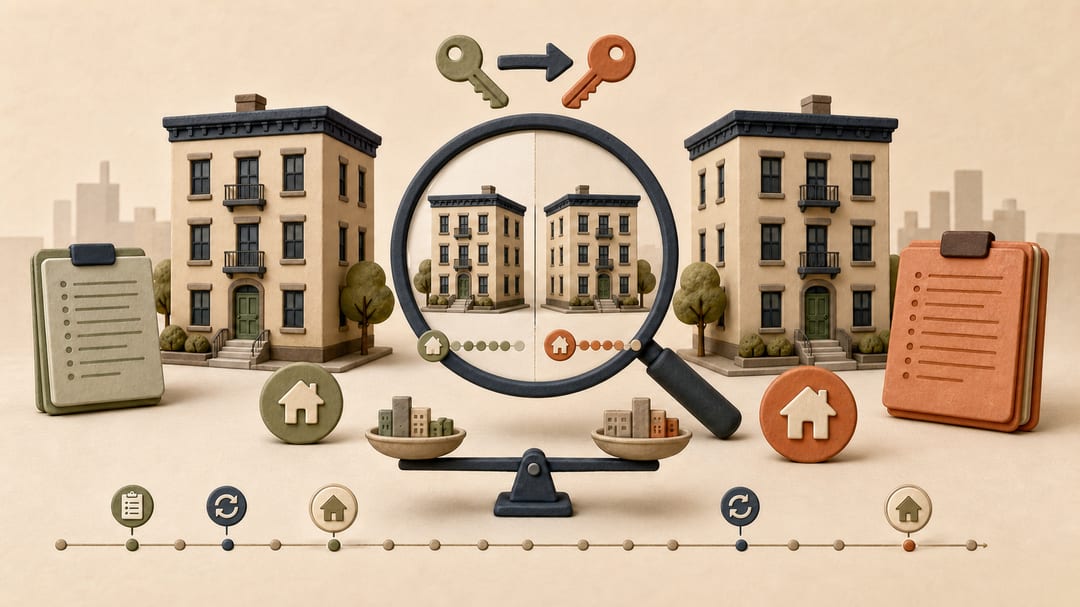
A higher tax bill does not mechanically authorize a higher rent. But evidence from Berkeley suggests that property-specific tax shocks can change what new tenants actually pay—partly because a sale forces landlords to look at the market again.
Last verified: August 16, 2026
Quick answer: Landlords do not always pass property taxes to renters, and there is no universal pass-through rate. A 2025 Federal Reserve Bank of Philadelphia working paper uses sale-triggered reassessments under California's Proposition 13 to study new-tenant rents in Berkeley from 1996 through 2022. Its preferred estimate is that each additional $1 of per-unit property tax was associated with about $0.53 in higher rent for a new tenant; an instrumental-variable estimate was about $0.89. The paper's proposed mechanism is not a simple automatic surcharge. Long-held rentals may drift below current market rent, and a sale can trigger both tax reassessment and more attentive repricing by a new landlord. The results concern one city, new leases and a preliminary working paper—not every rent increase, existing tenant or property-tax change.
The Puzzle: Same Local Market, Different Costs, Different Rents
Imagine two very similar apartment buildings on the same block.
One has been owned for decades. Its taxable value remains tied to an old acquisition-era base, so its property-tax bill is relatively low. The other has just sold. The county reassesses the transferred interest near current market value, creating a much larger tax bill for the buyer.
A simplified competitive-market benchmark says the two landlords should still charge the same market rent for comparable units. A prospective tenant cares about the apartment and available alternatives, not the owner's tax basis. The lower-cost owner should earn a larger profit; the higher-cost owner cannot make a tenant pay above the market merely by showing a bigger bill.
That benchmark is useful—but the Berkeley evidence suggests it does not fully describe actual new-lease pricing.
Sarah Baker's Philadelphia Fed Working Paper 25-41 finds that otherwise similar units exposed to larger sale-triggered property-tax shocks also experienced larger increases in new-tenant rent. The result is a departure from the textbook one-price benchmark, not the repeal of supply and demand.
Rental housing is full of frictions: units are not perfectly interchangeable, searches take time, moving is expensive, leases reset at intervals, information is incomplete and landlords do not all update prices in the same way. The research matters because it finds a cost-linked pricing difference even after applying unusually detailed property, neighborhood and timing controls.
Why Proposition 13 Creates a Useful Experiment
California's Proposition 13 generally ties a property's assessed value to an acquisition-era base value. That value may receive an annual inflation adjustment, usually capped at 2%, until a reassessable change in ownership or new construction occurs. A transfer commonly establishes a new base-year value for the transferred interest at current fair market value, subject to exclusions and other rules. California Constitution, Article XIII A · California State Board of Equalization: Change in Ownership
This can leave two comparable rental buildings with very different taxable values simply because one last sold recently and the other did not. When the long-held property sells, its assessed value may jump sharply. The size of that increase depends partly on how long the old tax base was allowed to diverge from market value.
That is valuable for research. A sale does not create the same tax shock for every building. A property sold only a few years after its prior transfer may see a smaller reassessment than a property held for decades, even if the two buildings sell for the same current price.
Several qualifications matter:
- the general 1% ad valorem limit is not necessarily the final tax bill, which can also include voter-approved debt and other charges;
- the annual assessment factor can be below 2%;
- decline-in-value rules can create a different path;
- some transfers qualify for exclusions; and
- a partial ownership transfer may reassess only the transferred interest.
The safe shorthand is therefore “acquisition-value assessment with capped annual growth and reassessment after many ownership changes,” not “every tax bill rises exactly 2% until every sale resets the entire property.” California BOE: California Property Tax—An Overview · Alameda County Assessor: Proposition 13
What the Study Actually Measures
The paper links three unusually detailed sources:
- Alameda County property-tax records from 1987 through 2022;
- Berkeley Rent Board unit-level lease records; and
- City of Berkeley building permits, used to capture observable renovations around a sale.
The main regression sample contains 3,590 buildings, 17,367 rental units and 97,017 tenant spells. About 15,019 tenant spells include a building sale. Although the larger Rent Board dataset reaches roughly 25,000 units, the regression sample applies matching and cleaning requirements.
Most importantly, the paper studies unrestricted rents set for new tenants from 1996 through 2022. It does not estimate how much rent was passed through to a sitting tenant at renewal. Berkeley's rules allow many new tenancies to begin at an initial rent chosen by the landlord, while later increases for covered continuing tenants follow a different regulatory framework. Berkeley Rent Board: Rent Control 101 · California Civil Code § 1954.53
That distinction is central:
| Price being measured | Included in the main study? | What it answers |
|---|---|---|
| Initial rent for a new tenant | Yes | How a landlord reprices when a unit turns over |
| Rent increase for a sitting tenant | No | What a current tenant may pay at renewal |
| Citywide average rent | No | The blended level across new and continuing tenancies |
| Asking rent in online listings | Not the core measure | What landlords advertise before a lease is signed |
The Three Results People Should Not Mix Together
The paper reports several numbers that answer different questions.
1. Rent rose about 6% after a sale
An event study finds that new-tenant rent rose by approximately 6% after a building sale and remained higher over the next several years. The paper finds no comparable pre-sale rent trend.
This is evidence that sales are repricing events. It is not an estimate that the tax increase alone caused the entire 6% change. A sale can coincide with new management, financing, renovation, lease strategy and attention to market conditions.
2. The preferred pass-through estimate is about $0.53 per $1
The main difference-in-differences design compares changes in new-tenant rents across sold and unsold buildings, while using the size of each building's tax shock as a treatment “dose.” It includes unit fixed effects and detailed neighborhood, year and lease-start-month controls.
The preferred estimate implies that a 100% sale-triggered increase in property tax raises new-tenant rent by about 5%. Expressed in dollars, the estimate is approximately $0.53 in higher rent for each additional $1 of per-unit property tax.
As a simple scale illustration—not a forecast—an additional $100 per month of per-unit tax would correspond to about $53 per month in new-tenant rent under that estimate.
3. The instrumental-variable estimate is about $0.89 per $1
The paper also uses the years between the current and previous sale as an instrument for the size of the tax shock. Under Proposition 13, a longer holding period generally permits a larger gap between old assessed value and current market value, creating a larger reassessment when the building sells.
That specification produces an estimate near $0.89 per additional $1 of per-unit tax. The two estimates are statistically difficult to distinguish.
But the higher number is not automatically the “more correct” answer. The paper acknowledges a challenge to the instrument: a long holding period may capture not only a larger tax gap but also longer landlord tenure and greater inattention to market rent. If holding duration affects rent through both channels, the exclusion restriction is imperfect.
The responsible summary is therefore a range found in this design, with $0.53 as the preferred main estimate—not a national 53% or 89% rule.
Why the Result Is Not Just “Costs Go Up, So Rent Goes Up”
The paper's most interesting contribution may be its proposed mechanism.
In a simple model, property tax on an existing unit is a fixed operating cost. A landlord who already charges the most profitable market rent cannot automatically charge more just because that fixed cost rises. The tax may reduce the owner's return instead.
Baker proposes that some long-term landlords are not charging the current market maximum in the first place. Their new-tenant rents may remain anchored to an older starting point and adjust incompletely as the local market changes. A sophisticated buyer can recognize that gap, acquire the building and reset later new-tenant rents closer to current market conditions. The sale simultaneously triggers a tax reassessment.
In this account, the chain is not:
higher tax → automatic rent surcharge
It is closer to:
long-held building → stale tax base and possibly stale rent → sale → reassessment and renewed market attention → higher new-tenant rent
The paper reports several patterns consistent with this story. The rent gap between new and incumbent landlords grows with the incumbent owner's tenure. Incumbent pricing appears more strongly anchored to a unit's initial rent than to a predicted current-market rent. Rent changes also cluster at round amounts.
Still, the research does not observe “attention” directly. It proposes and empirically motivates a model; it does not prove that every long-term landlord is inattentive or that repricing is the only mechanism.
Are the Apartments Really Identical?
No observational dataset can prove that two apartments are identical in every respect.
The paper uses strong methods to reduce the problem:
- unit fixed effects absorb stable characteristics of the same unit;
- neighborhood-by-time controls compare units facing similar local conditions;
- sale-price controls compare sold properties at similar transaction values;
- building permits capture many observable improvements; and
- the absence of pre-sale rent trends weakens the argument that deteriorating buildings simply needed repair before sale.
The result remains similar after controlling for landlord size, purchase price and permitted renovations. The main estimate falls only modestly when permit measures are added.
But administrative data cannot observe everything. Unpermitted work, lease concessions, family arrangements, tenant-provided services, subtle maintenance quality and changing management practices may remain. “Otherwise similar units with strong within-unit controls” is more accurate than “perfectly identical apartments differentiated only by tax.”
Six Distinctions That Keep the Debate Honest
| Question | What the evidence says | What it does not say |
|---|---|---|
| Who receives the tax bill? | The property owner is legally responsible for the bill. | Legal responsibility does not determine who bears the economic cost. |
| Do taxes affect rent? | In this Berkeley new-tenant setting, sale-triggered tax shocks affected actual rents. | Every tax in every market is passed through at the same rate. |
| What rent is measured? | Initial rent for a new tenant. | The next allowed increase for a sitting tenant. |
| What is the mechanism? | Repricing after a sale is consistent with landlord inattention and churn. | Tax mechanically determines rent or landlord psychology is uniquely proven. |
| Is this a property-tax result? | Yes: California taxes land and improvements under an acquisition-value system. | The same estimate applies to a pure land value tax. |
| Is this a statewide policy simulation? | No: it identifies a partial-equilibrium effect within one city. | Repealing Proposition 13 would raise statewide rent by a known percentage. |
The Congressional Budget Office has likewise noted that experts do not agree on how the property-tax burden on rental property is divided between owners and renters. Economic incidence can operate through rent, property value, returns to capital, supply and public services—not one channel alone. Congressional Budget Office
Does Proposition 13 Help Renters?
The study suggests that Proposition 13 can produce below-market-rent benefits for some new tenants whose long-term landlords have both low tax bases and stale rent-setting habits. The author describes this as a type of rent rebate.
That does not mean every renter receives a visible discount or has a legal entitlement to one. The benefit may depend on which property the tenant happens to occupy, how attentive the owner is, when the building last sold and whether the unit turns over. It can disappear when ownership changes.
California's Legislative Analyst's Office previously concluded that Proposition 13's benefits to renters were difficult to quantify. The Berkeley study supplies meaningful new evidence for one market and one pricing margin, but it does not establish the complete statewide distribution of benefits and costs. LAO: Common Claims About Proposition 13
The paper's policy model suggests that replacing acquisition-value taxation with market-value taxation could raise some rents through more frequent updating or ownership churn, while producing revenue that could fund targeted rental assistance. That is a model implication, not an observed statewide repeal experiment.
What This Means for a Renter
If a landlord says, “My property tax increased, so your rent must increase,” separate the economic explanation from the legal question.
The study shows that tax shocks can affect actual new-tenant prices. It does not grant a landlord a tax surcharge or override a lease, notice rule, rent cap or local stabilization program.
Ask:
- Is this a new lease, a renewal or an existing month-to-month tenancy?
- What rent rule applies to this property and tenant?
- Is the landlord giving a market comparison, a tax explanation or a legally required notice?
- What is the proposed effective date and increase?
- Are concessions, utilities, parking and other terms changing too?
For a California increase, use the correct address and tenancy facts rather than applying this research as law. Our separate Bay Area rent-increase guide explains why coverage, notice and local rules must be checked independently.
What This Means for a California Rental Buyer
Do not underwrite a purchase using the seller's legacy tax bill.
Estimate the buyer's expected reassessed value, the applicable tax rate and debt charges, supplemental-assessment timing and any special assessments. Then model rent from lawful and supportable market evidence—not from the amount needed to make the deal work.
The paper offers two useful warnings:
- a long-held building may contain rents below current new-lease levels; and
- capturing that gap may coincide with higher taxes, turnover costs, renovations, legal constraints and tenant-relations risk.
The result is not permission to assume a 6% increase after every acquisition. A credible underwriting model uses unit-level rent rolls, lease dates, tenant status, property condition, comparable signed rents and local regulation. It also separates property tax from insurance, financing, maintenance and capital expenditures. Our 12-month rental cash-flow audit covers that broader operating calculation.
What the Working Paper Still Cannot Answer
The updated paper is an official Philadelphia Fed working paper with a DOI, but the Fed labels it preliminary research circulated for discussion. It should not be described as a settled, peer-reviewed national result.
Its principal limits include:
- one unusually tight, regulated rental market;
- new-tenant prices rather than sitting-tenant increases;
- sale-triggered tax increases rather than symmetric tax cuts;
- incomplete observation of property quality and private arrangements;
- a behavioral mechanism that is supported indirectly rather than observed;
- an instrumental variable that may also capture landlord tenure and inattention; and
- a partial-equilibrium design that does not model statewide supply, property values, public services and renter assistance together.
These limits do not erase the finding. They define the question it answers well.
Frequently Asked Questions
Do landlords always pass property taxes to renters?
No. Pass-through depends on the market, time horizon, tax design, housing supply, regulation and pricing behavior. The Berkeley working paper estimates partial pass-through for sale-triggered shocks and new-tenant rents in one city.
How much pass-through did the Berkeley study find?
The preferred main estimate was about $0.53 in higher new-tenant rent for each additional $1 of per-unit property tax. An instrumental-variable estimate was about $0.89. These are research estimates, not a formula for an individual lease.
Did the study examine current tenants?
No. Its main analysis uses unrestricted new-tenant rents from 1996 through 2022. A sitting tenant's permitted increase is a separate empirical and legal question.
Does Proposition 13 apply to rental property?
Yes. Taxable rental real property generally operates within California's acquisition-value assessment system. Transfer exclusions, partial interests, new construction and decline-in-value rules can change a particular assessment.
Does a property sale automatically allow a rent increase?
No. A sale and reassessment do not override a lease, rent cap, notice requirement or other applicable tenancy rule. The paper studies observed new-tenant pricing; it is not legal authority for an increase.
Would a property-tax cut reduce rent by the same amount?
The paper does not establish that. Its identifying variation mainly comes from sale-triggered tax increases, and prices may adjust asymmetrically—especially when rents are sticky downward.
Is property tax the same as a land value tax?
No. California's real-property tax applies to land and improvements within an acquisition-value framework. A pure land value tax applies only to site value and has different theoretical incidence and investment effects.
Why can two similar rentals have different property-tax bills?
Under Proposition 13, assessed value generally grows from an acquisition-era base until a reassessable transfer or new construction. Properties acquired in different years can therefore have very different taxable values even when their current market values are similar.
Was the study peer reviewed?
The current version is Philadelphia Fed Working Paper 25-41, dated November 24, 2025 and published in December 2025. The Fed identifies it as preliminary research circulated for discussion, so it should not be presented as a final peer-reviewed consensus.
Put the Tax Bill and Rent Record in the Same File
A tax bill, sale record and rent notice answer different questions. Open Pine to organize assessment notices, tax bills, leases, rent history, comparable listings and deadlines into one timeline for review. Pine does not appraise market rent, calculate an owner's tax liability, determine whether an increase is lawful or provide legal, tax or investment advice.
Official Sources
- Sarah Baker, Property Tax Pass-Through to Renters, Philadelphia Fed Working Paper 25-41
- Philadelphia Fed DOI record
- California Constitution, Article XIII A
- California State Board of Equalization: Change in Ownership
- Alameda County Assessor: Proposition 13
- Berkeley Rent Board: Rent Control 101
- California Legislative Analyst's Office: Common Claims About Proposition 13
This article provides general information only and explains economic research and selected California property-tax and rental rules. It is not legal, tax, appraisal or investment advice. Property assessments, rent rules and permissible increases depend on the property, transaction, tenancy, date and jurisdiction. Consult the relevant public agency and qualified local professionals before acting.