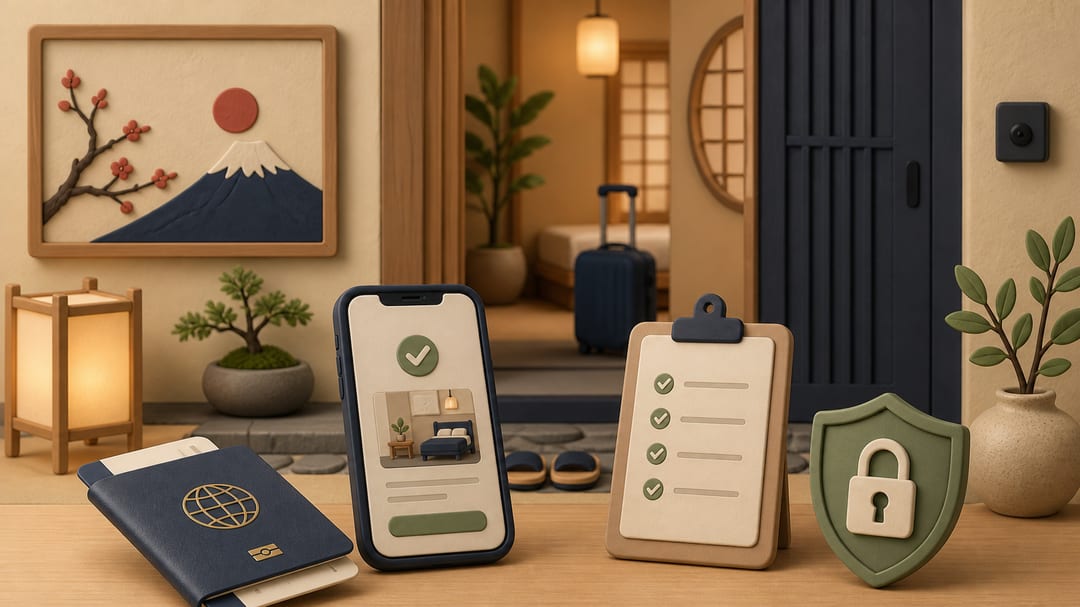
A request for passport information may be a normal lodging-registration step in Japan. The safer question is not simply whether the request feels unusual—it is whether the property can explain the legal purpose, use a verified channel and limit the request to information it actually needs.
Quick answer: Japan requires lodging operators to keep guest records. For foreign guests who do not have an address in Japan, official guidance says operators record information such as the guest’s name, address and contact details, plus nationality and passport number. A passport request can therefore be legitimate. But you should still verify the message through your reservation, avoid sending sensitive information to an unverified personal account, and never provide passwords, one-time codes, card details or an off-confirmation payment.
This article focuses on travelers staying in Japan, especially visitors using an online reservation platform to book a hotel, apartment-style property or private lodging. Rules and data practices can differ by accommodation type, local implementation and booking channel. This is general travel-safety information, not legal advice.
Editorial note: This article uses an anonymized and generalized travel scenario. Names, usernames, exact comments, vote counts and identifying details have not been reproduced.
The situation: a strange request that later makes more sense
Imagine first-time visitors to Japan book an apartment-style accommodation at a price well below nearby business hotels. A few days later, the host sends a message asking for names, a home address and occupation. The travelers wonder why the host needs information that does not appear on their passports and worry that the reservation may not be real.
Later, the message turns out to have been misunderstood. The name-address-occupation section was intended for Japanese citizens, while the request for international visitors was for passport copies. That distinction changes the analysis significantly.
The lesson is not that travelers should ignore privacy concerns. It is that three different questions need to be separated:
- Is the request consistent with Japan’s lodging-registration rules?
- Is the message genuinely connected to the accommodation and the reservation?
- Is the requested data being collected and transmitted in a reasonably secure way?
A “yes” to the first question does not automatically answer the other two.
Why a Japan accommodation may ask for passport information
Japan’s Ministry of Health, Labour and Welfare explains that lodging facilities must keep a register of guests. For foreign nationals who do not have an address in Japan, the record includes nationality and passport number in addition to name, address and contact information.
The Japan Tourism Agency’s private-lodging guidance similarly says operators must create and maintain a Lodgers’ Registry Book and record nationality and passport number when the guest does not have a fixed address in Japan. The agency’s identity-confirmation material also explains that an operator can ask a foreign guest without a Japanese address to present a passport and explain that the request is based on national regulations.
This is why a hotel or private-lodging operator may ask an international visitor to complete a guest form or provide a passport image. It can be a compliance step rather than a sign that the reservation is fake.
The electronic registry guidance lists fields such as guest name, address, occupation, nationality and passport number. That helps explain why a form may contain questions that feel broader than a typical booking profile. It does not mean a traveler should send every piece of personal information through any channel without asking what is required and how it will be handled.
A legitimate request still needs to be verified
A real legal requirement can be imitated by a scammer. A message may contain the correct dates, property name and reservation price and still direct a traveler to a fraudulent email address, website or payment account.
Before responding, compare the message with:
- the property name, address and reservation number in your confirmation;
- the guest-registration or identity-verification instructions shown in the booking account;
- the property’s official contact details and check-in instructions;
- the platform’s own help or safety guidance;
- the payment policy and cancellation terms shown at the time of booking.
If the request is not visible in the reservation record, ask the property to restate it in the platform’s official message thread. If you still cannot reconcile the request, contact customer service through the booking site or app—not through a phone number or link supplied only in the suspicious message.
Booking.com’s official safety guidance tells travelers to use official communication channels, watch for requests for personal or financial information, and check the booking confirmation before clicking links or changing payment arrangements. It also says that customer-service representatives should not ask for an account password or sensitive financial information such as a card number.
What information might be reasonable?
The exact request depends on the property and the guest’s status, but the following categories are different from one another:
Identity and lodging-record information
Name, address, contact details, nationality and passport number may be connected to guest-registration requirements. For a foreign visitor without a Japanese address, nationality and passport number are specifically identified in official guidance.
Check-in and safety information
Arrival time, the number of guests, emergency contact details, accessibility needs or an expected departure time may be relevant to operating the property. The property should still explain why it needs the information and whether it is mandatory.
Information that deserves extra scrutiny
Occupation, social-media profiles, unrelated family details, copies of multiple identity documents or personal photographs may require more explanation. Some forms may lawfully include occupation or other fields, but a traveler should ask which fields apply to them and whether the request comes from the accommodation’s verified registration process.
Information that should never be casually shared
Do not send an account password, one-time verification code, full card details, banking login, security answers or remote-access credentials. A legitimate lodging-registration request does not turn into permission for someone to take over your booking account or payment method.
How to share a passport copy more safely
If the request is verified and the law or property process requires a passport copy, use the narrowest reasonable route:
- Use the official upload or messaging flow if one is available. Avoid switching to a personal email address, private chat account or file-sharing link unless the platform or property independently confirms that channel.
- Ask what will be recorded. Confirm whether the property needs the full copy, which fields it must retain, who can access it and how long it will be stored.
- Do not alter required information. Never obscure or edit fields the operator is legally required to inspect. If the recipient permits it, a visible purpose-and-date watermark can help prevent reuse, but it should not cover the required identity information or machine-readable area.
- Keep a record of what you sent. Save the request, the property’s explanation and the date of transmission. Do not keep unnecessary copies in multiple unsecured places.
- Ask for confirmation. Request a short acknowledgment that the document was received for guest registration and that no additional payment or account action is needed.
These steps cannot guarantee that a recipient will handle personal information perfectly. They do create a clearer record and reduce the chance that a traveler sends a sensitive document to the wrong person.
Red flags that are different from an ordinary identity check
One unusual question is not enough to prove fraud. Look at the entire pattern instead.
Payment pressure
Be cautious if the message says the reservation will be canceled unless you transfer money immediately, buy gift cards, send cryptocurrency or pay a bank account that does not match the confirmation. Booking.com warns travelers about urgent payment requests and payment changes outside the confirmed policy.
A demand to leave the official channel
A property may have a legitimate reason to contact a guest by email, but a demand to move the entire conversation to an unverified channel removes useful protections and makes it harder to confirm who is speaking. Ask the property to keep the request in the reservation thread or have customer service validate it.
Requests for secrets instead of identity details
Passwords, one-time codes, card security codes and banking credentials are not guest-registration information. Stop and report the message if someone asks for them.
Links, attachments or login pages you did not expect
Do not click first and investigate later. Open the official booking app or type the known website address yourself, then check the reservation and contact support from there.
No explanation of the property’s identity
If the sender cannot clearly identify the accommodation, reservation number, legal operating name or check-in process, ask for clarification before sending a passport copy. A legitimate operator should be able to explain what the request is for.
Is an unusually low price proof that the accommodation is unsafe?
No. A lower price may reflect location, season, room size, age of the building, limited services, a washing machine instead of hotel amenities or a new property trying to attract reviews.
Price is still a useful reason to verify the basics. Check the total cost, taxes, cancellation policy, recent reviews, address, room type, check-in method and whether the property’s description matches the photos. Look for inconsistencies rather than treating the discount alone as proof of a scam.
What to do if the host’s request remains unclear
Use a calm, specific reply instead of sending data impulsively or accusing the host. For example:
Hello. We understand that Japan may require lodging guest registration. Please confirm which information is required for foreign guests, the legal or operational purpose, and the secure method for submitting it. We will provide the information through the reservation platform or another channel confirmed by customer service. Please also confirm that our reservation remains active and that no payment change is required.
This message does four useful things: it acknowledges that the request may be legitimate, asks for the minimum necessary explanation, preserves the conversation and seeks confirmation that the booking still exists.
If the host refuses to explain, sends repeated urgent payment demands or asks for account credentials, contact the booking platform before canceling. Save the reservation, messages and screenshots. If the platform cannot confirm the property or the reservation, arrange a backup lodging option if the trip is time-sensitive and review your cancellation or payment rights.
A simple decision framework
| Question | If the answer is yes | If the answer is no |
|---|---|---|
| Does the request match Japan lodging-registration information? | Ask how to submit it securely | Request an explanation before sharing |
| Is the message visible in the official reservation account? | Continue verification there | Contact the platform independently |
| Does the property explain purpose and retention? | Share only what is necessary | Ask for the property’s privacy and retention process |
| Does the payment request match the confirmation? | Follow the confirmed policy | Do not transfer funds; escalate |
| Is the request for a password, code or card secret? | Stop | Never provide it |
| Can you verify the property’s address and booking? | Keep the reservation record | Treat it as a serious warning sign |
Frequently asked questions
Do foreign visitors to Japan have to show a passport at a hotel or private lodging?
Official guidance says lodging operators must record nationality and passport number for foreign guests who do not have an address in Japan. A specific property’s process can vary, so verify the request through the reservation and the property’s official channel.
Is it normal for a lodging form to ask for an address or occupation?
It can be part of a guest registry or local operating form, but the question should be interpreted in context. Ask which fields apply to foreign guests and why they are required. Do not assume that every extra question is mandatory simply because it appears in a form.
Should I email a passport copy to the host?
Only after verifying the host, the property and the requested channel. Prefer an official upload or reservation message flow. If the request comes from an unverified personal account, ask the booking platform to confirm it first.
Can I refuse to provide the information?
You can ask questions and request a secure process. But if the information is required by applicable lodging rules, refusing may mean the accommodation cannot complete check-in. The practical choice is to verify the request and understand the consequence before arrival rather than waiting at the property.
What if the accommodation threatens to cancel unless I pay again?
Do not follow an urgent payment instruction that conflicts with your confirmation. Contact the booking platform through its official app or website, preserve the message and ask whether the reservation is active.
How can I know whether the booking will still be honored?
Check the reservation directly in your account, confirm the property’s address and check-in instructions, and ask official customer service to verify the status. If the property cannot be confirmed, make a backup plan before travel.
Official sources and further reading
- Japan Ministry of Health, Labour and Welfare: information for foreign guests at lodging facilities
- Japan Tourism Agency: private lodging obligations and guest registry
- Japan Tourism Agency: identity confirmation of guests
- Japan Tourism Agency: electronic lodger registry fields
- Japan Tourism Agency: overview of the Private Lodging Business Act
- Booking.com: Safety Tips for Travelers
- Booking.com: customer service and booking management
Final note
A passport request from a Japan accommodation may be completely ordinary, especially for an international traveler without a Japanese address. Privacy caution is still appropriate. Confirm the legal purpose, use a verified channel, share only what is necessary, keep payment inside the confirmed policy and contact official support before acting on an unclear message.
If you need to organize a reservation, host messages, screenshots and a dated travel-safety timeline before contacting support, 19pine’s organizing tool can help. It does not verify a property, guarantee a reservation or replace official customer service or professional advice.
This article provides general travel information and is not legal, immigration, cybersecurity or financial advice. Requirements can vary by accommodation type and current Japanese rules. For an active dispute or suspected fraud, contact the booking platform and relevant local authorities promptly.