Canada’s federal government has moved from a housing campaign proposal to funded programs, a legislated delivery body, and projects at different stages. But the honest test is not a headline. It is whether we keep the promise, the construction data, and each project’s delivery stage separate.
Quick answer: The stated federal goal was to double Canada’s pace of homebuilding to almost 500,000 new homes a year over the next decade—not to complete 500,000 homes in the first year or two million in four years. As of August 31, 2026, the latest national CMHC housing-starts trend was 247,377 at a seasonally adjusted annual rate, well below that long-run pace. That is an important interim signal, but it is a measure of construction starts—not finished homes—and it cannot by itself prove that federal policy has succeeded, failed, or caused the national result.
Editorial note: This article uses an anonymized summary of user-provided material. It is a non-partisan policy explainer based on official sources, not political, legal, financial, or investment advice.
Start with the promise that was actually made
Housing debates often become confusing before the first statistic appears. One person hears “almost 500,000 homes a year” and treats it as a one-year guarantee. Another points to a project announcement and treats it as a finished home.
Neither shortcut is a useful scorecard.
The relevant federal wording is to double the pace of homebuilding to almost 500,000 new homes a year over the next decade. The 2025 platform described a plan to create Build Canada Homes, use federal land and financing, and work with provinces, territories, and municipalities. An August 2025 federal news release used the same ten-year, almost-500,000 annual-pace framing.
That makes two claims inaccurate:
- “The government promised 500,000 homes in its first year.”
- “The government promised two million homes in its first four years.”
The target is still ambitious, and it should be tested rigorously. But it should be tested against its actual timeframe and measure.
The four labels every housing claim needs
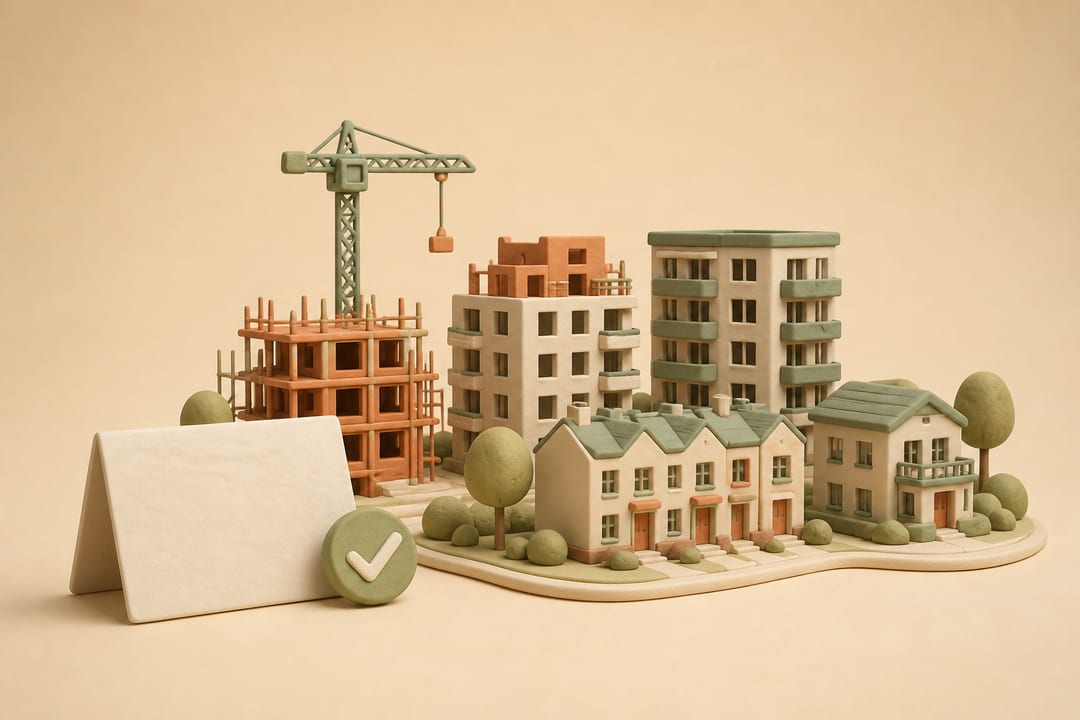
Before asking whether a program is working, identify where each claimed home sits in the delivery chain.
| Label | What it means | What it does not prove |
|---|---|---|
| Announced or planned | A policy, site, project, or funding envelope has been made public | That financing is final, construction has begun, or people can move in |
| Committed or approved | Funding, land access, or an agreement has advanced, sometimes with conditions | That the units are complete |
| Started or under construction | Physical work has begun, or a project is in the building pipeline | That the homes are ready to occupy |
| Completed or delivered | Construction has finished; an official source may also report occupancy separately | That one level of government alone caused the outcome |
CMHC normally counts a start when construction begins on a building, commonly when concrete is poured for the footing. A completion is when the proposed construction work has been performed, subject to limited exceptions. These are different measures, and a fair article or political claim should use the right word.
What the latest official numbers say—and what they do not say
The latest national release available at this article’s review date was CMHC’s July 2026 report, published August 18, 2026. It provides several useful but distinct snapshots.
| Official indicator | Latest figure | Careful interpretation |
|---|---|---|
| Six-month national housing-starts trend | 247,377 units (July 2026) | A six-month moving average expressed at a seasonally adjusted annual rate (SAAR), not a count of completed homes |
| National monthly housing-starts SAAR | 229,074 units (July 2026) | An annualized view of one month’s seasonally adjusted starts; not a full-year forecast or completion total |
| Actual year-to-date starts in centres of 10,000+ people | 131,851 units through July 2026 | Down 4% from the same period in 2025; it excludes smaller areas and is not a completion series |
| Homes under construction in centres of 50,000+ people | 373,091 units (July 2026) | A pipeline measure that may support later completions, not homes delivered now |
| Completions in centres of 50,000+ people | 19,773 units (July 2026) | One month of completions, not a national annual total |
The first number is the clearest near-term comparison with the long-run goal: the 247,377 starts trend is roughly half of an almost-500,000 annual pace. That is a meaningful gap. It is not, however, correct to relabel 247,377 as “homes built,” to treat it as the eventual annual completion count, or to use one monthly-release snapshot as a final verdict on a ten-year objective.
For context, CMHC reported 259,028 starts across all areas of Canada in 2025, up 5.6% from 2024 and the fifth-highest annual total on record. That historical figure also describes starts, not completions. It tells readers the country’s recent construction pace; it does not say how many homes were finished or who caused the change.
What has the federal government actually put in place?
The record supports saying that the federal delivery machinery is no longer only a campaign proposal.
Build Canada Homes launched in September 2025. The Build Canada Homes Act received Royal Assent in June 2026, establishing the framework for a federal Crown corporation. Budget 2025 set out an initial $13 billion over five years on a cash basis, alongside early land, rental-protection, supportive-housing, and partnership streams.
There is also evidence of project-level progress, but it needs its own label. In August 2026, Build Canada Homes reported a groundbreaking for a 74-unit Toronto rental project, including 17 affordable homes. A groundbreaking is real progress: it is evidence that construction has started. It is not evidence that 74 homes have already been delivered.
This distinction is especially important when a public dashboard combines terms such as “created or committed,” “planned,” “under construction,” and “built.” Those totals can be useful, but only if the category is repeated exactly. A broad program total is not automatically a Build Canada Homes total, a national starts total, or a count of occupied homes.
Why Ottawa cannot be the only line on the scorecard
The federal government can affect the conditions for more housing. Its tools include federal land, grants and cost-sharing, tax measures, mortgage and financing policy, infrastructure funding, immigration planning, national model codes, and housing data.
But it does not issue most building permits or set most local zoning rules. Provinces and territories govern areas such as building-code adoption and planning frameworks; municipalities generally carry out zoning, permitting, development approvals, charges, and local bylaws under provincial authority.
That does not make federal action irrelevant. It means a credible answer has to separate two questions:
- Is the federal government using its own levers effectively and transparently?
- Is national construction output moving toward the long-run pace, while taking account of provincial rules, local approvals, interest rates, labour, materials, and project timing?
An all-or-nothing claim about one government level will usually miss that shared reality.
A practical way to track the promise year by year
Rather than waiting a decade for a binary verdict, readers can use a small, repeatable scorecard.
- Restate the target and its horizon. Keep “almost 500,000 new homes a year over the next decade” intact. Do not substitute an immediate deadline.
- Track national starts and completions separately. Record the CMHC release date, the geography, whether a figure is actual or SAAR, and the period covered.
- Track the pipeline. Homes under construction can matter for future deliveries, but they remain a pipeline measure.
- Label federal projects by stage. Announced, funded, approved, started, completed, and occupied are not interchangeable.
- Look at affordability and tenure. More units alone do not reveal whether the homes are rental or ownership, market or below-market, in the places people need, or within reach of the intended households.
- Check the other delivery partners. Note relevant provincial, territorial, municipal, Indigenous, non-profit, and private-sector actions rather than assigning every national movement to Ottawa.
- Watch for comparable reporting. The most useful federal update would make its funding, land, project-stage, start, completion, affordability, and timing data easy to compare from one period to the next.
This method allows for two facts at once: implementation can be genuine, and the output benchmark can remain unmet.
The most accurate answer right now
As of the latest official data available for this article, Canada’s federal government has launched and legislated a housing-delivery institution, committed funding, and moved some projects into active stages. That is evidence of implementation.
At the same time, the latest national starts trend remains well below the stated long-run almost-500,000 annual pace. That is evidence that the output test has not yet been met at the current reported pace.
Neither point warrants a shortcut. A project announcement is not a completed home; a start is not a completion; a one-year snapshot is not a ten-year verdict; and national construction cannot be cleanly attributed to one order of government. The useful public question is whether each update makes the ramp-up visible—using consistent, stage-specific data that anyone can inspect.
Where Pine Fits
Open Pine to organise policy announcements, official data releases, project-stage updates, and open questions in a dated evidence log. Pine can help turn a pile of links and figures into a source-backed timeline and comparison; it does not provide political, legal, financial, or investment advice.
Frequently Asked Questions
Did the federal government promise 500,000 homes in the first year?
Not in the official wording reviewed for this article. The stated goal was to reach an almost-500,000-home annual pace over the next decade. That makes it a long-horizon rate objective, not a first-year completion commitment.
Does the July 2026 CMHC starts trend mean 247,377 homes were built?
No. It is a six-month trend expressed at a seasonally adjusted annual rate for housing starts. It is not an actual count of completed homes in the year.
Is 2025’s 259,028 figure a completion total?
No. CMHC reported 259,028 starts across all areas of Canada in 2025. Use it as a construction-pace reference, not as a count of homes delivered to residents.
Does a federal program create homes by itself?
Federal policy can finance, incentivize, coordinate, supply land, and attach housing conditions to agreements. Most zoning, permitting, and local development approvals sit outside direct federal control, so national results reflect multiple governments and market conditions.
What would count as better evidence that the plan is on track?
Look for consistent, dated reporting on national starts, completions, homes under construction, federal project stages, affordability and tenure, and the timing of funding and land transfers. The stronger the distinction between these categories, the more useful the evidence.
Official Sources
- Liberal Party of Canada: Canada Strong (2025 platform, pp. 40–42)
- Prime Minister of Canada: homebuilding commitment in August 5, 2025 announcement
- CMHC: Housing starts and construction data for July 2026
- CMHC: Housing starts in December 2025
- CMHC: Starts, Completions and Market Absorption Survey methodology
- Government of Canada: Build Canada Homes launch
- Government of Canada: Royal Assent of the Build Canada Homes Act
- Budget 2025: Build Canada Homes funding and early streams
- Government of Canada: Canada’s Housing Plan and responsibilities by government
- Housing, Infrastructure and Communities Canada: infrastructure regulatory roadmap
This article provides general information and is not political, legal, financial, investment, or real-estate advice. Housing data and program status change over time; check the linked official sources for later releases and the facts applicable to a specific decision.