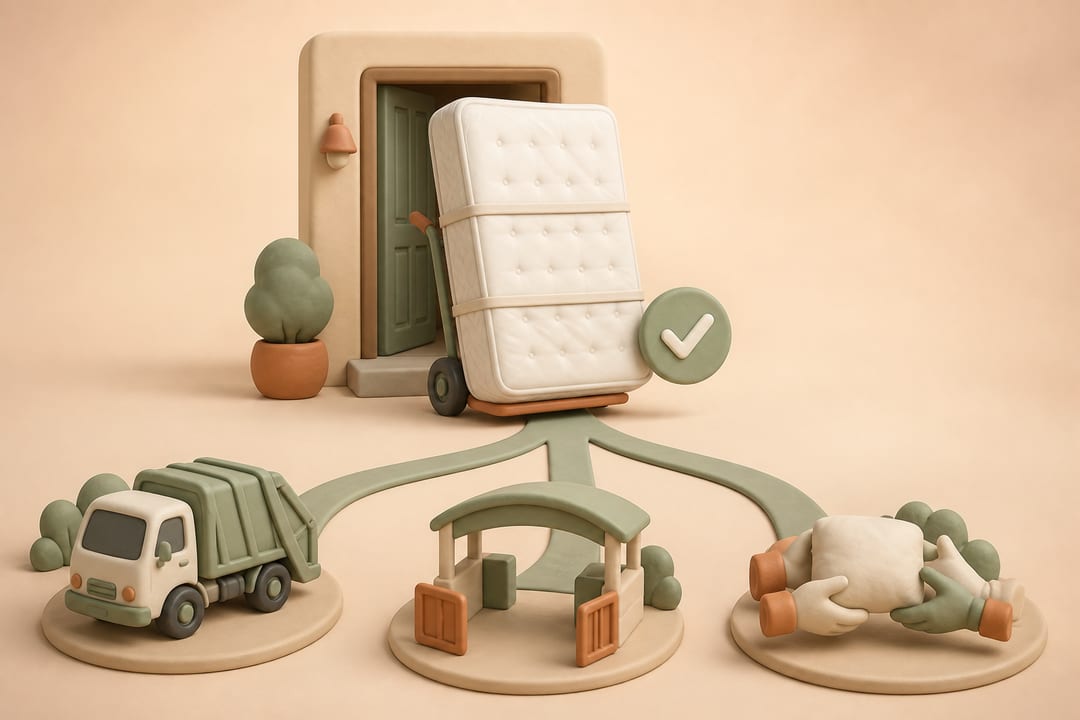
A queen mattress does not belong in a normal apartment dumpster, but the right alternative depends on who collects your building's trash.
Quick answer: If you live in a Washington, DC apartment building with four or more units, a condominium, a co-op or a mixed-use property, DC's appointment-based 311 bulk collection generally is not your service. Ask management for the building's bulk-waste procedure or hire a private licensed solid-waste collector. A DC resident may also be able to take an acceptable mattress to the Fort Totten Transfer Station using an approved vehicle and the required proof of residency. If you live in a single-family home or a building with no more than three units that already receives DPW trash service, schedule a bulk appointment through 311 before setting the mattress out. Never leave it at an alley, bridge, curb, unauthorized dumpster or someone else's property.
Editorial note: This article uses an anonymized summary of user-provided community material. We did not inspect the apartment, lease, mattress, building rules or any proposed hauler. This is general operational information, not legal advice. Building requirements and District facilities can change; confirm them before moving the item.
Last verified: August 10, 2026.
The Question Is Not Just “Where Can I Dump It?”
A renter near ZIP code 20005 needed to remove a queen mattress before moving out. The apartment would not allow the mattress in its normal trash area. Community replies proposed several options: schedule city pickup, list it for free, donate it, hire a Chinese-speaking mover, rent a truck, leave it for a person experiencing homelessness or take it to an isolated area.
Some of those suggestions can work only after verification. Others create an illegal-dumping, safety or move-out-charge risk.
The first question is simpler:
Who collects your building's ordinary trash—DC Department of Public Works or a private hauler?
That answer determines the disposal route.
Choose the Correct Route
| Your situation | Best starting route | What not to assume |
|---|---|---|
| Single-family home or residential building with no more than three units that receives DPW trash service | Schedule a bulk appointment through 311 | Do not put the mattress out before the appointment window |
| Apartment building with four or more units, condo, co-op or mixed-use property | Get the building's written procedure or use a private licensed hauler | A resident usually cannot substitute the city's household 311 service |
| DC resident with a suitable vehicle | Check resident drop-off at Fort Totten | Not every rental truck or van is admitted |
| Clean, dry, usable mattress with enough time before move-out | Confirm reuse or recipient pickup | A marketplace promise is not a completed removal |
| Infested, wet, stained or damaged mattress | Disposal—not donation—under building and public-health instructions | Do not transfer a pest or sanitation problem to another household |
DC DPW says its regular trash and bulk services cover single-family homes and residential buildings with three or fewer living units. Buildings with four or more units, mixed-use properties and other listed properties must arrange private collection. The District's multi-family guidance likewise tells building managers to create a bulk-waste system because residents of larger buildings cannot use the household 311 appointment program. DC DPW: Bulk Trash Collection · DC DPW: Trash Collections · Zero Waste DC: Multi-Family Zero Waste Guide
The ZIP code alone does not decide eligibility. A rowhouse split into three units and a high-rise on the same block can have different collection systems.
Route 1: Use 311 Only if the Address Receives DPW Trash Service
For an eligible household, DC collects bulky items by appointment. Mattresses, box springs, bed frames and household furniture are on DPW's accepted list.
The basic process is:
- Submit a bulk-trash request through DC 311 or call 311.
- Wait for a confirmed appointment before moving the item to the collection point.
- Wrap a mattress or box spring completely in plastic for curbside bulk collection.
- Put it where the property's normal trash and recycling are collected between 6:30 p.m. the night before and 6:00 a.m. on the appointment day.
- Keep the service-request number and photograph the wrapped item at the approved location.
DPW limits a bulk appointment to no more than seven items and warns that items left in public space outside the appointment can lead to a sanitation ticket. DC DPW: Bulk Trash Collection · Zero Waste DC: Mattresses
Do not schedule first and ask the building later. Even an eligible service request does not automatically authorize blocking a loading dock, hallway, fire exit or an area controlled by the property.
Route 2: In a Larger Apartment, Start With Management
For a typical multi-unit apartment near downtown DC, this is the most likely route.
Send the property manager a short written request:
I need to remove one queen mattress before my move-out date. Please confirm whether the building has a bulk-pickup day or approved hauler, the authorized staging location and time, whether the mattress must be bagged, whether I need to reserve the freight elevator or loading dock, and every fee or insurance requirement that applies.
Ask management to identify:
- the building's next scheduled bulk collection;
- whether the mattress must be wrapped or placed in a designated room;
- freight-elevator and loading-dock hours;
- whether the mover needs a certificate of insurance;
- whether residents may use any licensed hauler or only an approved vendor;
- the building's charge if staff arranges removal; and
- what proof closes the move-out task.
Do not treat “the dumpster is full” or “other people leave furniture there” as authorization. Get the exact location and time in writing.
If you hire a private hauler
Ask for a written, all-in quote that identifies:
- one queen mattress and any bed frame or box spring;
- floor, stairs, elevator and carrying distance;
- loading, transportation and disposal fees;
- mattress-bag or wrapping cost;
- same-day or urgent surcharge;
- certificate-of-insurance cost, if the building requires one; and
- a receipt showing the item was removed.
DC requires solid-waste collectors operating in the District to be registered and licensed. Check the business through the District's license-verification system and, when useful, compare it with DPW's current approved solid-waste-collector list. A social-media account, phone number, payment screenshot or claim that someone “does cleanouts” is not equivalent to an active license. DLCP: Solid Waste Collector · DLCP: Verify an Existing Business License · DPW: Solid Waste Collector Registration and Reporting
Pay in a traceable way and keep the final receipt. The cheapest pickup is not a bargain if the mattress is later abandoned and traced back to the building.
Route 3: A DC Resident Can Check Fort Totten Drop-Off
DPW's current Fort Totten page says District residents may take acceptable bulk items, including household furniture, mattresses, box springs and bed frames, to:
Fort Totten Transfer Station
4900 John McCormack Road NE
Washington, DC 20011
As of the last verification date, resident solid-waste drop-off hours are:
- Tuesday through Friday: 10:00 a.m.–2:00 p.m.
- Saturday: 7:00 a.m.–2:00 p.m.
- Monday, Sunday and District holidays: closed
Bring a DC driver's license. If your photo ID is from another state, DPW says to bring a current utility bill issued within 30 days or a lease/deed, with matching names. The material must originate in DC. Check the current Fort Totten page before leaving because hours, closures and accepted materials can change.
Check the vehicle before renting it
Fort Totten's current rules allow passenger cars, pickups, SUVs, passenger vans with rear seats and certain rental vehicles under 15 feet. They exclude commercial vehicles or tags, trailers, cargo vans, trucks longer than 15 feet and box trucks or decommissioned rental trucks.
That makes the comment “just rent a U-Haul” incomplete. The brand is not the test; the exact vehicle configuration and length are. Confirm the vehicle against the current facility rules before paying for it.
Should the mattress be wrapped for Fort Totten?
DC's official pages currently conflict. The general bulk page says mattresses must be wrapped, while the Fort Totten-specific page says mattresses and box springs brought to the station do not have to be wrapped. Curbside 311 collection clearly requires wrapping.
For self-drop, check the Fort Totten page or contact DPW on the day of the trip. Using a sealed mattress bag is a low-cost precaution that keeps the item contained during the trip, but it does not override facility instructions. DC DPW: Fort Totten Transfer Station · DC DPW: Bulk Trash Collection
Reuse Can Work—but Only With a Confirmed Recipient
If the mattress is clean, dry, pest-free, structurally sound and legal to transfer, reuse may be faster and less wasteful than disposal. DC's Reuse program suggests neighborhood groups and third-party exchange services such as Buy Nothing and Freecycle, while emphasizing that the District does not endorse a particular platform. Reuse DC: Exchange With Neighbors
A useful listing includes:
- exact size and approximate age;
- honest condition, stains, odors, sagging and pet or smoke exposure;
- whether the bed frame or box spring is included;
- building pickup hours and elevator rules;
- “pickup only” and a firm deadline; and
- the number of people and vehicle likely needed.
Protect your home and timeline:
- do not hold the item for someone who has not confirmed a time;
- do not disclose building access instructions publicly;
- meet in a staffed lobby or have another adult present;
- do not let a stranger wander through the apartment;
- photograph the completed pickup; and
- keep a disposal backup until the mattress is physically gone.
Do not assume a school, church, shelter or charity accepts used mattresses or offers free pickup. Ask the organization directly and confirm the exact item, condition and pickup date. Reuse DC provides a directory and says some—but not all—listed organizations offer pickup. Reuse DC Directory and Pickup Guidance
If Bed Bugs May Be Involved, Stop the Giveaway
Do not donate, sell or casually give away a mattress that may spread bed bugs. Notify the property manager and follow the building's pest-control instructions before moving it through common areas.
DC Health says a mattress does not automatically need to be discarded merely because it was in a room with bed bugs; condition and a professional control plan matter. If an infested mattress is discarded, DC Health's guidance says to slash or damage it so another person cannot reuse it. Coordinate containment and removal so insects are not spread through the building. DC Health: Control Bed Bugs
This is one reason “leave it for someone who needs it” is not a safe disposal policy. A discarded mattress can contain pests, moisture, mold or damage that a passerby cannot see.
Five Community Suggestions to Reject or Verify
| Suggestion | Better rule |
|---|---|
| “Leave it under a bridge or in an isolated area.” | Do not. Leaving waste on public or private property without authorization can be illegal dumping. |
| “Put it beside any large dumpster.” | Use only a location your building or hauler authorizes in writing. |
| “The city picks up every mattress for free.” | Only eligible DPW-served households can use appointment-based 311 bulk collection. |
| “Rent any U-Haul and take it to Fort Totten.” | Verify the exact vehicle; cargo vans, box trucks, trailers and vehicles over the limit may be rejected. |
| “Donate it and someone will pick it up.” | Confirm that the recipient accepts used mattresses, accepts its condition and will pick up before your deadline. |
DC law expressly includes mattresses within its definition of solid waste and prohibits dumping at unauthorized public or private locations. DC's waste-enforcement program investigates sanitation violations and illegal dumping. If you see dumping in progress or discover abandoned waste, report it through 311 rather than moving your own item to the same pile. D.C. Code § 8-901 · D.C. Code § 8-902 · DC DPW: Solid Waste Education and Enforcement Program
A Seven-Day Move-Out Plan
Seven days before move-out
- Photograph the mattress and room condition.
- Read the lease, move-out instructions and building handbook.
- Ask management for the approved bulk-removal route in writing.
- Identify whether normal trash is collected by DPW or a private company.
Five to six days before move-out
- If the mattress is genuinely reusable, post it with an honest condition report and a firm pickup deadline.
- If 311-eligible, request an appointment.
- If using a hauler, compare written all-in quotes and verify licensing.
- If self-dropping, confirm Fort Totten hours, ID and vehicle eligibility.
Two to four days before move-out
- Reserve the freight elevator or loading dock.
- Buy the required mattress bag or wrapping.
- Confirm the recipient, hauler or facility plan.
- Activate the backup route if a free-pickup recipient becomes unreliable.
Removal day
- Follow the building's route and staging instructions.
- Photograph the mattress leaving and the empty room.
- Photograph the approved collection point only if the item is being left there lawfully.
- Keep the 311 confirmation, transfer receipt, hauler invoice or recipient message.
Before returning keys
- Check the bedroom, hallway, loading area and trash room for debris.
- Ask management to confirm that no bulk item remains under your account.
- Save all proof with the move-out inspection photos and deposit records.
Why Proof Matters for the Security Deposit
A landlord may distinguish ordinary deterioration from a tenant's failure to remove personal property or waste. DC law says a housing provider cannot withhold a deposit for replacement value caused by ordinary wear and tear, but that does not make abandoned furniture ordinary wear. The cost, responsibility and required accounting depend on the lease, facts and applicable deposit rules. D.C. Code § 42-3502.17
Your evidence file should contain:
- the building's written disposal instruction;
- 311 service-request confirmation, if applicable;
- hauler license check, quote and paid receipt;
- recipient pickup confirmation, if reused;
- elevator or loading-dock reservation;
- time-stamped removal photos;
- empty-room and common-area photos; and
- the move-out inspection record.
If management later charges for removal, ask for the lease provision, photos, date, itemized amount and invoice or work record. Do not rely only on “I definitely took it out”; make the completed handoff visible.
What to Do if You Must Leave Tomorrow
Do not spend the final day waiting for marketplace messages.
- Ask management for its paid removal option or approved vendor immediately.
- Call licensed haulers and request a written same-day total, including building requirements.
- If you can transport it, check Fort Totten's current schedule, proof-of-residency rules and vehicle restrictions.
- Wrap the mattress if required and protect walls, elevators and flooring during removal.
- Save the receipt and photos before returning keys.
An urgent paid removal is usually easier to document than an unauthorized curbside shortcut that creates a building fee or illegal-dumping problem.
Frequently Asked Questions
Does Washington, DC pick up mattresses for free?
DC offers appointment-based bulk collection to residential households that already receive DPW trash service—generally single-family homes and buildings with no more than three units. Larger apartment buildings, condos, co-ops and commercial properties must use their building or a private licensed hauler.
Can I schedule 311 if I rent in a high-rise?
Usually not for the high-rise's bulk waste. Ask management who provides the building's regular trash collection and what bulk process that contract includes.
Does a mattress have to be wrapped?
Yes for DC's curbside bulk collection. Fort Totten's specific current page says wrapping is not required for resident drop-off, while another DPW bulk page says mattresses must be wrapped. Check the facility's current instruction before traveling; a sealed mattress bag is a practical precaution.
Can I leave the mattress next to my apartment dumpster?
Only if the building gives you that exact instruction. Otherwise it may be treated as unauthorized dumping or abandoned property, and the building may charge for removal.
Can I take a mattress to Fort Totten in a rental vehicle?
Potentially, but not every rental vehicle is accepted. Current rules allow certain rental vehicles under 15 feet and reject cargo vans, box trucks, trailers and other listed vehicle types. Verify the exact vehicle before booking it.
Can I sell or give away a used mattress?
Possibly, if it is clean, dry, pest-free and the recipient knowingly accepts it. Complete the handoff before your deadline and retain a disposal backup.
What if the mattress has bed bugs?
Do not transfer it to another household. Notify management, follow professional pest-control and containment instructions, and use an authorized disposal route.
How much should private removal cost?
There is no reliable universal price. Size, stairs, elevator access, parking, urgency, disposal fees, wrapping and insurance requirements can all change the quote. Compare the same written scope—not just the headline number.
Turn a Bulky-Item Problem Into a Documented Move-Out Task
Pine can help renters organize the building instructions, appointment records, hauler quote, receipt and move-out photos into one evidence file. If a disposal fee later appears on your ledger or security-deposit accounting, you will have a clear timeline for reviewing or disputing it.
Organize Your Move-Out Evidence With Pine
Official Sources
- DC DPW: Bulk Trash Collection
- DC DPW: Trash Collections
- DC DPW: Fort Totten Transfer Station
- Zero Waste DC: Special Waste—Mattresses
- Zero Waste DC: Multi-Family Zero Waste Guide
- Reuse DC
- DLCP: Solid Waste Collector Licensing
- DPW: Approved Solid Waste Collectors
- D.C. Code §§ 8-901 and 8-902: Solid Waste and Illegal Dumping
- DC Health: Control Bed Bugs
- D.C. Code § 42-3502.17: Security Deposits
This article provides general information, not legal advice. Confirm current facility hours, eligibility, accepted items, vehicle rules, building procedures and private-hauler licensing before moving a mattress or other bulky item.