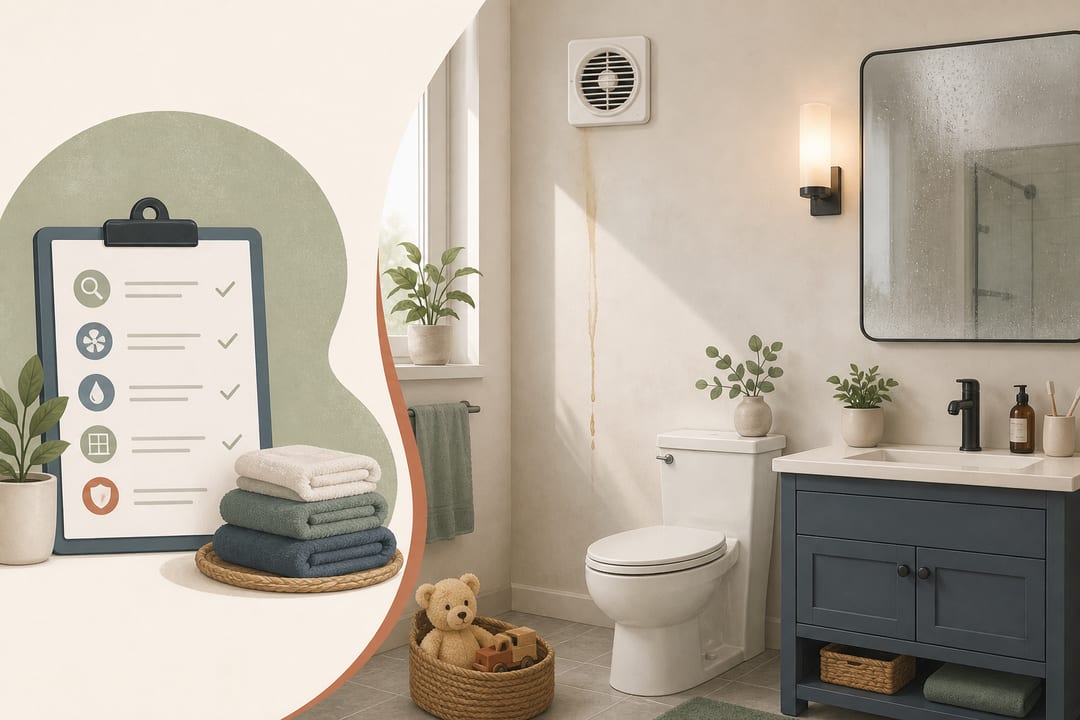
You move into a rental from another state, arrive after a long drive with very young children, and discover that the home was not properly cleaned. Then, after a shower, the bathroom walls appear to “weep” brown or sticky liquid.
That is more than a cosmetic annoyance. It raises three separate questions:
- What is the residue?
- Does the bathroom have a moisture, ventilation or contamination problem?
- What should a renter do before cleaning, repainting or letting children touch the surface?
The color alone cannot answer those questions. Brown or clear streaks can result from paint ingredients being drawn to the surface by moisture, condensation carrying dirt and body oils, old tobacco residue, mold or a plumbing/building problem. A photograph and a short description are not enough to diagnose the material safely.
Quick answer
If the residue appears mainly after a hot shower and is glossy, soapy, oily or sticky, one possible explanation is surfactant leaching from latex paint. Sherwin-Williams describes this as water-soluble paint ingredients collecting on the surface when moisture contacts paint that has not fully cured. It can look tan, brown or clear and may recur before the material is fully removed.
That possibility does not prove the wall is harmless. The same bathroom conditions can reveal condensation, poor exhaust ventilation, a hidden leak, mold growth or old tobacco contamination. If the home was previously smoked in, surface residue may matter even when the current occupants do not smell smoke. Infants and toddlers are more vulnerable to household hazards because they crawl, touch surfaces and put their hands or objects in their mouths.
For now:
- keep children away from the affected wall and prevent hand-to-mouth contact;
- photograph and document the residue before scrubbing or repainting;
- run the bathroom exhaust fan during and after showers, and confirm that it vents outdoors if possible;
- notify the landlord or property manager in writing and request an inspection of the paint, ventilation and moisture conditions;
- do not assume the material is nicotine, mold, methamphetamine residue or “just dirt” based only on its appearance; and
- seek medical advice promptly if a child develops wheezing, breathing difficulty, persistent cough, unusual irritation or other concerning symptoms.
An anonymized rental scenario
In one cross-border rental situation, a family moved into a house sight unseen after a friend completed a pre-move inspection. The family drove for many hours with an infant and a toddler and found dead insects, cobwebs and general dirt on arrival.
The tenant complained immediately and negotiated a rent reduction after doing a thorough clean. A possible pest issue was also raised. Later, the tenant noticed brown or wet-looking material running down the walls of the primary bathroom whenever someone showered. The bathroom was large, the exhaust fan was being used and the doors were left open to improve airflow.
The family’s concern was not simply “how do I clean this?” It was whether the wall was releasing paint ingredients, smoke residue or something more serious—and whether the children were safe.
The details matter. The tenant’s move-in photos, the written complaint, the rent-reduction agreement, the pest observations and the later bathroom videos create a timeline. None of those items identifies the residue by itself, but together they make it harder for the property manager to treat the issue as an isolated cleaning preference.
The most common possibilities
| Possible cause | Clues that may fit | What it does not prove |
|---|---|---|
| Surfactant leaching from latex paint | Tan, brown or clear; glossy, soapy, oily or sticky; appears after shower steam; may recur | That the paint is the only problem or that the wall has no moisture defect |
| Condensation carrying dirt, oils or product residue | Appears on cold walls or near the ceiling; tracks follow water droplets; worse after hot showers | That the building has adequate ventilation or that there is no mold risk |
| Old tobacco residue | Brown or yellow staining, oily film or a history of indoor smoking; residue can persist on surfaces | That every brown mark is nicotine, or that smell alone can confirm or exclude it |
| Mold or water damage | Musty smell, spreading spots, fuzzy growth, bubbling paint, soft drywall, persistent dampness or a leak | That color identifies the species or danger level |
| Plumbing, roof or wall cavity problem | Appears even when no one showers; follows a pipe, ceiling, exterior wall or recurring wet area | That wiping the surface solves the source |
| Unknown chemical or drug contamination | Unusual chemical smell, widespread residue, prior incident, irritation or contamination of multiple surfaces | That an internet comment or visual inspection can identify the substance |
The first two possibilities are common in bathrooms. They are also easy to confuse with other problems. Treat the table as a way to organize questions, not as a diagnosis.
What is surfactant leaching?
Latex paint contains surfactants and other water-soluble ingredients that help the coating spread and form a film. If moisture reaches the surface while the paint is curing—or repeatedly reactivates a vulnerable coating—those ingredients can move to the surface.
Sherwin-Williams describes the result as tan, brown or clear areas that may be glossy, soapy, oily or sticky. Moisture from showers is specifically identified as a possible trigger. The manufacturer’s general maintenance advice is to wash affected interior areas with soap and water, rinse and allow them to dry, although a rental tenant should document the condition and check with the landlord before undertaking a repair or repainting.
If surfactant leaching is the only issue, the main concern is usually the paint’s performance and appearance rather than an automatic finding that the room contains toxic mold. But a remote observer cannot establish that it is surfactant leaching. Paint residue and condensation can coexist with a ventilation failure or hidden water damage.
Do not paint over recurring residue. A stain-blocking primer may hide the symptom while moisture continues behind the coating. The surface and the source should be assessed first.
Could it be condensation?
Yes. Hot shower air carries moisture. When that air contacts a cooler wall or ceiling, water can condense. The droplets may collect dust, skin oils, hair products, soap or residues already present on the surface and then run downward.
The U.S. Environmental Protection Agency recommends running a bathroom fan or opening a window while showering, increasing air movement where practical and reducing indoor humidity. EPA also says that visible condensation on walls can be a sign of high humidity and should prompt quick drying and investigation of the moisture source.
Ventilation is not only about whether the fan makes noise. Check whether:
- the fan actually pulls air;
- the grille is clogged with dust;
- the fan vents outdoors rather than into an attic or wall cavity;
- the fan remains on during the shower and for a period afterward; and
- the room dries reasonably soon after use.
Opening the bathroom doors may help air movement, but it can also spread humid air into an adjacent bedroom. If the home has a window, fan and humidity gauge, document what happens under the same shower conditions instead of relying on a subjective impression.
The CDC’s mold guidance recommends keeping indoor humidity no higher than 50% when possible. A small hygrometer can record whether the bathroom or nearby bedroom remains unusually humid, although it does not replace an inspection.
Could old smoke residue be a health concern?
It is possible, but the visual description is not enough to say that the wall contains nicotine.
Tobacco smoke can leave residue on indoor surfaces after smoking stops. A CDC-hosted study describes thirdhand smoke as tobacco residues that persist indoors and may contribute to children’s exposure through contact with contaminated surfaces. Infants and toddlers may have more contact with floors, walls, furniture and objects than adults do.
The EPA says secondhand smoke exposure can harm infants and children and that ventilation, filtration and air cleaning can reduce but not eliminate exposure. That information does not mean every sticky bathroom mark is tobacco residue. It does mean that a known history of indoor smoking should be disclosed to the property manager and considered in the remediation plan.
Do not rely on smell as a laboratory test. Do not let a child touch or lick the residue. Ask the landlord whether the property has a documented smoke history, what cleaning or sealing was performed and whether a qualified indoor-environment professional should evaluate the affected surfaces.
Could it be mold or hidden water damage?
Possibly. Mold can appear in many colors, and color does not establish how dangerous it is. The more useful questions are whether the wall stays damp, whether the area is expanding, whether the paint is bubbling or the drywall is soft, whether there is a musty smell and whether there is a leak or persistent condensation.
The CDC says that if mold is growing in a home, the moisture problem must also be fixed. It does not recommend routine mold testing, because sampling does not reliably tell a household whether people will become ill and there are no health-based indoor standards for mold quantities.
That does not mean an inspection is pointless. It means the priority is finding and correcting moisture, not paying for a vague “toxic mold” label. A qualified professional may need to inspect the exhaust system, plumbing, roof, wall cavity, paint layers and damaged materials.
Seek medical advice for symptoms rather than waiting for a home test. Mold exposure can cause symptoms such as a stuffy nose, cough, wheezing, burning eyes or skin irritation, and people with asthma, chronic lung disease or weakened immune systems may be more vulnerable.
What to do in the first 24 hours
1. Protect children from contact
Keep infants and toddlers out of the affected area while the residue is wet or unidentified. Move bath toys, towels and toiletries away from the wall. Wash hands after anyone handles the surface, and wash any item that visibly touched the residue.
If a child has trouble breathing, blue lips, severe wheezing, marked lethargy or another emergency symptom, seek urgent medical care. For non-emergency concerns, call the child’s clinician and describe the building condition, the timing of exposure and any symptoms.
2. Document before cleaning
Take wide and close photographs in daylight. Record:
- the wall and ceiling location;
- the color, shine and texture;
- whether the residue is wet, dry, powdery, greasy or sticky;
- any odor, without deliberately placing a child or adult’s face close to it;
- whether it appears only after a shower;
- the shower duration, fan use and door/window position;
- the indoor humidity if you have a gauge;
- any bubbling, soft drywall, discoloration or visible growth; and
- the dates and times of every occurrence.
Do not scrape the wall, collect a sample in a household container or repaint before taking these records. If the landlord sends an inspector, ask what credentials and testing method will be used and request the written findings.
3. Use ventilation while waiting
Run the bathroom exhaust fan during showers and afterward. If a window can safely be opened, use it as EPA recommends. Dry visible condensation with a clean towel if doing so does not require touching unknown residue. Do not use a fan to blow the material into the rest of the home.
If the exhaust fan is broken, vents indoors or appears too weak for the room, report that specifically. “The fan turns on” is not the same as “the bathroom is adequately ventilated.”
4. Send a written maintenance notice
A useful notice is factual and specific:
Brown or sticky residue appears on the bathroom walls after showers. We first observed it on [date]. It is located on [wall/ceiling]. The bathroom fan is [working/not working/unknown] and appears to vent [outdoors/unknown]. We have attached dated photos and request an inspection of the paint, ventilation, moisture and any prior smoke or water damage. Because infants and young children live here, please confirm the inspection and interim safety steps in writing.
Add the earlier move-in cleanliness and pest concerns as separate items. Do not combine every complaint into an accusation that cannot be supported. Keep the request focused on inspection and repair.
Cleaning: what not to do first
An internet suggestion to use a strong primer or solvent is not a substitute for identifying the surface. Shellac-based products can have strong fumes, and painting over moisture or contamination can trap the problem or complicate later testing.
Avoid:
- mixing bleach with ammonia or other cleaners;
- using strong solvents around infants or without ventilation;
- scraping or sanding a possibly contaminated wall;
- dry-brushing visible mold or residue into the air;
- spraying air freshener to cover an odor; and
- signing a statement that the issue is resolved before an inspection.
If the landlord confirms that the issue is ordinary paint surfactant leaching and authorizes cleaning, follow the paint manufacturer’s instructions. If visible mold is present, follow local public-health guidance and the CDC/EPA safety precautions rather than improvising a chemical treatment.
What to ask the landlord or property manager
Ask for answers in writing:
- When was the bathroom last painted, and what product was used?
- Was the paint allowed to cure before the shower was used?
- Has the property previously had indoor smoking, vaping, fire or smoke remediation?
- Has there been a plumbing, roof or wall leak in or near the bathroom?
- Where does the exhaust fan discharge?
- When was the fan, duct and grille last cleaned or tested?
- Has the wall or ceiling been opened to check for hidden dampness?
- Will a qualified professional inspect the condition rather than only wipe and repaint it?
- What temporary steps should the family take while the inspection is pending?
- Will the rent reduction or any repair agreement be confirmed in writing?
The answers help distinguish a paint-maintenance problem from a building-system problem. They also create a record if the issue returns.
Does the landlord have to fix it?
That depends on the country, state, province, city, lease and facts. There is no single international rule that makes every cleaning issue a landlord violation.
As a practical matter, a tenant should not be expected to diagnose or permanently repair an unknown wall residue, defective exhaust system, hidden leak, mold condition or prior contamination without the owner’s involvement. Local law may assign responsibility differently for routine cleaning, tenant-caused moisture, pre-existing defects, habitability problems and emergency conditions.
Check the lease and contact the local tenancy authority, housing inspector, tenant adviser or qualified lawyer. Do not stop paying rent, deduct repair costs or break the lease solely because an online commenter says the landlord is responsible. Those remedies are jurisdiction-specific and can create a second dispute if used incorrectly.
When to escalate quickly
Escalate beyond a routine maintenance request if:
- the wall remains wet when no one has showered;
- the surface is soft, swollen, bubbling or crumbling;
- the residue appears across multiple rooms;
- there is a musty odor or visible spreading mold;
- the exhaust fan vents into the home or does not operate;
- there is a history of indoor smoking or an unremediated fire;
- a child develops respiratory or skin symptoms after moving in;
- the landlord refuses to inspect or repeatedly paints over the problem; or
- you suspect a chemical spill or illicit-drug contamination.
For suspected chemical contamination, do not touch or clean the area. Keep children and pets away, ask the landlord for a qualified assessment and contact the relevant local public-health, environmental-health or poison-information service.
Frequently asked questions
Is brown liquid on a bathroom wall automatically dangerous?
No. It may be paint surfactant or condensation carrying dirt. But appearance alone cannot rule out mold, hidden water damage, tobacco residue or another contaminant. Document it and request an inspection.
How can I tell whether it is surfactant leaching?
There is no reliable home diagnosis from color alone. Surfactant leaching can be tan, brown or clear and glossy, soapy, oily or sticky, especially after moisture reaches latex paint. The timing and paint history can support the theory, but a recurring condition still deserves a moisture and ventilation check.
Could old cigarette smoke be coming out of the walls?
Old tobacco residue can persist on indoor surfaces, but a brown bathroom mark does not prove nicotine. If indoor smoking is suspected, tell the property manager and ask for documented remediation or professional evaluation. Keep young children away from the residue.
Should I buy a mold test kit?
The CDC does not recommend routine mold testing. Finding and correcting moisture is more useful than trying to identify a mold species from a household air sample. A professional inspection may still be appropriate when there is persistent water damage, visible growth or a building-system problem.
Can I just wipe it off?
Do not clean an unknown residue before documenting it and notifying the landlord. If the landlord confirms ordinary paint surfactant and authorizes cleaning, follow the paint manufacturer’s instructions. Do not use strong solvents, sand the surface or mix cleaning chemicals around children.
Is using the bathroom fan enough?
Not always. The fan may be clogged, weak, incorrectly ducted or unable to handle the room’s moisture load. The goal is to remove humid air to the outdoors and prevent persistent condensation, not merely to hear the fan running.
Do I have to move out?
Not automatically. The decision depends on the condition, exposure, symptoms, inspection results, local law and the landlord’s response. If there is suspected contamination, severe moisture damage or a child with symptoms, obtain medical and local housing advice before deciding whether to remain.
A practical way to organize the problem
Move-in photos, cleaning receipts, pest complaints, rent-reduction messages, shower videos, repair requests and inspection reports can quickly become scattered across email and phone apps. Put them into one dated timeline and separate what you observed from what someone guessed the residue might be.
19pine can help organize rental documents, photos, maintenance notices, receipts and questions into a clear record for your next conversation with a landlord, housing authority, indoor-environment professional or doctor. It does not identify unknown substances, provide medical advice or replace local legal guidance.
Official sources
- U.S. EPA: A Brief Guide to Mold, Moisture and Your Home
- U.S. EPA: Biological Contaminants and Indoor Air Quality
- CDC: Mold
- CDC/NIOSH: Mold, Testing and Remediation
- U.S. EPA: Secondhand Tobacco Smoke and Indoor Air Quality
- CDC: Preventing Exposure to Secondhand Smoke in the Home
- CDC/NIOSH: Assessment of the Contribution of Indoor Surface Residues to Children’s Nicotine Exposure
- Sherwin-Williams: Surfactant Leaching
Disclaimer: This article provides general information about unexplained bathroom-wall residue, indoor moisture and rental maintenance. It is not medical, legal, environmental, tenancy, toxicology or emergency advice. The source material does not identify a jurisdiction, and landlord duties and tenant remedies vary by country, state, province, city and lease. A healthcare professional should assess symptoms, and a qualified local professional should assess suspected contamination, mold, leaks or ventilation problems.