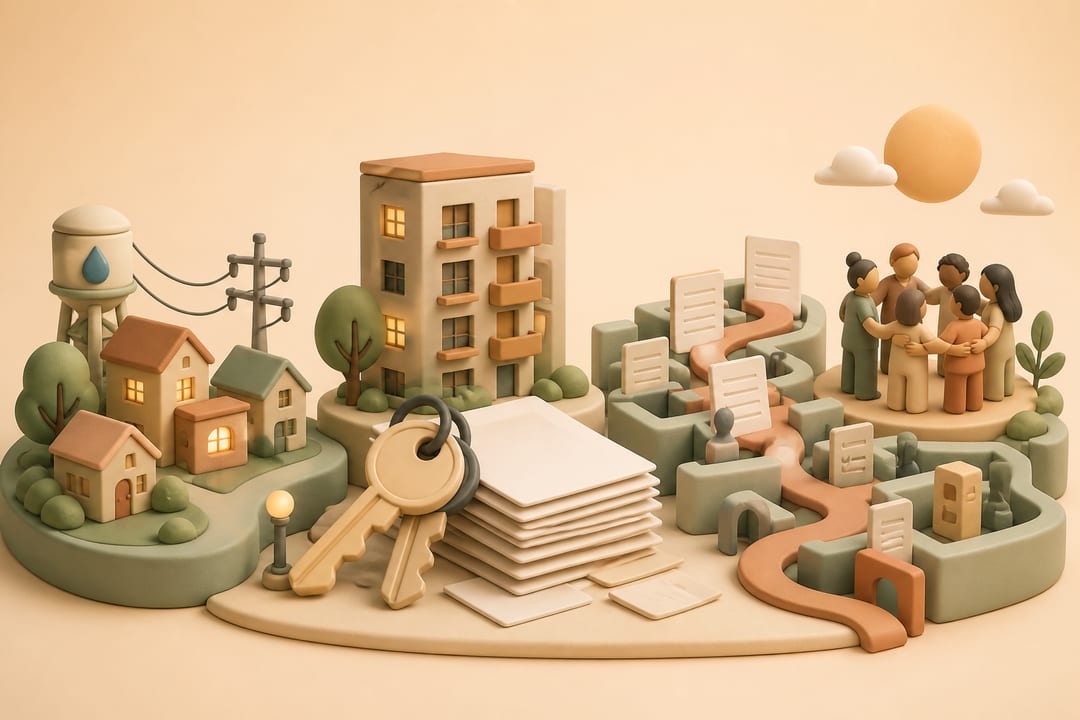
A country can offer safe water, reliable infrastructure, strong institutions and more opportunity while many residents still feel financially squeezed, overworked or alone.
Quick answer: In many high-income countries, basic material security is more reliable on average—but “easy” depends on who you are, where you live, what you earn, what you need and whether you have family or community support. The biggest modern pressures are often housing affordability, healthcare access, income after essential costs, competition for opportunity, administrative complexity and loneliness. The fairest comparison is not a single national ranking; it is a profile of security, affordability, opportunity, access and belonging.
Editorial note: This article uses an anonymized synthesis of user-provided material. Individual experiences, country classifications and personal claims were not independently verified. This article provides general educational information, not immigration, financial, legal, medical or investment advice.
The Question Behind the Question
Someone living in a lower-income country asks whether life in a wealthy, developed country is really as easy as people elsewhere are taught to believe. They are not asking only about salaries or consumer goods. They want to know what residents actually worry about:
- Can an ordinary worker afford a safe home?
- Does a higher wage still feel higher after rent, taxes, transport, childcare and healthcare?
- Are public systems reliable when something goes wrong?
- Is it possible to build a career without already having the right education, connections or location?
- Does a more individualistic society provide enough family and community support?
The answers in the discussion point in two directions at once. Some people describe clean water, stable electricity, safer streets, stronger labour protections and a functioning safety net as advantages so normal that locals stop noticing them. Others describe unaffordable housing, slow care, wage pressure, debt, long commutes, competition and loneliness as serious daily hardships.
Both descriptions can be true. They are measuring different layers of life.
Stop Treating “Developed” as a Personal Income Statement
The World Bank's income groups classify economies using gross national income per person. That is useful for comparing broad national income levels, but the World Bank explicitly warns that GNI per capita does not directly measure development or residents' welfare. It does not show how income is distributed, what housing costs in a particular city or whether a specific person can access services.
The World Bank's explanation of GNI per capita is an important guardrail: a high national average is not the same thing as a comfortable household budget.
The United Nations Development Programme's Human Development Index adds life expectancy, education and standard of living. That is broader, but it is still an average. The Inequality-adjusted Human Development Index discounts the result when those achievements are distributed unevenly.
This gives us a better starting point:
Country-level prosperity
≠
The lived experience of every household
When comparing countries, ask both “How high is the average?” and “How widely is the benefit shared?”
What Is Often Easier—and Why It Becomes Invisible
The strongest case for life being easier in a high-income country is not that everyone is rich. It is that many everyday failures are less likely, less severe or more recoverable for the average resident.
Depending on the country and region, that may include:
- more reliable utilities and transport;
- safer food and drinking water;
- greater access to formal employment and education;
- stronger worker protections and social insurance;
- more predictable public administration;
- better access to technology, information and consumer goods; and
- greater room to plan beyond the next emergency.
These advantages are easy to miss because they feel like background conditions. People notice a rent increase immediately. They rarely notice every day that the lights turned on, food was available, a contract was enforceable or an emergency service could be called.
That does not make the rent increase unimportant. It means the comparison needs more than one question. A household can enjoy a higher level of infrastructure and still be one missed paycheque away from serious instability.
Challenge 1: Housing Can Absorb the Benefits of a High Income
Housing is where national prosperity most visibly collides with household reality.
A country can have high wages and strong institutions while workers in its most productive cities spend a large share of their disposable income on rent or mortgage payments. People may have access to good jobs but be unable to live near them. Others may move to a cheaper region and lose access to public transport, childcare, family support or suitable employment.
The OECD's housing data treats affordability as a household-level issue. Its measures include housing costs as a share of disposable income and the share of households spending more than 40% of disposable income on housing. National averages can conceal sharper pressure in capital and metropolitan areas.
For an individual, the practical calculation is not salary alone:
Disposable income
− adequate housing
− utilities and energy
− transport
− food
− childcare or eldercare
− taxes and insurance
= room for savings, health, leisure and emergencies
When the remainder is small, a country can feel unaffordable even if its headline income is high.
Housing also shapes the rest of life. It affects whether someone can leave their parents, have children, host friends, live near work, recover from illness or build savings. That is why housing often appears in conversations about both financial stress and declining social mobility.
Challenge 2: Healthcare Can Be Better and Still Hard to Use
Healthcare comparisons often become too simple. “Free healthcare” does not necessarily mean immediate access, and expensive healthcare does not necessarily mean every resident is excluded. There are at least three separate questions:
- Is the service formally covered?
- Can the person reach it in a reasonable time and distance?
- Can they afford the out-of-pocket cost, medicines, dental care or lost work time?
The World Health Organization's definition of universal health coverage includes access to needed quality services without financial hardship. The OECD's work on unmet healthcare needs separates barriers such as cost, distance and waiting time and shows that access can still be unequal within high-income systems.
This is the more accurate conclusion:
Stronger average healthcare systems can reduce certain risks without eliminating waiting lists, regional gaps, cost barriers, unequal treatment or the fear of losing income while seeking care.
Healthcare is therefore both an advantage and a source of anxiety, depending on the person's country, insurance, income, medical needs and location.
Challenge 3: A Higher Wage Does Not Guarantee More Purchasing Power
People often compare salaries across countries without comparing the basket of essentials those salaries must buy. That can produce a misleading conclusion in either direction.
A lower-income country may have cheaper local services, rent or food, especially for people earning foreign-currency or upper-middle-class incomes. A high-income country may offer a much higher wage but also charge more for housing, transport, childcare, education, insurance and care.
The relevant measure for a household is purchasing power after essentials, not the salary number in isolation. The OECD's analysis of inflation and cost-of-living pressure explains why price increases in essentials hit lower-income households harder: food and energy take up a larger share of their budgets.
That helps explain a common generational complaint: older households may remember a time when an ordinary wage could support independent housing and steady savings, while younger workers with more education still struggle to reproduce that path. Whether that pattern is true must be checked with country-specific data, but the mechanism is clear: when essential costs rise faster than disposable income, the same work buys less security.
Challenge 4: Opportunity Is More Available—and More Competitive
Developed economies often offer more formal opportunities, but those opportunities can be difficult to enter. A good job may require credentials, documented experience, language ability, professional networks, geographic mobility and a long sequence of applications.
That creates a paradox:
- opportunity is more visible;
- the rewards can be larger;
- the competition is broader; and
- the cost of falling behind can be high.
People who arrive without local credentials, family support or a professional network may experience a gap between a country's advertised opportunity and the opportunity they can actually reach. People born there may also discover that the old “work hard, buy a home, raise a family” sequence no longer works in the same way.
This is why “there are more opportunities” and “it is easy to get ahead” are not synonyms. A system can offer real mobility while still making mobility highly competitive and uneven.
Challenge 5: Administrative Complexity Becomes a Daily Tax
Another recurring theme is complexity. In a highly regulated society, many parts of life may be safer or more predictable because rules exist—but following those rules can require time, paperwork, credentials and specialist knowledge.
Examples include:
- applying for work, benefits or housing;
- understanding insurance and healthcare referrals;
- building a credit history;
- registering a business;
- navigating immigration or residency paperwork;
- finding childcare or eldercare; and
- challenging a decision made by an institution.
For someone with time, language fluency, money and a supportive network, complexity can be manageable. For someone working multiple jobs or moving across borders, it becomes a hidden cost. The rule may be neutral on paper while the process remains much easier for people with more cultural and financial capital.
This is not a reason to romanticize less regulated systems. It is a reminder that “the service exists” is different from “the service is easy to use.”
Challenge 6: Community and Loneliness Do Not Follow GDP
Material comfort does not automatically produce a sense of belonging. In some places, family and neighborhood networks provide practical support even when formal services are weaker. In others, public systems are more reliable but adults are expected to manage more of life alone.
The OECD's research on social connections and loneliness treats connection as a quality-of-life issue rather than a soft extra. It distinguishes regular contact, perceived support and subjective loneliness. Those are not the same thing: someone can see many people and still feel that there is no one to call when something goes wrong.
Social connection can affect:
- emotional resilience during unemployment, illness or relocation;
- access to informal childcare and eldercare;
- the ability to find work or housing through trusted networks;
- mental health and daily motivation; and
- whether a person experiences a city as a community or simply as an expensive place to live.
The right comparison is not “individualism is bad” or “family networks are always better.” It is: what support does a person have, and what happens when they need help?
Challenge 7: Safety and Stability Are Unevenly Distributed
Many residents of high-income countries describe a lower baseline fear of hunger, unsafe water, infrastructure failure or arbitrary violence. That advantage is real for many people, but it is not evenly distributed by neighborhood, income, race, disability, immigration status or housing situation.
The same country can contain:
- safe and unsafe neighborhoods;
- well-connected and isolated regions;
- high-quality and neglected public services;
- secure housing and homelessness; and
- people with strong legal protections and people who struggle to use them.
This is another reason national labels are too blunt. A person comparing countries should compare the actual city, region, job, household and support network—not only the country's reputation.
A Better Way to Compare Life Across Countries
Use a two-layer model. First ask whether basic capabilities and protections are broadly available. Then ask how much of that prosperity an ordinary household can actually keep and use.
| Dimension | The question to ask | Useful evidence |
|---|---|---|
| Baseline security | Are water, food, energy, shelter, safety and emergency systems broadly reliable? | Infrastructure, health, housing quality and local safety data |
| Affordability | What remains after adequate housing and essential costs? | Housing-cost burden, local prices, disposable income and taxes |
| Opportunity | Can education and work become a stable life? | Employment, wages, credential barriers, regional access and mobility |
| Access in practice | Can people use healthcare and public services when they need them? | Cost barriers, waiting times, distance and coverage gaps |
| Belonging | Does the person have support and meaningful connection? | Social support, loneliness, living arrangements and community resources |
| Distribution | Who benefits from the national average? | Income groups, inequality-adjusted indicators and regional breakdowns |
This framework prevents two common mistakes:
- Romanticizing hardship elsewhere. Lower prices or stronger family ties do not erase unreliable services, unsafe conditions, poor job quality or limited mobility.
- Romanticizing wealthier countries. Better infrastructure and higher average incomes do not guarantee affordable housing, fast healthcare, meaningful work or community.
The most honest answer is conditional: life may be materially safer and more predictable in a high-income country while still being emotionally, financially or administratively difficult.
A Relocation or Comparison Checklist
If you are considering moving, studying, working or retiring in another country, do not rely on a country's reputation. Build a household-level comparison.
Money
- What is the realistic after-tax income for your actual occupation?
- What is the rent or purchase cost for safe, adequate housing?
- How much will transport, food, utilities, childcare, insurance and healthcare cost?
- What happens if you lose your job or cannot work for several months?
Access
- Can you use healthcare immediately, or are there waiting and referral steps?
- Are services available in the region where you can afford to live?
- What documents, language skills, credentials or credit history are required?
- Can you challenge a decision or obtain help when paperwork goes wrong?
Opportunity
- Is your qualification recognized?
- Can you work legally and change employers?
- Are there jobs outside the most expensive cities?
- Is the expected salary enough to build savings after essentials?
Belonging
- Who would help if you became sick?
- How will you make friends outside work or school?
- Is there affordable childcare, eldercare or community space?
- Are you moving toward a support network or away from one?
Distribution and risk
- Does the national average reflect people in your income group?
- Are there large regional or neighborhood differences?
- How would your experience change based on disability, age, family status, gender, ethnicity or immigration status?
- What is your plan if the job, visa or housing arrangement fails?
The goal is not to calculate a perfect score. It is to expose the assumptions hidden inside the phrase “a better life.”
The Short Version
Living in a developed country is often easier in the sense that basic systems, services and opportunities are more available on average. That is a meaningful advantage, and people who grew up with it may underestimate it.
But ease is not evenly distributed, and it is not the same as happiness. A person can live with safe water and reliable electricity while being unable to buy a home. They can have formal healthcare coverage while waiting months for treatment. They can earn more than they would elsewhere while having less disposable income after rent. They can live in a safe city while feeling socially isolated.
The question is therefore not “Which country is easy?” It is:
Which country gives this particular person the strongest combination of security, affordability, opportunity, access and belonging?
That answer requires more than a map, a salary comparison or an idealized story about any part of the world.
Where Pine Fits
Open Pine to organize relocation research, rental listings, employment offers, visa documents, healthcare questions, household budgets and decision notes in one place. Pine can help turn scattered information into a comparison timeline and a focused list of questions for local professionals. It does not rank countries, provide immigration advice or guarantee a successful move.
Frequently Asked Questions
Is life objectively easier in a developed country?
Often, average material security and institutional capacity are stronger, but “easier” depends on income, location, health, family status, immigration status, housing and support networks. National averages do not describe every household.
What are the biggest problems in developed countries today?
Common pressures include housing affordability, healthcare access, essential-cost inflation, job competition, debt, administrative complexity, unequal opportunity and loneliness. Their severity varies significantly by country, city and household.
Why can people in wealthy countries still feel poor?
Because national income is an average, while households pay local prices. High rent, childcare, transport, energy, taxes and healthcare costs can consume much of a person's disposable income even when the country's average income is high.
Are people happier in poorer countries because they have stronger communities?
There is no universal answer. Family and community support can improve resilience, but lower incomes may also bring serious risks and limited options. Compare the actual person's safety, services, costs, opportunities and relationships rather than assuming one social model is always better.
Is the phrase “First World” still useful?
It is a blunt label for current quality-of-life analysis. Income groups, human-development measures, inequality data, housing costs, healthcare access and social-support indicators provide more precise questions. A specific country or city is usually more informative than a broad label.
Does a higher salary always mean a better life abroad?
No. Compare after-tax income with local housing, transport, food, childcare, insurance, healthcare and savings potential. Also include non-financial factors such as legal status, language, safety, family support and social connection.
Can a country be wealthy but still have serious poverty?
Yes. National averages can coexist with large inequality, regional gaps, homelessness or communities with poor access to services. The IHDI and household-level indicators help reveal what an average income measure hides.
Official Sources
- World Bank: Country and Lending Groups
- World Bank: Why Use GNI per Capita to Classify Economies?
- UNDP: Human Development Index
- UNDP: Inequality-adjusted Human Development Index
- OECD: Housing
- OECD: Affordable Housing Database—Housing Costs Over Income
- OECD: Inflation and Cost of Living
- WHO: Universal Health Coverage
- OECD: Unmet Needs for Healthcare
- WHO: Financial Protection
- OECD: Social Connections and Loneliness in OECD Countries
- OECD: Social Support Indicator
This article provides general information, not immigration, financial, legal, medical or investment advice. Country conditions vary by region and change over time. Verify current local rules, costs, eligibility requirements and service access before making a major life decision.