Apartment living requires a certain amount of noise tolerance. It also requires a certain amount of consideration. Those two ideas are not opposites.
Footsteps, doors, plumbing, children, pets, appliances, conversations, and the occasional mysterious thud are part of sharing a building. But repeated loud music at night, hours of amplified sound, deliberate stomping, screaming, or a building so poorly insulated that ordinary movement becomes impossible to live with can be a genuine problem.
Quick answer: The key question is not whether a neighbor makes any sound. It is whether the sound is ordinary for the building and time of day, or whether its volume, duration, repetition, timing, or deliberate character substantially interferes with another resident’s ability to sleep and use their home. Lease rules, building design, local noise codes, and the facts all matter.
This article gives a general U.S. framework because the underlying situation does not identify a state or city. Quiet-hours rules, nuisance standards, landlord duties, recording laws, and complaint procedures vary by location. The California and New York City sources below are examples of local guidance, not nationwide rules.
A Concrete Scenario
Consider a renter who can hear a neighbor walking, closing doors, using the bathroom, running appliances, and occasionally dropping something heavy. The renter is told that apartment buildings are shared spaces and that some tolerance is expected.
Then the details become more complicated:
- The upstairs floor may transmit ordinary footsteps like pounding.
- A child may run indoors for long periods, including early in the morning.
- A dog may bark or scratch at the floor whenever someone passes.
- Music, a television, or a speaker may vibrate through a shared wall.
- A vacuum, party, or loud conversation may happen during sleeping hours.
- A resident may be working nights and have a very different sleep schedule.
- A building may have weak floors, thin walls, hard surfaces, or poor impact-noise control.
The mistake is to treat every complaint as either “the neighbor is simply living” or “the neighbor is violating the law.” A better analysis asks what kind of sound it is, how often it occurs, what can realistically be changed, and which remedy matches the source.
Four Categories of Apartment Noise
1. Ordinary incidental living sounds
These are sounds most residents should expect in a shared building, especially during daytime and early evening:
- normal walking and ordinary footfalls;
- doors, cabinets, toilets, showers, and plumbing;
- a child playing for reasonable periods;
- a pet moving around the home;
- cooking, laundry, and ordinary appliances;
- conversations at a normal household volume;
- people entering or leaving the building.
“Expected” does not mean “never annoying.” It means the sound may be part of the housing arrangement rather than an actionable disturbance. A resident can still ask for a simple mitigation, such as moving a speaker or adding a rug, without treating the neighbor as malicious.
2. Preventable but non-malicious noise
Some sounds are not intentional harassment, but a reasonable person may be able to reduce them:
- hard shoes or heavy heel-walking over a bedroom;
- speakers or a television placed against a shared wall;
- furniture dragged across an unprotected floor;
- a dog’s nails or repeated jumping on hard surfaces;
- late-night vacuuming or other avoidable chores;
- dropping weights, using a drum kit, or practicing amplified instruments in a shared building.
This category is where a calm conversation can work best. The neighbor may not know where the sound travels. One resident in the source material discovered that a small object placed on a counter could sound dramatically louder in the apartment below because of the way the cabinet and floor transmitted vibration. The receiving resident heard the impact; the other resident did not.
The goal is not to demand that the neighbor stop living normally. It is to identify a low-cost change that reduces the impact.
3. Recurring or unreasonable disturbance
Noise becomes more serious when it is unusually loud, prolonged, repeated, targeted, or concentrated during protected quiet hours. Examples may include:
- amplified music or television that vibrates another unit;
- repeated shouting, parties, or loud arguments late at night;
- deliberate pounding on a ceiling or wall to intimidate someone;
- heavy equipment, instruments, or exercise activity for hours in a building that prohibits it;
- a dog barking continuously without meaningful intervention;
- repeated impact noise that wakes a neighbor every night and continues after specific notice.
The exact legal threshold varies. A single loud crash at 2 a.m. may be disruptive but not establish a continuing nuisance. A recurring pattern supported by dates, recordings, witnesses, and building rules is easier to evaluate and address.
4. An emergency or safety issue
Fighting, threats, gunshots, explosions, fire alarms, suspected abuse, or an immediate danger should not be handled as an ordinary lease dispute. Contact emergency services when appropriate. A non-emergency noise complaint process is not a substitute for an emergency response.
Normal Noise, Excessive Noise, or a Bad Building?
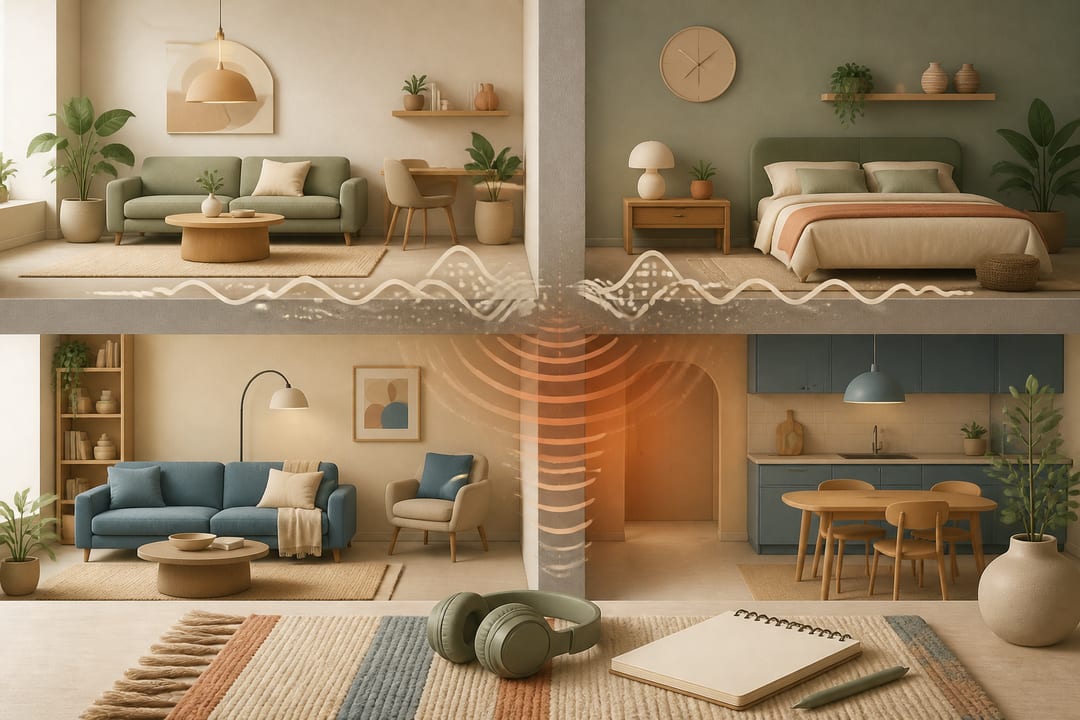
Noise complaints often involve more than one cause. A person may be walking normally while a defective floor assembly turns each step into a low-frequency impact. A child may be behaving like a child while bare flooring and a lightweight ceiling amplify the sound. A tenant may be inconsiderate, but the building may also be making the problem worse.
Before blaming a neighbor, separate three possible sources:
| Source | What it looks like | Best first question |
|---|---|---|
| Behavior | The sound is amplified, repeated, avoidable, or timed in a way that disregards the building | Can the resident make a specific low-cost change? |
| Building transmission | Ordinary activity travels unusually far through floors, walls, pipes, vents, or structure | Can management inspect, add materials, repair a defect, or change the unit arrangement? |
| External or shared systems | HVAC, elevators, doors, plumbing, alarms, construction, or common areas create the sound | Is this a maintenance, building-rule, or local-code issue? |
The solution depends on the source. Headphones may help with occasional television noise, but they will not repair a vibrating ceiling. A rug may reduce impact noise, but it will not solve a wall-mounted subwoofer. A polite request may fix speaker placement, while a repeated building defect may need a property-management work order.
What Does “Quiet Enjoyment” Actually Mean?
“Quiet enjoyment” is often quoted as if it means a tenant is entitled to silence. It usually does not.
In many jurisdictions, the covenant of quiet enjoyment protects a tenant’s right to use and possess the home without substantial interference. It is not a promise that a multi-unit building will be acoustically silent. The exact doctrine and remedies vary by state.
For example, California Civil Code section 1927 describes a landlord’s obligation to secure the tenant’s quiet possession during the rental term. California’s 2026 tenant guide explains quiet enjoyment in the context of substantial interference and also notes that a landlord may give a good-faith warning when a tenant’s or guest’s conduct may violate the agreement, rules, or laws.
That illustrates two important limits:
- A tenant does not automatically win a legal claim because a neighbor can be heard.
- A landlord may still have responsibilities when a serious, ongoing disturbance is within the landlord’s legal control and the lease or local law requires action.
Do not use “quiet enjoyment” as a shortcut for “my home must be silent,” and do not use ordinary apartment noise as a shortcut for “management never has to respond.”
A Practical Noise-Complaint Test
Before sending an angry message or filing a formal complaint, evaluate the pattern across seven questions:
- What is the sound? Footsteps, music, voices, a pet, plumbing, construction, impact vibration, or something else?
- When does it happen? Daytime, evening, posted quiet hours, or a time when most residents reasonably sleep?
- How long does it last? Seconds, several minutes, recurring bursts, or hours?
- How often does it happen? One event, occasional events, or an almost daily pattern?
- How intense is it in the receiving unit? Can you hear it, or does it wake you, vibrate furniture, interrupt calls, or make a room unusable?
- Can the source resident reasonably reduce it? A speaker location, rug, footwear, pet routine, or time change may be workable; ordinary plumbing may not be.
- What rule or right is implicated? Lease quiet hours, building rules, local noise code, maintenance duties, fair-housing accommodation, or an emergency concern?
The goal is not to assign a moral score. It is to turn “they are always loud” into facts that another person can evaluate.
How to Document a Noise Problem Without Escalating It
Keep a dated log
Record the date, start and end time, type of noise, where you heard it, what impact it had, and whether it stopped after a request. Include quiet periods too. A reliable record should not exaggerate or fill every blank with guesses about the neighbor’s motive.
Capture the sound carefully
Short recordings can show the character and timing of a disturbance, but a phone recording may not capture low-frequency vibration accurately. Do not record private conversations where local law prohibits it, enter another person’s home, or use surveillance that creates a separate privacy problem. Keep the original file and note the date and device.
Save the governing documents
Collect the lease, quiet-hours clause, community rules, pet policy, amenity rules, construction notices, prior complaints, maintenance tickets, and management responses. A rule saying “quiet hours are 10 p.m. to 8 a.m.” may be useful, but it may not define every sound as a violation or create a right to absolute silence during the day.
Report the impact, not a diagnosis
Write “impact noise wakes me at 5:50 a.m. on most weekdays” rather than “the upstairs tenant is intentionally trying to torture me.” Describe what you know and label what you are inferring.
A Better Escalation Path
1. Start with a specific, non-accusatory request
If there is no immediate danger, a brief request can be more effective than a general complaint:
Hi, I’m hearing a strong vibration in the bedroom below the living-room wall, usually between 10:30 p.m. and midnight. I’m not sure whether it is the speaker, furniture, or something else. Would you be willing to move the speaker a little away from the shared wall or lower the bass after quiet hours? I’m happy to compare locations so we can find a solution.
This gives the neighbor a concrete action and leaves room for the possibility that they do not realize how sound travels.
2. Contact management with the relevant clause and log
If the noise continues, submit a written request to the landlord or property manager. Attach the dates and the applicable lease or building rule. Ask what process the building uses for recurring noise complaints, whether management can inspect the units, and whether there are practical mitigation options.
Do not demand that management evict someone based on a single unexplained sound. Do ask for a response when the issue is recurring, documented, and materially affecting sleep or use of the home.
3. Use local government or mediation when appropriate
Noise enforcement is often local. For example, NYC311 lists different complaint categories for residential music, talking, television, animals, and banging or moving furniture, and notes that the process depends on the location and type of noise. The city also points residents toward mediation for chronic disputes.
That is an example of why a generic “call the police” answer is usually poor advice. Check the city or county’s noise code, 311 or non-emergency line, housing agency, and mediation resources. Some local rules depend on the time, measured decibel level, type of activity, or whether an officer can observe the disturbance.
4. Treat retaliation and self-help as separate risks
Do not bang on the ceiling, threaten the neighbor, block access, shut off utilities, remove belongings, or change locks. If a landlord threatens retaliation, an illegal lockout, or a rent action after a good-faith complaint, preserve the communications and seek local advice promptly.
If the noise is connected to a disability, medical condition, child, caregiver, or assistance animal, additional fair-housing and reasonable-accommodation rules may apply. That does not mean every disturbance is exempt; it means the parties should use the accommodation process rather than make assumptions.
What Can Actually Help?
Measures for the receiving resident
- Move the bed or desk away from the shared wall or ceiling area.
- Use a fan, white-noise device, or headphones for intermittent sounds.
- Ask management whether a different unit is available if the building’s transmission is severe.
- Protect sleep with a consistent routine rather than monitoring every sound.
- Ask a clinician about persistent sleep disruption, anxiety, or sound sensitivity.
These measures are coping tools, not proof that the source resident has no responsibility.
Measures for the source resident
- Put rugs or floor coverings in high-impact areas where allowed.
- Avoid hard-heeled footwear and dragging furniture late at night.
- Keep speakers and subwoofers away from shared walls and floors.
- Use soft-close pads on cabinets and toilet seats.
- Give pets exercise and enrichment, and trim nails where appropriate.
- Move noisy chores and instruments away from posted quiet hours.
- Ask the neighbor where the sound is strongest instead of guessing.
Measures for landlords and building owners
- Inspect floors, ceilings, doors, pipes, vents, and shared mechanical systems.
- Check whether flooring and area-rug rules are being applied consistently.
- Repair loose equipment, door closers, fans, elevators, and plumbing components.
- Explain quiet hours and complaint procedures to all residents.
- Consider acoustic underlayment, resilient channels, ceiling improvements, or unit transfers when the economics and building design support them.
Better sound insulation is often a property-investment issue, not a personality contest between neighbors.
Common Mistakes
“You chose apartment living, so you have no right to complain”
Renting an apartment does mean accepting some shared-living sound. It does not waive every lease rule, local noise protection, or landlord duty. It also ignores that many people rent because of cost, location, family needs, or housing availability.
“Any noise after 10 p.m. is illegal”
Quiet hours are often building rules, not a universal legal cutoff. A local ordinance may use different times, decibel limits, activity categories, or enforcement standards.
“Normal walking can never be a problem”
Ordinary walking is usually expected, but the receiving unit may experience it as severe impact noise because of the building. Start by investigating sound transmission and possible mitigation instead of assuming either bad intent or total immunity.
“Noise sensitivity proves the complaint is unreasonable”
The person experiencing the sound may be genuinely losing sleep even if the source resident does not hear it. Document the impact and test practical changes. If a disability or medical condition is involved, consider the applicable accommodation process.
“Record everything and confront the neighbor publicly”
Over-monitoring, public accusations, ceiling banging, and threats can create new legal and safety problems. Keep a focused record, communicate privately, and use the official process when needed.
Where Pine Fits
Open Pine to organize the lease, quiet-hours rules, dated noise log, recordings, messages, maintenance tickets, and management responses into a clear timeline. Pine can help separate observed facts from assumptions and prepare a focused request for a property manager, mediation service, housing agency, or local professional. It does not measure legal noise violations, provide legal advice, or guarantee a result.
Frequently Asked Questions
What noise is normal in an apartment?
Ordinary footsteps, doors, plumbing, appliances, conversations, children, pets, and people coming and going are generally expected in shared housing. Whether a specific sound is excessive depends on its timing, duration, volume, repetition, building design, lease rules, and local law.
How do I know if a noise complaint is legitimate?
Look for a recurring, objectively describable pattern that is unusually loud, prolonged, avoidable, targeted, or occurring during applicable quiet hours. A single mysterious thud is usually different from nightly music that vibrates the walls or repeatedly interrupts sleep.
Are quiet hours the same as a legal noise ordinance?
No. Quiet hours may come from a lease or building rules. A city or county may have a separate noise code. Check both, and do not assume the hours in one document override the other.
Can a landlord be responsible for noise from another tenant?
Possibly, depending on the lease, the severity and persistence of the disturbance, what the landlord knows, and what local law requires. A landlord is not automatically required to guarantee silence or evict a neighbor after one complaint. A serious documented pattern may require a response, investigation, or enforcement under the applicable rules.
Can children, pets, or people who work nights be exempt from noise rules?
Not automatically. Normal family life and ordinary pet activity are relevant facts, but they do not create a universal exemption from neutral lease rules or local law. Disability-related accommodations and protected-family-status issues may require separate analysis.
Should I contact the police about a noisy neighbor?
Use emergency services only for an immediate threat or danger. For ordinary recurring noise, start with the lease and property manager, then use the local non-emergency, 311, noise-code, housing, or mediation process that applies in your area.
What if the building is simply poorly insulated?
Document the sound and ask management to investigate the construction or maintenance issue. Request practical mitigation, such as floor coverings, equipment repairs, acoustic work, or a transfer. A building defect can coexist with a neighbor’s reasonable behavior.
Official Sources
- California Civil Code § 1927 — California example of the statutory covenant of quiet possession.
- California Department of Real Estate: 2026 Landlord/Tenant Guide — California-specific guidance on quiet enjoyment, tenant conduct, warnings, and landlord-tenant procedures.
- California DRE: Landlord and Tenant Rights — Official publication index and current guide editions.
- NYC311: Noise Complaints — New York City example of complaint categories and mediation resources.
- NYC Department of Environmental Protection: Noise Code — New York City example of local noise-code enforcement and complaint routing.
- EPA: State and Local Noise Enforcement Legal Memoranda — Background on the role of state and local governments in community-noise control.
This article provides general information about U.S. housing and noise disputes, current to August 22, 2026. It is not legal, medical, or mental-health advice. Noise standards, quiet-enjoyment rules, recording laws, fair-housing protections, landlord duties, remedies, and complaint procedures vary by state, city, county, building, lease, and facts. Consult a qualified local attorney, tenant advocate, housing agency, clinician, or property professional before taking formal action.