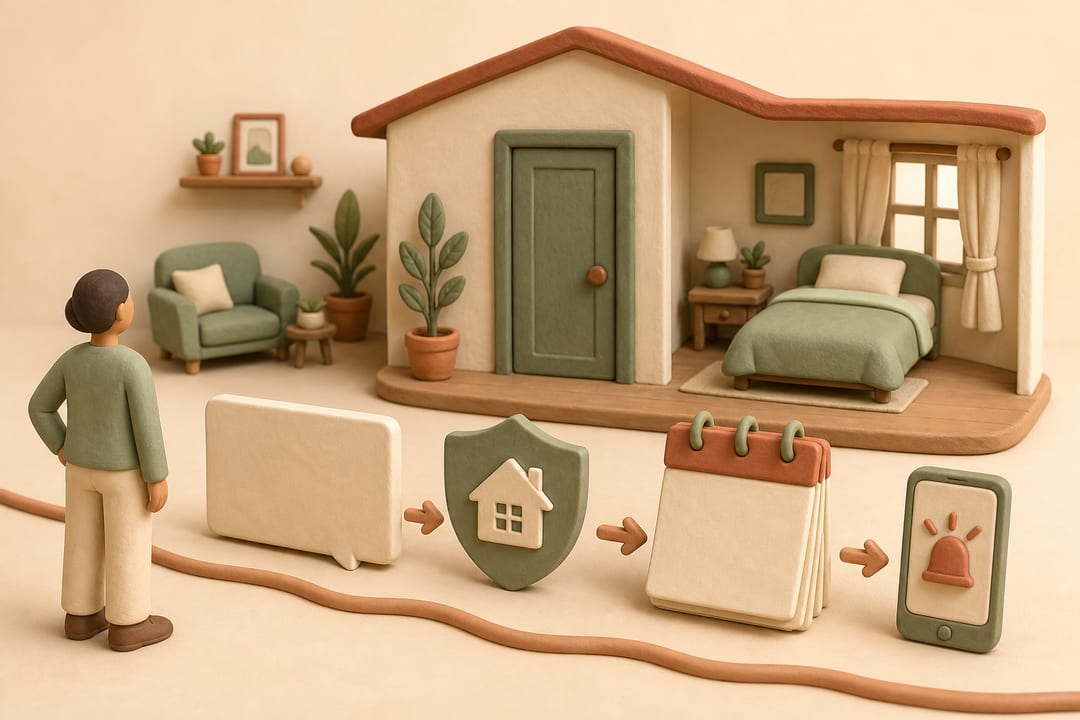
A quiet guest, a house-rule problem, a possible emergency and a holdover risk are four different situations. A safe host response begins by refusing to treat them as one.
A first-time U.S. host accepted a roughly one-month reservation for a private room in the host's home. The guest arrived before the published check-in time, then spent most of several days privately in the room. One check-in message went unanswered. Later, the guest went outside, ordered deliveries and asked whether the host could provide a meal.
The host felt compassion, then anxiety. Was the guest in distress? Would an occasional meal become an expectation? Could outdoor smoking turn into indoor smoking? Could a 30-day reservation create tenant rights? Commenters escalated the uncertainty with predictions about drugs, homelessness, “professional tenants” and a guest who would never leave.
Most of those conclusions were not supported by the reported facts.
Quick answer: There is no nationwide U.S. rule that every Airbnb guest automatically becomes a tenant on day 30. Airbnb treats reservations of
28or more consecutive nights as monthly stays for cancellation and payment purposes, but that platform category does not decide legal occupancy status. State and local law, the type of property, whether the host shares the home, the agreement, licensing rules and the facts of possession may all matter. During the stay, silence or solitude alone is not a rule violation or proof of danger. Use a neutral written check-in for ordinary uncertainty, a fact-based message for an observed rule issue, and911or988only when the facts support an actual safety escalation.
Editorial note: This article uses an anonymized summary of user-provided community material. The account, guest and property have not been independently verified. The discussion is general U.S. information, not legal, medical, mental-health, insurance or safety advice for a particular person or jurisdiction.
What the Host Observed—and What the Host Inferred
An anxious host can turn a small number of observations into a much larger story. The first discipline is to separate the two.
| Reported observation | Possible explanations | What it does not establish |
|---|---|---|
| The guest arrived before the published check-in time | Misunderstood the time, traveled early, had nowhere convenient to wait, or asked for flexibility | Fraud, tenancy or dangerous intent |
| The guest spent several days quietly in the room | Privacy, rest, remote activity, illness, stress or many other possibilities | Drug use, self-harm or a plan to overstay |
| One nonurgent message went unanswered | The guest missed it, did not want social contact or did not view it as requiring a reply | An emergency by itself |
| The guest ordered food and water and later left the room | The guest was meeting personal needs privately | A need for the host to monitor daily activity |
| The guest smoked outdoors | Smoking occurred in the reported location | Indoor smoking or illegal-drug use |
| The guest asked for a meal | A request was made | A continuing duty to provide food or a change in the reservation terms |
This distinction is not only about being kind. It gives the host a defensible operating record. “Guest was quiet, so I suspected drugs” is speculation. “At 7:20 p.m., smoke entered the shared hallway and the guest confirmed smoking indoors” is a specific issue that can be compared with a disclosed rule.
The 30-Day Rule Is Not a National Rule
The most consequential comment in the thread claimed that after 30 days the guest would automatically become a long-term tenant and Airbnb would stop protecting the host. That statement imported a Canadian provincial warning into an unspecified U.S. situation and treated it as universal.
It is not.
Three different clocks are commonly confused:
| Clock | What it may control | What it does not decide by itself |
|---|---|---|
Airbnb's 28-night threshold |
Monthly-stay cancellation terms and monthly payment handling | Whether state law calls the occupant a tenant, lodger, transient guest or something else |
| A city or state's short-term-rental definition | Licensing, registration, taxes, zoning or operating limits | Every right and removal procedure between host and occupant |
| State or local landlord-tenant law | Possession, entry, notice, eviction and remedies | Airbnb's cancellation or payout calculation |
Airbnb's current home cancellation policy applies its monthly-stay rules to reservations of 28 or more consecutive nights. Airbnb also collects and releases payments monthly for many such stays. Those are platform rules.
Airbnb's own monthly-stay guidance for hosts says that a guest staying a month or longer may establish tenant rights and that the exact number of days depends on the jurisdiction. That wording matters: may is not always, and the relevant jurisdiction—not the Airbnb label—controls the legal analysis.
Local law may use a different dividing line for a different purpose. New York City, for example, describes a rental of fewer than 30 consecutive days as a short-term rental for its registration regime. Washington's residential landlord-tenant statute, by contrast, defines a tenant by a person's entitlement to occupy under a rental agreement—not by announcing a universal 30-day conversion. NYC Office of Special Enforcement, RCW 59.18.030
The legal answer may also differ between:
- a hotel or licensed transient accommodation;
- an entire home handed exclusively to the guest;
- a room in an owner-occupied home with shared living spaces;
- an apartment the host is renting rather than owning;
- a fixed reservation versus repeated extensions; and
- a guest who checks out as agreed versus an occupant who remains after the reservation.
Do not solve that uncertainty by assuming 27 nights is a universal safe harbor. It may fit Airbnb's shorter-stay cancellation category while failing to answer the local occupancy, licensing, tax or removal question.
Before accepting a stay close to a local threshold, ask a local housing attorney, relevant city or county office, or qualified short-term-rental professional:
- How does this jurisdiction classify a paid occupant in this exact type of space?
- Does owner occupancy or shared access change the classification or removal process?
- Which short-term-rental license, lodging tax or registration rules apply?
- What notice and court process would apply if the occupant did not leave?
- Does the host's lease, mortgage, HOA, condo rule or insurance policy restrict the stay?
Airbnb Cannot Replace Local Possession Law
Airbnb can maintain the reservation record, process platform payments, apply its policies and provide Support. It cannot guarantee that a person will leave, and its identity or background processes do not eliminate future misconduct risk. Airbnb's current U.S. Terms of Service expressly disclaim a warranty that verification or background checks will identify past misconduct or prevent future misconduct.
That means a long-stay plan needs two parallel files:
Platform file
= reservation + messages + house rules + alterations
+ payment/cancellation record + Airbnb Support case
Local-law file
= property classification + permits + written occupancy terms
+ entry rules + notice/removal procedure + insurance constraints
If the guest remains after checkout, do not improvise by changing locks, removing belongings, blocking access to necessities or physically confronting the occupant. Preserve the reservation and communications, contact Airbnb, and obtain location-specific advice before acting. The correct procedure may depend on facts that a platform message cannot resolve.
Use a Three-Lane Response, Not Constant Surveillance
The host's next step should match the evidence.
| Lane | Examples | Host response |
|---|---|---|
| Ordinary privacy | Guest stays in the room, orders delivery, declines conversation, keeps an unusual schedule | Send at most a neutral listing check-in; otherwise respect privacy |
| Documented reservation issue | Confirmed indoor smoking, unauthorized visitor, damage, access problem, noise or another specific disclosed-rule issue | Record the observable fact, quote the relevant rule, request a concrete correction and keep Airbnb Support informed |
| Safety escalation | Fire, sounds of acute medical distress, visible injury, a direct threat, a stated self-harm plan or another objective immediate-danger indicator | Contact local emergency services; after immediate needs, notify Airbnb Safety |
Airbnb's privacy policy says hosts must obtain permission before accessing a listing during the reservation unless there is an emergency. In a shared stay, hosts and guests must also obtain permission before entering non-shared spaces such as bedrooms and private bathrooms. Airbnb: Protecting Your Privacy
“The guest has not talked to me” is not permission to enter. A genuine emergency may justify immediate action, but the emergency should come from objective circumstances—not simply discomfort with the guest's personality.
A Privacy-Respecting Welfare Check
When the concern is real but not urgent, begin with a message that checks the accommodation rather than interrogating the guest.
Hi [first name]—just checking that access, water, temperature, Wi-Fi and the listed appliances are working as expected. You do not need to share personal details. When convenient, please reply “all set” or tell me which listing issue needs attention.
That message does four useful things:
- confirms the host is reachable;
- makes a reply easy;
- avoids demanding medical, financial or family information; and
- creates an on-platform record.
Airbnb recommends keeping primary communication in its messaging system so the platform has a clear record if Support becomes involved. Airbnb: Keep Your Conversations on Airbnb
If there are actual warning signs of a mental-health crisis, a host should not try to diagnose or counsel the guest. The U.S. 988 Suicide & Crisis Lifeline accepts calls about someone else and can help identify available resources. If the person appears to be in imminent danger, the Lifeline directs people to call 911 or local emergency services. Quiet behavior by itself does not establish suicidal intent.
Airbnb separately advises contacting local emergency services when an emergency is in progress and offers 24-hour support for other safety issues. Airbnb: Safety Tips
No Indoor Cameras—even in a Shared-Home Listing
Living in the same home does not create a right to record the guest inside.
Airbnb has prohibited security cameras and recording devices that monitor any interior part of a home since April 30, 2024. The prohibition includes common areas in private-room listings and applies even when a device is turned off or disconnected. Hidden cameras remain strictly prohibited. Permitted exterior cameras must be disclosed and cannot monitor areas with a greater expectation of privacy. Airbnb: Security Cameras and Recording Devices
The practical rule is broader than “do not install a camera in the bedroom”:
- do not add an indoor camera because a guest makes you nervous;
- do not use a door sensor, smart device or exterior camera to build a minute-by-minute behavioral profile;
- do not publish a guest's private messages or personal story; and
- do not enter a private room to “see what they are doing” absent permission or a genuine emergency.
External safety devices and noise monitors have their own disclosure, placement and local-law requirements. A device allowed by Airbnb may still be restricted by applicable privacy or recording law.
House Rules Should Address Conduct, Not Character
A good house rule identifies a behavior, a location and an expected action. It does not label a guest as suspicious, unstable, homeless or a “tenant from hell.”
Early arrival
If check-in is 3:00 p.m., the host can decline access before that time or approve a specific exception in the Airbnb thread. Do not hand over access and later treat the approved exception as misconduct. If an early arrival cannot be accommodated, send a clear message before the access code or key becomes active.
Meals
A one-time gift does not need to become an amenity. The host can be direct without shaming the guest:
Meals are not included in this reservation, so I cannot provide ongoing food service. The fridge and microwave are available as described in the listing.
If breakfast or other food is advertised, the host must provide what the listing promises. If it is not advertised, adding regular meal service can introduce expectations, allergy questions and operational duties the listing was not designed to handle.
Smoking
Enforce the rule that was actually disclosed. If the rule prohibits smoking anywhere on the property, identify the observed location and ask the guest to stop. If the rule prohibits only indoor smoking, outdoor smoking does not prove an indoor violation.
Use a factual format:
At [time], we observed [specific conduct] in [location]. The listing rule states [exact rule]. Please confirm by [time] that the rule will be followed for the remainder of the reservation.
Do not upgrade “I saw the guest smoking” to “the guest is using drugs” without evidence.
Extensions
Do not make a casual verbal or off-platform extension near a legally meaningful threshold. Before accepting an alteration, check the new total length, local occupancy consequences, pricing, payment schedule, insurance and the written checkout plan. Keep the approved change on Airbnb.
Price Is Not a Safety-Screening Tool
One comment suggested that the nightly price was too low and therefore attracted an unsafe guest. The reported facts do not support that conclusion.
Price affects demand, positioning, payout and occupancy. It is not a background check, a mental-health screen or evidence of future conduct. A higher price may change the applicant pool; it cannot guarantee a safer person.
Airbnb requires booking guests to complete identity verification, but Airbnb itself says the process has safeguards rather than guarantees. Its background-check information also warns that records can be incomplete or outdated and cannot promise future behavior. Airbnb: Verifying Your Identity, Airbnb: Background Check Limitations
Nor is it accurate that a host necessarily sees “nothing” before accepting. For a request-to-book reservation, Airbnb says the host may receive information such as the guest's first name, review history, identity-verification status, account age, languages and profile link; the exact display and booking flow can vary. Airbnb may also offer a new host an experienced guest setting for the first reservation, but it expressly says that status is not an endorsement. Airbnb: Guest Details Before Booking, Airbnb: First Reservation Settings
Apply disclosed, lawful reservation requirements consistently. Airbnb's current Nondiscrimination Policy prohibits differential treatment based on disability and other protected characteristics, including perceived characteristics. Financial hardship, a quiet personality or behavior the host interprets as “unusual” should not be converted into a disability stereotype.
The Pre-Booking Checklist for a 28+ Night Stay
The time to solve a long-stay problem is before the calendar is blocked.
Legal and property authority
- Confirm local short-term, mid-term and residential-rental classifications.
- Check license, registration, tax and maximum-stay rules.
- Review the host's lease, mortgage, HOA or condo documents.
- Ask what removal process applies after a holdover.
- Confirm whether owner-occupied or shared-home rules change the analysis.
Listing and reservation terms
- Exact check-in and checkout times.
- Which bedroom, bathroom and shared spaces are included.
- Smoking and vaping locations.
- Visitors, maximum occupancy, quiet hours, parking and pets.
- Kitchen, fridge, microwave and laundry access.
- Whether any meals, cleaning or linen changes are included.
- Mail, packages and address-use expectations, subject to local law.
- Extension requests and the channel for approving them.
Safety and privacy
- Emergency numbers, hospital information and a backup host contact.
- Working smoke and carbon-monoxide alarms and a visible fire extinguisher.
- A permission-based access procedure for repairs.
- No indoor cameras or recording devices.
- Disclosed, compliant exterior devices only.
- A written decision tree for ordinary silence, rule problems and emergencies.
Financial and insurance
- Airbnb's monthly payout timing, especially for a new host.
- Cancellation exposure if the host decides to end the reservation.
- Personal short-term-rental or landlord insurance and exclusions.
- Cash reserve for damage, legal help, delayed payout or lost availability.
The new-host point is concrete: Airbnb says that for a monthly stay, a host with fewer than two completed stays may not receive the initial payout until 28 days after scheduled check-in if the listing location is not verified or certain other conditions apply. Confirm the actual release date in the earnings dashboard rather than assuming the first month is immediately available. Airbnb: Payouts for Monthly Stays
Airbnb's AirCover program includes host damage protection, host liability insurance and a 24-hour safety line, but it has conditions, exclusions and claim deadlines. Airbnb states that Host Damage Protection is not an insurance policy. It should not be treated as a replacement for the host's own insurance or local legal plan. Airbnb: AirCover for Hosts, Airbnb: Host Damage Protection Terms
A First-Week Operating Plan
For a new host, structure reduces the urge to monitor.
Before check-in
- Confirm the reservation dates, names, guest count and check-in time in Airbnb.
- Send access and shared-space rules without adding new requirements.
- Activate a reservation-specific access method at the agreed time.
- Confirm the emergency contact sheet and safety equipment.
After the first night
Send one concise message asking whether access and essential amenities work. Our guide to Airbnb automated host messages provides a five-message structure and explains when automation should stop for human handling.
If a concern appears
Write down:
- date and time;
- what was directly observed or reported;
- the exact listing rule or safety issue involved;
- what message was sent;
- whether the guest replied;
- Airbnb Support case details; and
- any emergency or professional guidance received.
Do not record theories about the guest's diagnosis, immigration status, housing status or criminality as if they were facts.
Before checkout
Confirm the published checkout time and instructions through Airbnb. Do not introduce surprise chores, fees or access restrictions. If the guest asks to extend, pause and recheck the local-law and insurance file before approving it.
Where Pine Fits
Long-stay anxiety grows when reservation terms, house rules, support messages, insurance documents and local guidance are scattered across different places.
Open Pine to organize the listing, reservation, messages, photos, local rules and insurance documents into one timeline. Pine can separate observed facts from unanswered questions and prepare a focused list for Airbnb Support, an insurer or a local professional. Pine is not an emergency service and does not determine whether a guest is a tenant or authorize entry or removal.
Frequently Asked Questions
Does an Airbnb guest automatically become a tenant after 30 days?
No nationwide U.S. rule makes that statement universally true. Airbnb applies monthly-stay platform rules at 28 consecutive nights, while legal occupancy status depends on the applicable state and local law, property type, agreement and facts. Check the exact jurisdiction before accepting or extending a long stay.
Is 27 nights always safe from tenant-rights issues?
No. Twenty-seven nights falls within Airbnb's shorter-stay cancellation category, but it is not a universal legal safe harbor. Local licensing, occupancy, tax and possession rules can use different definitions.
Can a host enter because the guest has not replied?
Airbnb's privacy policy requires guest permission before a host accesses the rented space during a reservation unless there is an emergency. Silence alone does not establish an emergency. Local entry law may add further requirements.
Should a host call police for a welfare check?
Use 911 or local emergency services for an objectively immediate danger. For a possible emotional or suicidal crisis that is not clearly imminent, the U.S. 988 Lifeline can advise people concerned about someone else. Do not use emergency services as a way to pressure a quiet guest or solve a checkout dispute.
Can an Airbnb host have a camera in a shared living room?
No. Airbnb prohibits cameras and recording devices that monitor indoor spaces, including common areas in private-room listings, even when the device is off. Disclosed exterior cameras and compliant noise monitors have separate rules.
Does offering food change the Airbnb reservation?
A one-time voluntary gesture does not automatically rewrite every term, but hosts should clarify whether meals are included and avoid creating an ongoing service they did not list or prepare to operate. Fulfill any food service that was advertised.
Can a host refuse a booking extension?
An extension is generally a request to alter the reservation, not an automatic entitlement. Before deciding, the host should review Airbnb's alteration process and any local-law consequences of the new total stay length. Do not move the extension or payment off-platform.
Can a host change the locks after the reservation ends?
Do not assume so. If an occupant remains, local possession and removal law may control. Preserve the record, contact Airbnb and obtain jurisdiction-specific advice rather than using self-help.
Does charging more prevent difficult guests?
No price guarantees a guest's conduct. Set a sustainable rate, but use clear rules, lawful consistent booking criteria, platform records, insurance and a long-stay legal review as the actual risk controls.
Official Sources
- Airbnb: Cancellation Policies for Monthly Stays
- Airbnb: Things to Consider Before Hosting Monthly Stays
- Airbnb: Payouts for Monthly Stays
- Airbnb: Protecting Your Privacy
- Airbnb: Security Cameras and Recording Devices
- Airbnb: Keep Your Conversations on Airbnb
- Airbnb: Nondiscrimination Policy
- Airbnb: Verifying Your Identity
- Airbnb: Guest Details Hosts Can See Before Booking
- Airbnb: Choose Who to Welcome for a First Reservation
- Airbnb: AirCover for Hosts
- Airbnb: Host Damage Protection Terms
- Airbnb: Terms of Service
- SAMHSA: 988 Frequently Asked Questions
- 911.gov: Frequently Asked Questions
- NYC Office of Special Enforcement: Tips for Hosts
- Washington RCW 59.18.030: Definitions
This article provides general information and is not legal, medical, mental-health, insurance or emergency advice. Airbnb policies and state, county, city, building and contract rules change. If anyone appears to face immediate danger, contact local emergency services. For a stay or holdover, obtain advice based on the property's exact jurisdiction and occupancy facts.