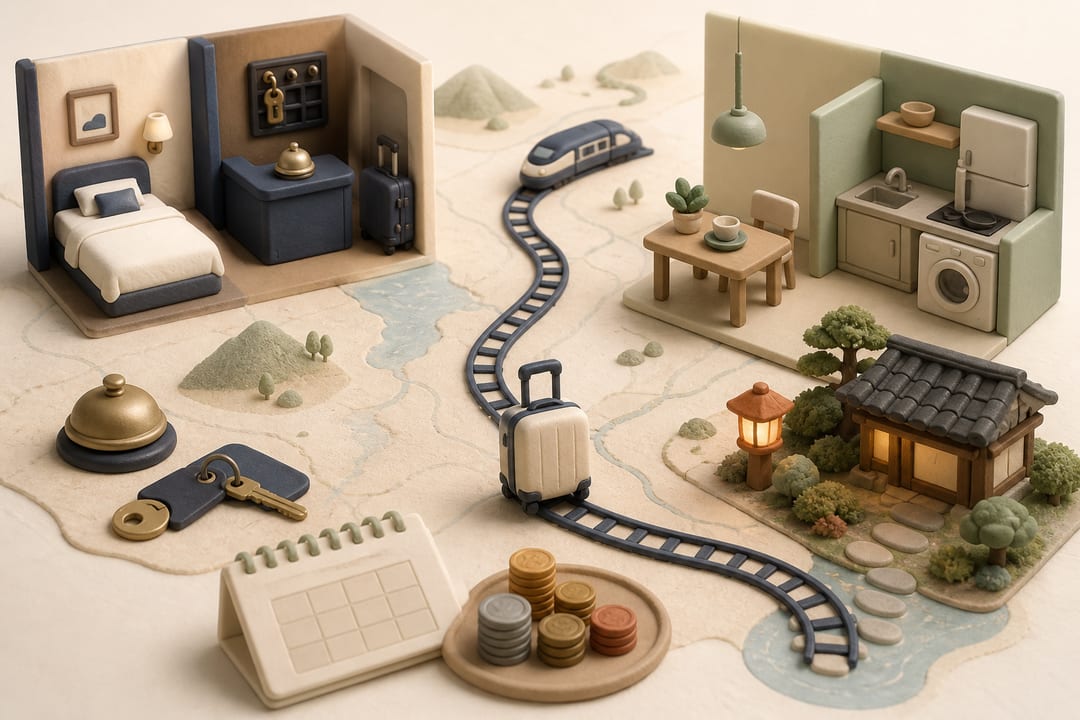
For a first solo trip across several Japanese cities, the best answer is usually not one accommodation type. It is the right property for each part of the route.
Imagine a first visit to Japan lasting about two to two and a half weeks. The traveler is going alone, expects to move between several cities, has not finalized the route, and wants to keep the entire lodging bill near USD 2,000.
Should every night be in a hotel? Would a vacation rental provide more space and better value? Is a mix needlessly complicated—or exactly what the trip needs?
The labels do not answer those questions. A compact hotel near the correct station may save time, simplify luggage forwarding, and provide support after a delayed arrival. A legal apartment-style stay may become useful during a longer stop when a washer and kitchen will actually be used. A ryokan can be a one-night experience rather than the default for an entire route.
The useful comparison is therefore not hotel versus Airbnb as brands or identities. It is total trip cost, route friction, verified services, and legal status for each stay.
Quick answer: For a first-time solo traveler changing cities every few days, a staffed hotel or business hotel is usually the lower-friction default. Compare a legal vacation rental or apartment-style property for a 4–6-night base only when its kitchen, laundry, or extra space has real value after cleaning fees, service fees, local tax, station access, cancellation terms, and luggage limitations are included. Keeping every stay in hotels is still a perfectly rational choice.
Editorial note: The opening scenario is an anonymized summary of user-provided material and has not been independently verified. Dates, cities, season, room requirements, real-time prices, exchange rate, and candidate properties were not supplied. This article is general travel-planning information, not legal, tax, security, or booking advice.
Let the Shape of the Itinerary Decide
A traveler who stays in one city for 16 nights has a different accommodation problem from someone making five stops in 16 nights. Before comparing listings, divide the itinerary into segments.
| Trip segment or need | Start the comparison with | Why |
|---|---|---|
| First night after an international flight | Staffed hotel with confirmed late-arrival process | Delays, directions, keys and immediate questions are easier to handle when support is available |
| One to three nights before changing cities | Hotel or business hotel near the station actually used | One-time rental fees and self-check-in effort are harder to justify on a short stay |
| Luggage forwarding or storage is important | Property with written luggage policies, often a hotel | A staffed receiving point is usually easier, but it must still be confirmed |
| Four to six nights in one city | Hotel, legal private lodging and apartment-style property | Laundry, a kitchen and living space may finally offset the added rules or fees |
| One memorable traditional stay | Ryokan, if the rate and schedule fit | It can be treated as a distinct experience instead of a trip-wide default |
| Social atmosphere or the lowest workable bed cost | Hostel or guesthouse | Dormitory, private-room, curfew, storage and bathroom details must be compared separately |
| Final night before an early departure | Hotel with a verified airport or rail connection | Route reliability may matter more than room size |
This framework produces a sensible default for a multi-city solo trip: use hotels for the high-friction movement days, then consider one longer apartment-style stay if it solves a specific problem. It does not require a rental. It simply gives one a fair place in the comparison.
“Hotel,” “Business Hotel,” and “Airbnb” Are Not Equivalent Categories
The Japan National Tourism Organization's accommodation overview describes several common options, including Western-style hotels, business hotels, ryokan, hostels and private lodging. The marketing name alone does not establish the exact room, services, price or legal route.
Business hotels
Business hotels are commonly simple, efficient and close to train stations. JNTO notes that their rooms are often compact—roughly 12–20 square meters as a general pattern. That can work very well for one person, but the exact room area and bed size matter. A 13-square-meter room with no useful place to open a suitcase is not interchangeable with a larger room merely because both are called “business hotels.”
Do not assume every hotel has a 24-hour desk, free breakfast, a coin laundry or the ability to receive forwarded luggage. Verify each service for the property, room and rate.
Full-service hotels
These may offer larger rooms, more staffed services and easier luggage handling, but none of those features should be inferred from a star label. For this itinerary, a full-service property should earn its higher total through location, flexibility or a service the traveler will use.
Ryokan
A ryokan may include tatami, futon, baths and meals, but inclusions vary by rate. Compare a room-only hotel with a room-only ryokan—or account for the actual value of dinner and breakfast. Check meal deadlines, check-in cutoff, bath arrangements and whether the selected rate accepts one guest.
Hostels and guesthouses
These can include dormitories, private rooms or both. “Guesthouse” is not a standardized promise about privacy or facilities. Confirm the room type, shared-bath setup, locker size, quiet hours, curfew, towels, laundry and all mandatory fees. A private room whose final total approaches a hotel rate should be compared on location, sleep quality and services rather than its category name.
Private lodging and apartment-style stays
In Japan, Airbnb is a booking channel, not a legal lodging category. A listing may operate under an Inns and Hotels Act permit, a Special Zone Private Lodging authorization, or a notification under the Private Lodging Business Act. The last category is often called minpaku.
Under the Private Lodging Business Act, a notified private lodging may operate for no more than 180 nights in each reporting year, and local rules can impose additional operating-period restrictions. That 180-night rule limits the operator; it is not a traveler entitlement and does not describe every apartment-style stay.
Treat “serviced apartment” as a description of functions, not proof of a separate nationwide license category. Verify the property's legal basis, front-desk or remote-support model, cleaning schedule, minimum stay, kitchen, washer, package policy and final price.
What a USD 2,000 Lodging Budget Really Allows
Do not allocate the entire USD 2,000 to advertised room rates. Reserve 10%–15% for local accommodation taxes, currency movement, card charges, a late itinerary change or one optional splurge.
That leaves a bookable target of USD 1,700–1,800:
| Trip length | Absolute ceiling with no buffer | With 10% buffer: USD 1,800 to book | With 15% buffer: USD 1,700 to book |
|---|---|---|---|
| 14 nights | $142.86 per night | $128.57 per night | $121.43 per night |
| 16 nights | $125.00 per night | $112.50 per night | $106.25 per night |
| 18 nights | $111.11 per night | $100.00 per night | $94.44 per night |
These figures are budget guardrails, not forecasts of Japanese room prices. Actual availability depends on the dates, cities, events, season, neighborhood, room, cancellation policy and booking timing.
Keep every candidate's original JPY checkout total and the date it was quoted. Convert all candidates on the same day using the same exchange-rate source. Recheck the rate before any later payment rather than using today's conversion to promise what a future trip will cost.
Compare the Checkout Total, Not the Search Card
A headline nightly price can omit the exact costs that change the decision. Airbnb's official pricing explanation says a home reservation total can include the nightly price, platform service fee, cleaning fee, other applicable fees and taxes. Hotels and other booking channels can also present taxes, meals and cancellation conditions differently.
Normalize every candidate into the same table:
| Cost or function | What to record |
|---|---|
| Room subtotal | Exact dates, one guest, exact room or listing and selected rate |
| Cleaning and service fees | Full checkout amounts, not a nightly search result |
| Local accommodation tax | Whether included, collected later or still unconfirmed |
| Breakfast | Included in this rate, available for a fee, or unavailable |
| Laundry | In-room, shared or service; cost, hours, detergent and dryer availability |
| Kitchen | Private or shared, plus actual appliances and cookware |
| Cancellation | Deadline in local time, refund after the deadline and any nonrefundable portion |
| Room and bed | Square meters, bed dimensions and usable suitcase space |
| Station access | Walk from the actual entrance to the station exit and rail line needed |
| Support | Desk hours, delayed-arrival process, emergency contact and language options |
| Luggage | Storage before/after the stay, receipt of forwarded bags and outbound shipment |
One-time rental fees are especially important on a multi-city route. A cleaning fee spread over six nights may be manageable; the same fee repeated across several two-night stays can destroy the apparent saving.
Cancellation is also property- and rate-specific. Airbnb's guest cancellation guide explains that the applicable policy appears on the listing and during checkout. Hotels similarly offer refundable and nonrefundable rates. Record the exact free-cancellation deadline rather than assuming one accommodation type is always more flexible.
A Legal Private-Lodging Checklist for Japan
Do not rely on the platform name, reviews or attractive interior photos as evidence that a property is authorized.
Japan recognizes multiple legal routes for private accommodation. The Japan Tourism Agency's minpaku guidance describes Inns and Hotels Act permits, Special Zone Private Lodging authorizations and Private Lodging Business Act notifications. Government guidance for intermediaries says listing information should identify the applicable notified housing and notification details. A legitimate property under another route may use a different permit or authorization format, so the correct question is not “Where is this one specific number prefix?” but “What legal route and number apply to this property?”
Before booking, record:
- The permit, authorization or minpaku notification number. Save the listing page and ask the property or platform if the legal basis is unclear.
- The operator or manager and emergency contact. Know who can respond when a self-check-in code, lock or appliance fails.
- The location and access. Confirm the practical walk, stairs, elevator, building entrance and any late-night access limits.
- The check-in identity process. Confirm how identity will be checked and which verified channel will collect required information.
- The complete price. Include cleaning, service fees, taxes payable later and foreign-currency costs.
- The cancellation terms. Save the policy shown for those dates and that rate.
- The actual amenities. A washer may not include a dryer; a kitchenette may not support the cooking imagined.
- The building and neighborhood rules. Review quiet hours, guests, shared areas, smoking and garbage sorting.
- The luggage plan. Never assume an unattended property can receive a suitcase.
- The support plan. Save arrival instructions offline and keep a backup contact method.
Do not move payment off the verified booking channel because someone claims it is needed to confirm a license or passport.
Passport Requests Can Be Normal—Verify the Recipient and Process
A passport request from a Japanese accommodation is not automatically suspicious. The Ministry of Health, Labour and Welfare says a foreign guest without an address in Japan must provide nationality and passport number in addition to normal guest-register information, present the passport, and allow the accommodation to retain a copy. Japan Tourism Agency guidance describes corresponding identification requirements for registered private lodging.
The safe interpretation is narrow:
- the request itself can be a legitimate part of check-in;
- the request does not, by itself, prove that the listing is legal;
- confirm the booked property, address, legal number and requester through the reservation or official property channel;
- provide only the information required for check-in through the property's confirmed process;
- never provide account passwords, payment-card passwords or unrelated financial credentials.
There is no single upload tool established here for every accommodation. If the property sends an unfamiliar link, verify it through a known contact before uploading identity documents.
Luggage Forwarding Is a Chain, Not a Hotel Amenity You Can Assume
Japan's luggage services can make a multi-city route much easier. JNTO's luggage and storage guide describes coin lockers, service counters, airport-to-hotel delivery and other hands-free options. Availability, cutoff times, dimensions, weight and excluded items still depend on the carrier and location.
The receiving property is part of the chain. Yamato Transport's vacation-rental precautions state that pickup and delivery are unavailable at an Airbnb-like accommodation when no staff member is present at a front desk. A service center may be an alternative, but that requires a separate plan.
Before sending a bag, obtain answers from both the carrier and the next accommodation:
- Will the property accept a bag before check-in?
- During which hours will staff be present?
- What guest name, reservation name and arrival date must appear on the shipping label?
- What delivery day should be requested?
- Can the current property arrange outbound shipment?
- If the next property is unattended, which carrier office can hold the bag and what identification is needed for pickup?
Hotels often make this easier, which is one reason they fit movement-heavy segments. But “hotel” still does not guarantee storage or delivery acceptance. Get the answer in writing.
Local Accommodation Tax Can Change the Winner
Accommodation tax is local, generally calculated per person and per night, and may not be included in the amount collected during booking. Even a solo traveler must calculate it for every taxable night.
As of this article's review date:
- Tokyo: The Tokyo Metropolitan Government's current rules use fixed per-person, per-night amounts for qualifying hotel and ryokan room charges. From April 1, 2027, Tokyo's announced revision changes the threshold and applies a 3% tax to taxable room charges of at least JPY 13,000 per person per night while expanding coverage to additional lodging categories, including private lodging. A trip that crosses that date must use the rule applicable to the actual stay night.
- Kyoto City: Kyoto's revised accommodation tax, effective March 1, 2026, uses five per-person, per-night tiers based on the accommodation charge. The lowest tier is JPY 200 and higher-priced stays can have materially larger amounts.
- Osaka Prefecture: Osaka's accommodation-tax schedule, effective September 1, 2025, uses JPY 200, 400 and 500 tiers for taxable per-person, per-night room charges and covers hotels, ryokan, simple lodging and specified private-lodging categories across the prefecture.
These examples are not a complete Japan tax guide. For every stop, record the jurisdiction, taxable base, rate for the stay date, whether the platform collected it, and any amount due at the property.
A Practical Mixed-Itinerary Pattern
The route should determine the exact cities, but the following pattern shows how functions can be assigned:
Nights 1–4: a staffed hotel near the first useful rail line
Use a property with a confirmed late-arrival process, enough luggage space and clear support. The purpose is to absorb international-arrival uncertainty and make the first days easy.
Nights 5–7: a compact hotel for a short second-city stay
Prioritize the station and route. A kitchen is unlikely to repay the effort of a two- or three-night rental unless there is a specific dietary or accessibility need.
Nights 8–12: compare a hotel with a legal apartment-style property
This is where an in-room washer, kitchen and table may matter. Compare the complete five-night cost, legal number, drying setup, garbage rules, cancellation and support. Choose the apartment only if those functions will be used and the final tradeoff is better.
One optional night: ryokan
Price the exact solo rate and meal plan. If the experience breaks the lodging buffer, it is optional—not a failed trip.
Final nights: return to a hotel with the right departure connection
Protect the flight or train day. Confirm whether the property can store or forward luggage and whether early departure is possible.
There is an even simpler valid answer: book hotels for the whole trip. A mix is a tool, not an objective.
A Six-Step Booking Workflow
1. Freeze the city sequence before optimizing rooms
Choose the order of cities and the number of nights in each. Fewer unnecessary moves reduce cleaning fees, check-in tasks, packing time and luggage-transfer risk.
2. Choose the useful station or neighborhood in each city
“Near a station” is too vague. Identify the line and station exit that serve the planned route, then measure the walk from the actual property entrance.
3. Collect three comparable candidates for each segment
Enter the same dates and one guest. Save the exact room or listing, full JPY checkout total, tax treatment, cancellation deadline, room size, support hours and luggage answer.
4. Check legality and operations before price
For private lodging, record the permit, authorization or notification. For every property, verify check-in, emergency support, laundry, luggage and late-arrival handling.
5. Normalize totals and apply the buffer
Add separately payable taxes and costs. Compare the result with the relevant USD 94–129 buffered nightly target, depending on trip length and buffer choice. Do not force every night to match the average: a less expensive short stay can create room for one ryokan night.
6. Book the chosen rate and schedule rechecks
Where a refundable rate is worth the difference, record its cancellation deadline in Japan local time. Recheck unfinalized bookings before that deadline, but do not cancel a workable reservation based only on a cheaper search-card price.
A Message to Send Before Booking
When a listing leaves important fields unanswered, send a concise confirmation through the verified property or platform channel:
Hello, I'm considering booking [room/listing] for one guest from [date] to [date]. Before I book, could you please confirm:
- the accommodation's applicable license, authorization, or minpaku notification number;
- the final total for these dates, including any cleaning or service fees, and whether local accommodation tax is included or payable on arrival;
- the exact cancellation deadline and refund terms for this rate;
- the room size and whether [private/shared] laundry and kitchen facilities are included;
- check-in and support hours, including the process if my arrival is delayed; and
- whether you can store luggage before or after the stay and receive or send luggage through a delivery service.
Thank you.
How Pine Can Keep the Route Organized
The decision is not difficult because of one hotel room. It becomes difficult when four stays have different currencies, taxes, cancellation deadlines, license details, check-in methods and luggage instructions.
Pine can help turn confirmations and checkout screenshots into one itinerary record containing:
- dates, nights, room type, JPY total and the comparable USD amount;
- taxes included and taxes still payable;
- permit, authorization or notification number;
- free-cancellation deadline in the correct time zone;
- front-desk hours, emergency contact and check-in instructions;
- washer, dryer, kitchen and room-size details;
- luggage acceptance, shipping date, reservation name and tracking number;
- missing answers that still need confirmation.
Pine cannot certify that a listing is legal merely because it appears on a platform, guarantee a future exchange rate, or promise that a hotel will accept luggage. It can make the evidence and unanswered questions visible before they become travel-day surprises.
Frequently Asked Questions
Is USD 2,000 enough for 2–2.5 weeks of solo accommodation in Japan?
It creates an absolute average ceiling of about USD 111–143 per night across 14–18 nights. After reserving 10%–15%, the practical booking target becomes about USD 94–129 per night. Whether that is enough depends on the dates, cities, neighborhoods, events, room requirements and cancellation flexibility. Use it as a cap, not a market-price claim.
Are Airbnb stays legal in Japan?
They can be, but the platform name does not establish legality. A property may operate under an Inns and Hotels Act permit, a Special Zone Private Lodging authorization or a Private Lodging Business Act notification. Verify the applicable legal route and number for the specific property.
Does the 180-night minpaku limit restrict how long a guest can stay?
The national rule limits how many nights a notified property may operate in its reporting year; local rules can add restrictions. It is not a universal promise about guest stay length and does not describe every licensed lodging route.
Is it normal for a Japanese hotel or minpaku to request a passport copy?
Yes. Japan requires foreign guests without a Japanese address to provide passport-related information and a copy for the guest register. Confirm that the request comes from the booked property through a verified process, and do not provide unrelated credentials.
Are hotels always cheaper than vacation rentals for solo travelers?
No. Neither category is always cheaper. Enter the exact dates and compare the complete total, including cleaning, service fees, tax, breakfast, laundry, transit and cancellation value. Short stays make one-time rental fees more significant.
Are Japanese business-hotel rooms too small for a solo traveler?
JNTO describes rooms around 12–20 square meters as a common pattern. Some solo travelers find that efficient; others need more suitcase or work space. Check the exact room area, bed and floor plan before booking.
Can a vacation rental receive forwarded luggage?
Never assume it can. Some unattended properties cannot receive carrier deliveries. Ask the property and carrier, then use a service center or another plan when no staff member can accept the bag.
Is accommodation tax included in the booking total?
Sometimes, but not always. Tax varies by destination, stay date, lodging category and taxable room charge. Confirm whether it has been collected or will be due at the property.
Should a solo traveler use a capsule hotel?
It can be useful for a short novelty or budget stay, but compare privacy, sound, luggage storage, bathing arrangements, check-in rules and the final total. It does not need to become the base for a two-week trip.
Is a mixed hotel-and-rental itinerary always better?
No. It is useful only when a longer stay makes the apartment functions worthwhile. An all-hotel itinerary may be simpler and better aligned with a movement-heavy route.
Official Sources
- Japan Tourism Agency: About the Private Lodging Business Act
- Japan Tourism Agency: Minpaku FAQ
- Japan Tourism Agency: Safety-assured private lodging
- Ministry of Health, Labour and Welfare: Passport presentation and copy requirements
- Japan National Tourism Organization: Accommodation in Japan
- Japan National Tourism Organization: Luggage and storage
- Tokyo Metropolitan Government: Accommodation tax
- Kyoto City: Accommodation-tax revision effective March 2026
- Osaka Prefecture: Accommodation tax
- Yamato Transport: Vacation-rental delivery precautions
This article provides general information only. Accommodation rules, tax, prices, exchange rates, carrier service areas and property policies can change. Confirm the rules and final terms that apply to the actual property, destination and dates before booking.