For a short Bangkok trip, the best accommodation is not always the one with the most space. It is the one that fits your priorities without adding avoidable uncertainty.
Quick answer: For a 10-day solo trip built around sightseeing, regular training, evening outings and easy logistics, a reputable hotel or professionally managed serviced apartment is usually the lower-friction choice. A hotel gives you clearer check-in, housekeeping, support and a more predictable operating setup. A serviced apartment can add a balcony, washing machine, refrigerator or kitchenette. A residential condo may look cheaper and more spacious, but you should verify the operator’s lawful basis for short stays and whether the building permits them before booking.
This guide focuses on Bangkok, Thailand, and a roughly 10-day stay. It separates two questions that are often mixed together: Which option suits your trip? and Is this particular short-term accommodation being operated lawfully? Thailand’s rules can depend on the property, operator, length and structure of the stay, and any applicable exception. This is general travel information, not legal advice.
Editorial note: This article uses an anonymized and generalized travel scenario. Names, usernames, exact comments, advertisements and identifying details have not been reproduced.
The trip profile that makes this decision difficult
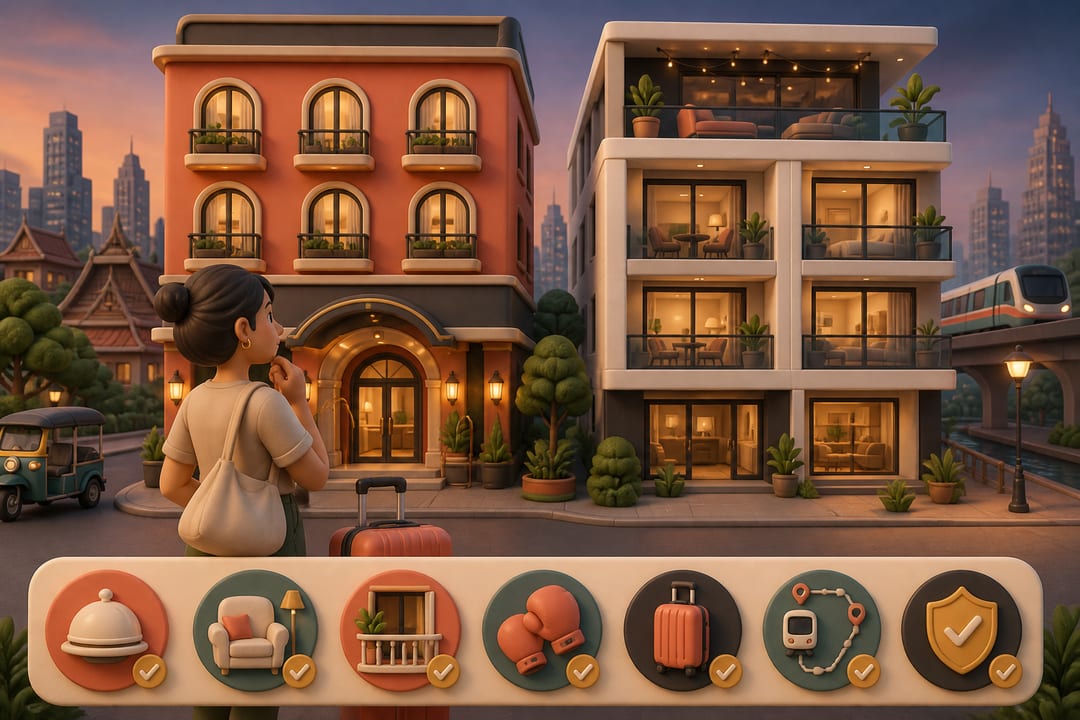
Imagine a solo professional in his mid-thirties planning ten days in Bangkok in September. The plan is a mix of daytime sightseeing, training at martial-arts gyms and evenings at polished bars or lounges. He would like a private balcony and hopes to keep the accommodation budget around $500–700.
That sounds like a simple hotel-versus-rental question until the practical requirements appear:
- A balcony is attractive after a long day, but it may be a room-specific feature rather than a building-wide amenity.
- A washing machine, refrigerator and microwave can be more valuable than a larger lobby.
- A room close to the gym may save more time and energy than a cheaper room farther away.
- Late-night arrival, key access and help with a problem matter more when traveling alone.
- A low nightly rate may not remain low after cleaning fees, service fees, deposits, transport and laundry.
- A bookable residential unit is not automatically the same thing as a licensed hotel.
The right choice is therefore a priority exercise, not a popularity contest between two accommodation categories.
The three options worth comparing
1. A conventional hotel
A hotel is usually the easiest option for a short stay. You can normally expect a defined check-in process, a staffed desk or on-site contact, housekeeping arrangements and a clearer escalation path if the room is not as described.
Hotels may also solve part of the lifestyle brief: a rooftop, lounge, gym, pool or restaurant can provide the “evening out” experience without requiring the room itself to do everything. Laundry service is convenient, although it may cost more than using an outside service.
The trade-offs are familiar: less living space, fewer kitchen facilities and a balcony that may not be available in every room category. A hotel room can also look affordable until breakfast, laundry, transport and taxes are added.
2. A professionally managed serviced apartment or aparthotel
This is often the most useful compromise for a 10-day trip. A well-run serviced apartment may offer more space, a private balcony, a refrigerator, a microwave, a kitchenette or an in-unit washer while still providing an identifiable operator and a more structured arrival process.
Do not treat the label alone as proof of legal status. “Serviced apartment” describes a style of accommodation, not a universal guarantee that every property has the same licence, registration or building permission. Ask the operator how the property is operated, whether short stays are accepted and what support is available during the booking.
Also confirm the housekeeping schedule. An apartment-style room may not include daily service, fresh towels or linen changes in the same way as a full-service hotel.
3. A residential condo offered for a short stay
This may appear to offer the best amenities: a balcony, a full kitchen, a washing machine and a home-like layout. It can be appealing when a hotel room feels too small or when the traveler wants to spend quiet evenings at home.
The uncertainty is operational as much as legal. Who meets you with the key? Is there a front desk? Can the building’s juristic office admit short-term guests? What happens if the access card stops working at night? Is the host allowed to offer the unit for the planned stay? Who handles a deposit dispute or a maintenance problem?
Positive reviews and a successful payment do not answer those questions. If the operator cannot explain the arrangement clearly, the apparent savings may be buying you a problem you will have to solve while traveling.
What Thai accommodation rules mean for a short stay
The legal point is more nuanced than a simple “under 30 days is illegal” rule.
The Department of Provincial Administration’s government-hosted English information translation of the Hotel Act B.E. 2547 (2004) defines a hotel as accommodation established for business purposes to provide temporary accommodation to travelers or other persons in exchange for compensation. The same definition excludes accommodation established to provide accommodation for a monthly-paid service charge or upward only, along with other prescribed categories. The English translation is marked unofficial; the original Thai law remains authoritative.
That framework matters because a paid, temporary stay may fall within regulated hotel activity unless a specific exclusion or exception applies. It does not mean that every short-term rental can be labeled illegal, and it does not mean that a listing is compliant merely because it is available to book.
The 2023 Royal Gazette ministerial regulation describes a narrow category of small accommodation that is not treated as a hotel when the stated conditions and prescribed process are met. The published conditions include no more than eight rooms, no more than 30 guests in total, temporary paid accommodation operated as supplemental income, inspection and a notification letter from the registrar. The room-and-guest count is not an automatic exemption. Older online summaries may still mention a four-room/20-person threshold, so check the current regulation rather than relying on an outdated summary.
The practical takeaway is simple: do not rely on a slogan about a 30-day threshold. Ask what the property is, who operates it, what legal basis the operator relies on and whether the required conditions or notification apply. If you need a low-uncertainty trip, choose an accommodation that can answer those questions before you pay.
Bangkok’s authorities also continue to review alleged unlicensed hotel businesses. For example, a Huai Khwang District report dated August 10, 2026 describes a review of alleged hotel businesses operating without permission and inspections of establishments’ operating licences. This does not predict what will happen at any particular property, but it is a useful reminder that “it seems common” is not the same as “it is verified.”
For international visitors, ask who will handle the required residence notification. The Immigration Bureau’s TM.30 guidance explains the online residence-notification process, and the official public handbook describes the Section 38 reporting duty for a house-master, owner, possessor or hotel manager receiving a foreign visitor. TM.30 is a separate immigration reporting issue—not proof that a property has a hotel licence or permission under condominium rules.
A decision matrix for a 10-day Bangkok stay
| Your highest priority | Usually the strongest starting point | What to verify |
|---|---|---|
| The simplest arrival and backup support | Hotel | Check-in hours, front desk, late arrival process and emergency contact |
| Balcony plus apartment-style amenities | Serviced apartment or aparthotel | Exact room type, private balcony, washer, kitchenette and housekeeping |
| Lowest legal and operational uncertainty | Hotel or clearly identified professional operator | Property type, operating identity and booking terms |
| Space and a home-like evening routine | Serviced apartment | Cleaning schedule, kitchen inventory, maintenance response and deposit terms |
| Easy access to training | Any property near the gym or a reliable transit connection | Door-to-door travel time at the hours you will actually train |
| A controlled $500–700 accommodation budget | Compare total trip cost across options | Taxes, service fees, breakfast, laundry, deposits and transport |
| Late nights while traveling alone | Staffed hotel or serviced apartment | Building access, lighting, reception and the route from transit |
The table is a starting point, not a ranking of neighborhoods or properties. In Bangkok, a prestigious area can still be inconvenient if it leaves you far from the gym or a practical BTS/MRT connection. Choose the commute you will repeat, not just the map pin that looks attractive.
How to compare the real cost
Start with the full amount you will pay, not the headline nightly rate. For each option, record:
- room rate and taxes;
- service, cleaning or platform fees;
- security deposit and refund conditions;
- breakfast and drinking-water costs;
- laundry or dry-cleaning costs;
- transport to the gym, airport and evening destinations;
- cancellation and date-change rules; and
- any charge for an early arrival or late checkout.
For a ten-day stay, a slightly higher room rate may be worthwhile if it saves daily transport, makes laundry easy and gives you a reliable check-in. The reverse can also be true: a cheaper room far from your gym may consume time and money every day.
If the budget is strict, decide which amenity is truly non-negotiable. A balcony, full kitchen, in-unit washing machine and luxury neighborhood may not all fit within the same total. A hotel with a small refrigerator plus nearby laundry can be a better overall match than an unverified condo selected only because it includes a washer.
Questions to ask before booking a short-term unit
Send these questions in writing and keep the answers with your confirmation:
- What type of accommodation is this? Is it a hotel, serviced apartment, aparthotel or residential condominium?
- Who is the operating entity or host? Ask for the name used for the booking and the contact responsible during the stay.
- How is a stay of this length permitted? Ask the operator to explain the relevant licence, registration or official exception rather than accepting “everyone does it.”
- Does the building permit short-term guests? Confirm how guests receive keys, access cards and building instructions.
- What exactly is included? Confirm the private balcony, view, washer, refrigerator, microwave, cookware, towels and housekeeping frequency.
- What is the late-arrival plan? Ask who can help if your flight or transport is delayed.
- What happens if something goes wrong? Confirm the response time for a lockout, plumbing issue, air-conditioning problem or room mismatch.
- What is the total cost? Ask for every mandatory fee, the deposit process and the refund timeline.
- What are the cancellation and relocation terms? Understand what happens if the operator cannot honor the booking.
- Is the balcony private and usable? A rooftop terrace or shared outdoor area is not the same as a balcony attached to your room.
If the answers are vague, contradictory or delivered only as pressure to pay immediately, pause before booking. A clear answer is part of the product you are buying.
A practical itinerary-first choice
For this type of trip, use the itinerary to choose the room:
- Training first: Shorten the route to the gym. Confirm the commute at training time, not only during a quiet midday map search.
- Sightseeing second: Pick a transit connection that makes multiple days easier. BTS or MRT proximity can matter more than a slightly larger room.
- Evenings third: If you plan to visit lounges, confirm the route home, building access and whether the property has a staffed arrival process.
- Recovery every day: Air conditioning, sleep quality, a comfortable shower and a way to wash clothes may be more valuable than decorative luxury.
- Balcony as a bonus or requirement: If it is essential, ask for the exact room category and written confirmation. Do not rely on a building photo.
This often leads to a hotel or serviced apartment with the right room features, rather than a generic short-term condo in a supposedly perfect neighborhood.
A simple booking decision tree
Choose a hotel if you value predictable check-in, staff support, housekeeping and a clear operating identity more than kitchen space.
Choose a professionally managed serviced apartment or aparthotel if you need a balcony, laundry or kitchenette and the operator can clearly explain the accommodation’s operating basis and guest process.
Consider a residential short-term rental only after the operator explains the lawful basis for the stay, the building accepts the arrangement and the access, deposit, cancellation and support terms are documented. If those answers are missing, keep looking.
You can use Pine to organize listing details, total-cost notes, host messages, building rules and unanswered questions into one dated comparison before you commit. Pine does not verify a property’s licence, guarantee a booking or replace official customer service or professional advice.
Frequently asked questions
Is a short-term rental under 30 days illegal in Bangkok?
There is no safe one-line answer for every property. Thailand’s Hotel Act regulates temporary paid accommodation, while the legal framework also contains exclusions and a narrow small-accommodation category with stated conditions. The current category described in the 2023 regulation uses an eight-room/30-guest threshold alongside inspection and notification requirements. Verify the property, operator, building rules and applicable licence or notification instead of relying on a blanket 30-day claim.
Is a hotel better than a short-term rental for ten days in Bangkok?
Usually, a hotel is the lower-friction option for a solo traveler who prioritizes easy arrival, support, housekeeping and location. A serviced apartment can be better when a balcony, washer, refrigerator or kitchenette matters more and the operator is professionally managed and properly documented.
Can I get a balcony in a Bangkok hotel?
Often, but it depends on the exact room category and property. Confirm that the booking includes a private balcony, not only a rooftop, shared terrace or floor-to-ceiling window. Ask whether the balcony is usable and whether any smoking or noise rules apply.
Are serviced apartments a safe compromise?
They can be. A serviced apartment may combine hotel-style support with apartment amenities, but the label is not a universal legal guarantee. Confirm the operator’s identity, short-stay process, building access, housekeeping and the property’s operating basis.
Should I choose a place with a washing machine?
Only if the convenience justifies the total cost and any additional uncertainty. Compare the price and turnaround of hotel laundry or nearby laundry services with the value of an in-unit washer. Do not choose an unclear residential arrangement solely to avoid paying for laundry.
How important is staying near my gym?
Very important if you plan to train regularly. Bangkok’s heat, traffic and travel time can turn a “nearby” listing into a daily burden. Check the actual route from the property to the gym at the hours you expect to travel.
Do positive reviews prove that a short-term property is compliant?
No. Reviews can help you assess cleanliness, noise and check-in, but they do not prove the operator’s licence, building permission or legal basis for the stay. Treat compliance as a separate verification question.
Official sources
- Department of Provincial Administration: Hotel Act B.E. 2547 (2004), government-hosted English information translation
- Royal Gazette: Ministerial Regulation on Hotel Business Categories and Operation Criteria (No. 2), B.E. 2566 (2023)
- Department of Provincial Administration: hotel and non-hotel accommodation service guidance
- Department of Lands: Condominium Act and related regulations
- Immigration Bureau: TM.30 residence-notification system
- Immigration Bureau: Section 38 public handbook
- Bangkok Metropolitan Administration, Huai Khwang District: review of alleged unlicensed hotel businesses
- Bangkok Metropolitan Administration public-service portal
This article provides general travel and accommodation information, not legal advice. Rules and remedies can depend on the property, operator, building, contract, current regulations and facts. For a property-specific concern, ask the operator for documentation and consult the relevant local authority or a qualified professional before booking.