If you're trying to decide between Claude, ChatGPT, and Gemini, let me save you hours of trial and error. As an AI reviewer at 19pine.ai, my name is Millie, and I test these tools by throwing my actual daily workload at them. In this guide, I’m giving you my unfiltered field notes on which AI assistant genuinely wins in 2026 based on real-world tasks. We’ll cover who is best for writing, coding, and heavy research, complete with a breakdown of their $20/month pricing tiers. By the end of this read, you'll know exactly which tool to open the next time you have a task you're dreading to start.
Quick comparison table
Strengths, pricing, best for, at a glance
| Tool | What it's best at (in real life) | Where it gets annoying | Paid plan most people compare | Best for |
|---|---|---|---|---|
| Claude (Anthropic) | Long-form writing, calm tone control, handling big docs without getting weird | Occasional "I'm not sure" hedging: fewer consumer integrations | Pro: $20/mo | Writers, operators, people living in documents |
| ChatGPT (OpenAI) | Versatility: writing + coding + "do the thing" tasks: strong ecosystem | Can overconfidently answer: you still need to verify | Plus: $20/mo | Generalists who want one tool for almost everything |
| Gemini (Google AI) | Research workflows plus Google-adjacent convenience: very competitive value tiers | Output quality can vary by task: depends on which model/tier you're on | AI Pro: $19.99/mo (or AI Plus $7.99) | People who want research + storage + daily utility in one bundle |
If you're skimming: ChatGPT is the best "Swiss Army knife," Claude is the best "writer/editor who doesn't panic," and Gemini is the best "research companion that comes with a bunch of practical extras."
And yes, this is the bit most people miss: for most professionals, the winner isn't "which AI is best 2026," it's which one is best for the specific task you dread starting.
Best for writing
Long-form quality and tone consistency
I write for a living, so I'm picky in a way that's honestly a little annoying. I'm not looking for "pretty sentences." I'm looking for:
- Tone that holds steady across 1,500–2,500 words (not just the first three paragraphs)
- Clean structure that doesn't feel templated
- Edits that respect my intent (not rewriting my point into something safer and blander)
On long-form, Claude is the one I trust to stay coherent the longest. It's particularly good at taking a messy outline (or a brain-dump from my project management board) and turning it into something that reads like a human wrote it on purpose.
ChatGPT is close, and sometimes faster to get to "good enough." But if I'm doing sensitive tone work (client voice, subtle persuasion, avoiding marketing-speak), I find myself doing more steering: "Don't be salesy. Stop summarizing. Keep the same level of detail."
Gemini can absolutely write, but in my testing it's a little more variable. Some drafts land clean: others come out with that faintly "polished but generic" vibe. If you're writing something where originality matters, thought leadership, a strong POV, a narrative intro, Claude tends to require fewer passes.
Winner + why
Winner: Claude.
Not because it's magical, but because it's consistent. When I'm writing between 3–5 video calls a week, the winning feature is reliability: Claude is the one that most often gives me a draft that feels like a real starting point, not a template I have to resuscitate.
Best for coding
Benchmark scores
If you're hoping for a neat "Tool A got 92, Tool B got 88" moment, benchmarks exist, but they age fast and don't map perfectly to your actual repo.
So I treat benchmarks like restaurant ratings: useful for screening, not for deciding. In 2026, the practical reality is that top-tier ChatGPT and Claude models are both strong at everyday coding tasks (debugging, refactors, explaining unfamiliar code). Gemini has improved a lot, but I still see more variance depending on the prompt and the complexity.
Real task results
Here's what I actually care about as someone who codes to ship a thing (not to win a contest):
- "Read this file and tell me what's wrong." ChatGPT is very good at stepping through code behavior and proposing fixes in a way that feels like pair programming.
- "Refactor this without breaking it." Claude is careful and readable, but sometimes too cautious, great for safety, slower for momentum.
- "Generate a script and edge-case it." ChatGPT tends to be the most "full-stack helpful" here: it will draft, test mentally, suggest logging, and offer alternatives.
In the middle of a Tuesday, I gave both Claude and ChatGPT the same annoying task: untangling a small automation that was failing silently (the worst kind). ChatGPT got to a usable fix faster. Claude got there too, but I had to push it harder to stop hedging and commit to a likely cause.
Winner + why
Winner: ChatGPT
For coding, I want decisive help that's easy to iterate with. ChatGPT is the most consistently useful for real-world dev work, especially if you bounce between "write code," "explain the error," and "document what we changed" in the same sitting.
Best for research and analysis
Context window comparison
For research-heavy work, context is oxygen. If the model can't "hold" what you've given it, you waste time re-explaining, exactly what none of us have.
As of March 2026 pricing pages:
- Gemini AI Pro advertises up to 1M context (and higher tiers go further).
- Claude Team/Enterprise commonly references 200K context as standard.
- ChatGPT doesn't present context sizes in the same marketing-forward way, and capabilities vary by plan/model.
Translation: if your life involves big PDFs, long transcripts, or multi-document synthesis, Gemini and Claude are the two I reach for first, Gemini for sheer headroom, Claude for "I can actually read this output without sighing."
Accuracy and citation quality
Let's be honest: all three can hallucinate. The difference is how they behave when the ground is shaky.
- Claude is generally better at stating uncertainty in a way that's still useful (not just "I'm not sure" and then nothing).
- ChatGPT can be very persuasive even when it's wrong. I don't say that to scare you, just to remind you that confidence isn't accuracy.
- Gemini is solid for synthesis, and it fits naturally into "search-and-summarize" style work. But I still verify anything that looks like a hard claim.
I don't guess. I verify. If I'm publishing or sending something to a client, I want:
- citations that map cleanly to the claim
- the ability to trace back to source language
- a model that doesn't invent "helpful" specifics
In that lane, I've had the best luck with Gemini for breadth and Claude for clean reasoning. If you're asking "gemini vs claude vs gpt for research," my answer is: Gemini for massive context and speed, Claude for careful analysis that reads like a competent colleague.
Winner + why
Winner: Gemini (by a nose).
The context headroom matters, and the pricing bundles make it easier to justify if research is a daily habit. Claude is a close second for analysis quality, especially if you value clarity over volume.
Best for daily use
Free tier comparison
If you're trying to figure out which AI is best 2026 for everyday work without committing immediately, the free tiers matter more than companies want to admit.
Here's the practical read:
- Claude Free: limited messages, but you still get a lot of the product experience (and features like Artifacts). Good for "I need to write something decent today."
- ChatGPT Free: limited access (notably limited GPT-5.3), but it's enough to learn whether the workflow fits you.
- Gemini Free: basic access: it's fine for lightweight tasks, but you'll feel the ceiling sooner if you do heavy research or long-context work.
If you're only using AI occasionally, like drafting a stubborn email or summarizing meeting notes, free is workable on all three. If you're using it daily, the paid tiers are where the friction drops.
Mobile experience
I do most "real work" from home, but my actual life happens in little pockets: in line for coffee, between errands, before boarding a flight. Mobile matters.
- ChatGPT is the most consistent "open the app, ask, get something usable" experience for me. (Note: App Store billing is separate, so follow this guide to cancel ChatGPT subscription on iPhone if you subscribed there and plan to switch).
- Gemini feels natural if you're already living in Google's world, and it's strong for quick research.
- Claude on mobile is perfectly fine, but I use it more intentionally, when I'm sitting down to write or revise.
Winner + why
Winner: ChatGPT.
For daily use, I want the tool that's hardest to break with a rushed prompt. ChatGPT is the most forgiving when I'm time-pressured and writing with one thumb.
Pricing breakdown
Free / Plus / Pro tiers compared
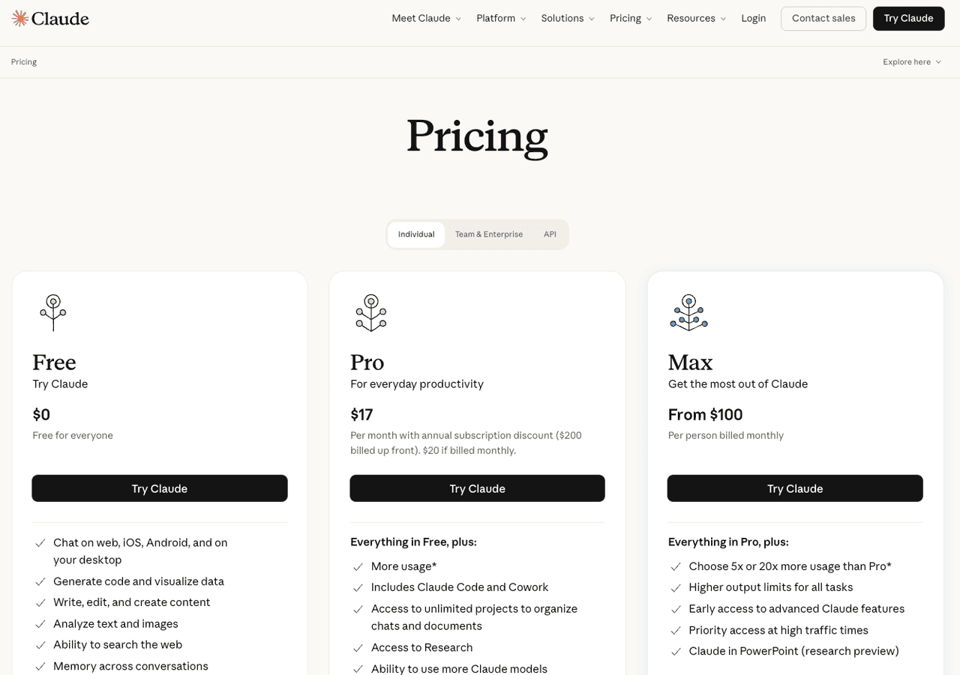
Pricing shifts, promotions come and go, and annual discounts muddy the waters. But as of March 2026 (US pricing), here's the cleanest comparison across Anthropic vs OpenAI vs Google AI.
| Tool | Free | Mid tier | Top individual tier |
|---|---|---|---|
| Claude | $0 (limited) | Pro: $20/mo ($17/mo annual) | Max: $100–$200/mo |
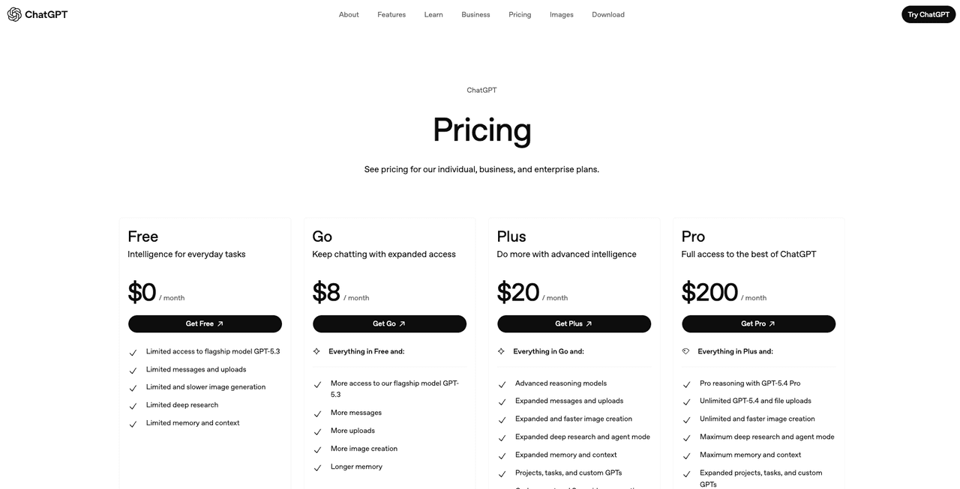
| ChatGPT | $0 (limited GPT-5.3) | Plus: $20/mo (also Go $8/mo) | Pro: $200/mo |
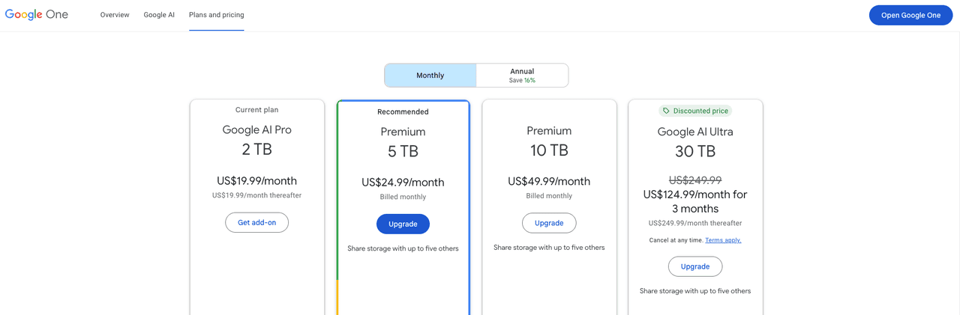
| Gemini | $0 (basic) | AI Plus: $7.99/mo (promo sometimes $3.99) | AI Pro: $19.99/mo: AI Ultra: $249.99/mo (promo) |
What I'd actually tell a friend:
- If you want one paid plan and you'll use it daily, $20/mo is the real battleground (Claude Pro vs ChatGPT Plus vs Gemini AI Pro).
- Gemini's value looks better if you also care about the bundled storage and the "one subscription for a few needs" feel.
- The $200+ tiers are for people pushing limits constantly. Most professionals don't need them unless AI is central to their output. If you are rethinking your current setup, here is a quick guide on how to cancel ChatGPT Plus subscription so you can switch tools easily.
One more small note: Gemini is the most explicit about family sharing and plan bundles. That can matter if you're trying to justify the spend without adding yet another line item you'll resent later.
Decision tree — which should you use?
If you only read one part, make it this. Here's how I decide when I'm staring at my calendar and trying not to add "compare AI tools" as a new chore.
- If your main goal is writing that sounds like you (long-form, sensitive tone, fewer rewrites) → Pick Claude Pro.
- If you need the most flexible assistant (coding + drafting + random problem-solving in the same day) → Pick ChatGPT Plus.
- If your work is research-heavy (big docs, synthesis, "pull the threads together") and you like the idea of bundled value → Pick Gemini AI Pro
If you're not ready to pay yet:
- Start with ChatGPT Free if you want a broad test drive. *(If you're already on a paid tier and want to downgrade instead, here is how to cancel ChatGPT subscription).
- Start with Claude Free if you mainly want better writing.
- Start with Gemini Free if you mainly want quick research and you're already comfortable in Google's ecosystem.
My colleague-level verdict: there isn't a single winner in the claude vs chatgpt vs gemini debate. There's a winner for your most expensive annoyance. For me, writing is the bill I pay every week, so Claude earns its spot. But when I need a tool that will handle whatever lands in my inbox next (and it will), ChatGPT is still the one I keep within arm's reach.
I've laid out everything you need. The rest is up to you.
If you’re tired of the "emotional tax" of customer service, let our autonomous agents step in. With Pine, you only pay when we successfully complete your task, making it a risk-free way to lower your bills or secure refunds. Start your first task with Pine for free.
Frequently Asked Questions (Claude vs ChatGPT vs Gemini)
Claude vs ChatGPT vs Gemini: which AI assistant is best in 2026?
There isn’t one universal winner in the Claude vs ChatGPT vs Gemini debate—it depends on the task. ChatGPT is the most versatile “Swiss Army knife,” Claude is best for consistent long-form writing and tone control, and Gemini shines for research workflows, big-document synthesis, and value bundles.
Which is better for long-form writing: Claude or ChatGPT or Gemini?
For long-form writing, Claude tends to be the most consistent, especially for 1,500–2,500-word drafts that need steady tone and non-templated structure. ChatGPT can be faster but may need more steering to avoid generic phrasing. Gemini can write well, but quality feels more variable by task and tier.
Is ChatGPT better than Claude for coding and debugging?
For everyday coding work, ChatGPT often feels like the strongest “pair programmer” for debugging, iterating on fixes, and generating scripts with edge cases. Claude is careful and readable but can hedge more and move slower without additional prompting. Gemini has improved, but results can vary with complexity and prompts.
What’s best for research on big PDFs and long transcripts—Gemini or Claude or ChatGPT?
For research-heavy work with large inputs, Gemini and Claude are usually the top picks. Gemini AI Pro advertises up to 1M context, which helps with massive PDFs and multi-doc synthesis. Claude is strong for careful analysis that reads cleanly. ChatGPT can work well, but context details vary by plan/model.
How much do Claude Pro, ChatGPT Plus, and Gemini AI Pro cost per month?
As of March 2026 US pricing, the most-compared plans cluster around $20/month: Claude Pro is $20/mo, ChatGPT Plus is $20/mo, and Gemini AI Pro is $19.99/mo. Gemini also offers AI Plus at $7.99/mo. Higher “power user” tiers jump to $200+ monthly.