A tidy showing tells you how a rental looks. Running every promised system tells you how it may actually live.
Quick answer: During the tour, verify the legal space, run the heat and any promised air conditioner, trace moisture and pest entry points, listen with the windows and HVAC in different states, test the exact parking maneuver, walk the laundry route and test internet where you will work. Save the listing and put every important promise—AC, screens, parking, laundry, Wi-Fi, shared-space rules and repairs—into the lease or a signed addendum. A condition can be a poor fit without being a code violation, and a code-compliant room can still be a poor fit for you.
Editorial note: The opening scenario is an anonymized summary of user-provided community material. The property, landlord, conditions and communications were not independently verified. This article does not identify or accuse a landlord. It provides general California information, not legal advice, an inspection or a health diagnosis. City and county rules may differ.
The Rental Looked Fine Until Daily Life Began
A renter described moving into a small private rental in the San Gabriel area. The space appeared acceptable during the showing, but several problems reportedly became clear only after ordinary use.
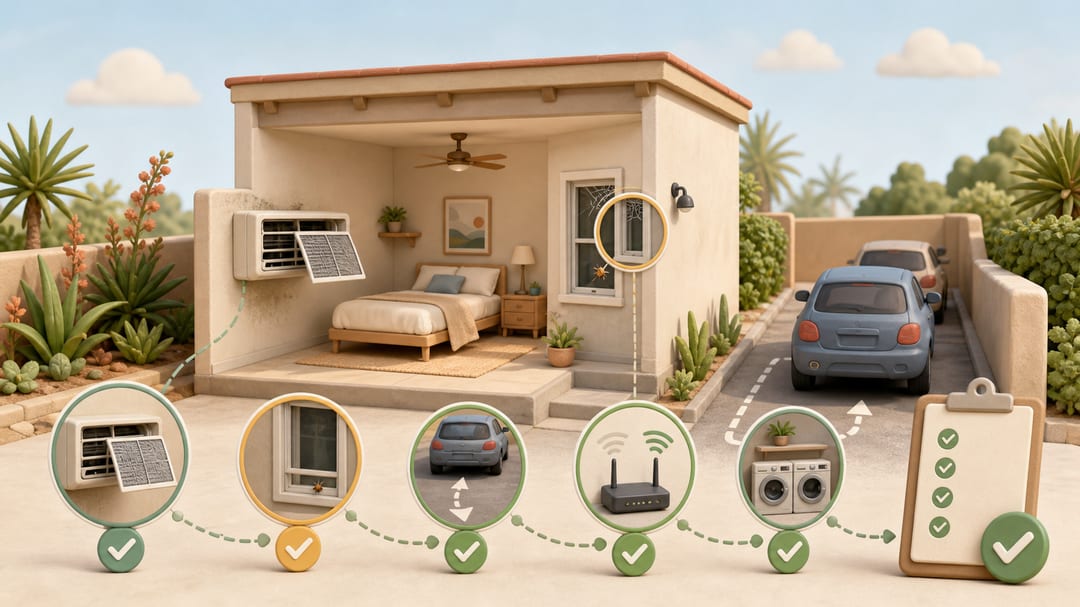
Outdoor insects repeatedly entered from a garden-facing doorway. The renter wanted to add an insect screen but said the owner objected to its appearance. A wall air conditioner reportedly developed an unpleasant odor after it ran. Household noise carried into the room. The “parking space” required backing around other vehicles. Laundry was shared and reached by an outdoor route. Internet advertised as fast reportedly struggled with remote work and gaming.
At move-out, even the key return and a simple receipt became more complicated than expected.
None of those claims has been independently verified. More importantly, the labels do not supply automatic legal conclusions:
- one spider or cricket is not automatically an infestation;
- hearing ordinary household activity is not automatically a breach of quiet enjoyment;
- California generally requires adequate heat, but does not impose one universal statewide requirement that every ordinary rental have air conditioning;
- the sources reviewed do not establish a universal California rule requiring every exterior door or openable window to have an insect screen;
- a washer, dryer, parking space or Wi-Fi connection is not automatically a statewide habitability requirement; and
- an awkward parking maneuver can be a decisive practical problem even when it violates no housing code.
The lesson is not “avoid every private landlord.” It is:
Do not inspect a private rental as a furnished room. Inspect it as a system you will operate every day.
Separate Three Different Decisions
Renters often collapse three questions into one emotional reaction.
| Decision | What it asks | Who or what answers it |
|---|---|---|
| Legal baseline | Does the unit substantially lack required housing conditions, or does a local code apply? | California law, local code and an authorized inspector or court |
| Contract delivery | Did the landlord provide the specific unit, facility or service promised? | Listing, lease, addenda, messages, condition records and performance |
| Personal fit | Can you tolerate the real noise, parking, laundry, ventilation and internet arrangement? | Your own tests and priorities |
A room can pass the code baseline but fail your personal fit test. An included amenity can be contractual without being a habitability essential. A bad smell can justify investigation without proving the substance, cause, health effect or legal responsibility.
This distinction makes a tour more useful. You do not need to prove the room “illegal” to decide it is wrong for you.
Minute 0–5: Identify the Space and the People
First determine what is actually being offered. “Studio,” “private suite,” “back house,” “converted garage,” “ADU” and “room with private entrance” are marketing descriptions, not permit findings.
Ask:
- Am I renting one bedroom, an entire dwelling unit, an ADU or a JADU?
- Which kitchen, bathroom, yard, entrance, laundry and parking areas are exclusive or shared?
- Who owns the property, signs the agreement, receives rent and handles repairs?
- Does the owner personally live on the property?
- How many lawful occupants share each facility?
- Is anyone claiming that the arrangement is a single-lodger situation?
- What permit or final-inspection record supports a converted or accessory space?
California’s special single-lodger provision is narrow. It concerns one lodger in a dwelling personally occupied by the owner, where the owner retains access and overall control. An owner’s relative living nearby—or a listing casually using “lodger”—does not settle the status. California Civil Code § 1946.5
A bed, kitchenette and side entrance also do not prove that a garage or storage conversion was approved for living or sleeping. Health and Safety Code § 17920.3 identifies inadequate exits and portions used for living, sleeping, cooking or dining that were not designed or intended for those uses as potential substandard conditions. California Health and Safety Code § 17920.3
For a City of San Gabriel property, the city’s ADU information page and planning/building departments are the appropriate starting points. If the address is outside city limits, use the county that actually has jurisdiction.
Minute 5–10: Run the Heat and Any Promised AC
Do not accept “it works” while the equipment remains off. Ask permission to operate it long enough to observe startup, airflow, noise and odor.
Heat and AC are not the same legal question
California Civil Code § 1941.1 expressly includes heating facilities that complied with applicable law when installed and remain in good working order. California’s general statewide habitability list does not impose the same universal rule requiring air conditioning in every ordinary rental. California Civil Code § 1941.1
An installed or advertised AC still matters. The lease may promise it, local rules may apply, and a defective unit may create a separate moisture, electrical, mechanical or health-and-safety issue. Distinguish “this rental has no AC” from “this installed AC produces a persistent musty odor, leaks or appears unsafe.”
Use your senses as evidence, not a diagnosis
The California Department of Public Health treats a musty or moldy odor, visible water damage, damp material and visible mold as useful signs that moisture should be investigated. CDPH also explains that California has no residential mold-spore threshold that can declare a room medically or legally safe. If moisture or mold is visible or smelled, finding and correcting the water source is more useful than buying a number from an air sample. CDPH: Frequently Asked Questions About Mold
During the tour:
- Run the heat and confirm that it serves the rented space.
- Run every offered AC mode for several minutes.
- Compare the odor before startup and while air is flowing.
- Listen for rattling, grinding or water movement.
- Look at accessible filters, return grilles and visible condensate areas without dismantling equipment.
- Inspect nearby walls, ceilings and flooring for staining, bubbling paint, warping, rust, condensation or softness.
- Test the bathroom fan, kitchen ventilation and dryer exhaust.
- Ask for the dates of the last HVAC service, filter change, leak repair and moisture complaint.
EPA notes that cooling coils, condensate pans and other HVAC components can become moisture-contamination sources. Persistent odor, wet components or visibly contaminated insulation may require an appropriately qualified HVAC or building professional—not air freshener as a substitute for diagnosis. EPA: Should You Have the Air Ducts in Your Home Cleaned?
Before signing, California residential landlords must provide prospective tenants the state’s mold booklet. The booklet is useful education, but receiving it does not replace an exact-unit inspection or a written repair promise. California Health and Safety Code § 26148, CDPH renter mold booklet
Minute 10–15: Trace Pests, Openings and Ventilation
An occasional outdoor insect and a recurring indoor pattern are different observations. Record what exists instead of choosing the legal label first.
California’s tenantability statute addresses cleanliness and accumulations of rodents and vermin, while Health and Safety Code § 17920.3 addresses insect, vermin or rodent infestation as determined by the appropriate official. Severity, repetition, harborage, breeding, structural entry points, sanitation and control of the affected area all matter. California Civil Code § 1941.1(a)(6), California Health and Safety Code § 17920.3(a)(12)
Look at:
- door bottoms and thresholds;
- window frames and tracks;
- gaps around pipes, cables and AC penetrations;
- baseboards and cabinet backs;
- garage, attic and crawlspace connections;
- water heaters, sinks and other moisture sources;
- standing water, yard debris and trash storage;
- repeated webs, egg sacs, droppings, dead insects or traps; and
- the route between outdoor plants and the rented space.
EPA’s integrated-pest-management approach starts with identifying the pest, monitoring the pattern, removing food and water, and correcting entry or harborage conditions. One sighting does not always require broad pesticide treatment. EPA: Integrated Pest Management Principles
Do not assume a screen is either guaranteed or forbidden
The statewide sources reviewed require weather protection, unbroken doors and windows, specified locks, required ventilation and safe emergency egress. They do not establish a universal tenant right to an insect screen on every ordinary California door and window.
Local codes, a special housing type, an existing screen or the lease may produce a different result. If opening a garden-facing door or window is the practical ventilation plan, ask during the tour:
- Which doors and windows have operable insect screens?
- May a removable screen be installed, and who approves the design?
- Who maintains it?
- Can it be opened immediately for emergency egress?
- What alternative ventilation is available if the door must remain closed?
Put the answer in writing. Do not install a fixed screen or security device that blocks an exit or violates the agreement.
Minute 15–20: Listen to the Actual Sound Sources
Silence during a scheduled daytime showing is weak evidence. If quiet matters, visit at the times you will sleep, work and return home.
Listen with:
- windows closed, then normally open;
- HVAC off, then running;
- the entry door closed;
- laundry or gates operating, if possible; and
- ordinary activity in shared rooms.
Record the source and time: road traffic, aircraft, trains, gates, pumps, AC compressors, laundry, pets, music, voices, footsteps or shared plumbing. A 30-second phone recording can preserve your comparison, although a phone decibel app is not a calibrated enforcement finding.
California Civil Code § 1927 protects quiet possession, but it does not create an absolute right to silence. Whether recurring noise creates a lease, nuisance or quiet-enjoyment issue depends on severity, duration, source, notice and the landlord’s ability to control it. California Civil Code § 1927
Ask neutral questions:
- What are the written quiet hours, and do they apply equally to everyone?
- What recurring building or street sounds should I expect?
- How are complaints documented and addressed?
- How many lawful occupants share the walls, hall, kitchen, bathroom, laundry and driveway?
Do not ask whether children live nearby or seek “adults only” housing as a noise-screening shortcut. California prohibits housing discrimination based on familial status and restricts inquiries and advertisements expressing that preference. Evaluate measurable sound and neutral rules, not protected family characteristics. California Government Code § 12955
Minute 20–25: Perform the Parking and Laundry Chore
“Parking included” does not tell you whether the space works. “Laundry available” does not tell you whether it is convenient.
Test parking with the vehicle you will use
Ask to see the exact space. Then:
- drive the entry and exit route;
- perform the real forward or reverse maneuver;
- measure tight clearance rather than estimating it;
- identify every tandem vehicle and who must move it;
- confirm whether spaces are assigned or first-come;
- locate curbs, low landscaping, gates and blind corners;
- check overnight street restrictions and permit requirements;
- identify the remote, key or code;
- ask about guest parking and towing; and
- write the space and arrangement into the lease.
A difficult reverse-in space may be lawful and still be a daily dealbreaker. Decide from a real maneuver, not a sketch or verbal assurance.
California added separate unbundled-parking requirements for certain qualifying residential properties beginning with specified 2025 tenancies, but the statute contains location, property and other boundaries. Do not assume that every private room, ADU or existing lease must separate parking from rent. Verify whether Civil Code § 1947.1 applies to the exact property. California Civil Code § 1947.1
Walk the laundry route with a basket
Confirm:
- which washer and dryer are included;
- how many households share them;
- access route, lighting and gate keys;
- hours, reservations and load limits;
- per-load cost and payment method;
- detergent and storage rules;
- dryer exhaust and ventilation;
- repair contact; and
- the alternative during an outage.
A washer and dryer are not universal statewide habitability requirements. But when laundry access is advertised or written into the agreement, failure to provide it can be a contract or amenity dispute. California DRE specifically advises that promises and referenced rules should appear in the rental agreement and be reviewed before signing. California DRE: When You Have Decided to Rent
Minute 25–30: Test Wi-Fi, Locks and the Written Deal
“High-speed Wi-Fi” is not a performance specification. If internet matters for work, school or gaming, test from the exact desk and sleeping area—not beside the owner’s router.
Record:
- internet service provider and plan;
- whether the network is landlord-provided or independently available to the unit;
- download speed, upload speed, latency and packet loss during the visit;
- router location and whether Ethernet access is possible;
- how many households share the connection;
- equipment, installation and recurring costs;
- outage contact and backup plan;
- whether the tenant may order separate service; and
- any data, bandwidth or device restrictions.
One speed test is a snapshot, not a guarantee. Repeat it at a likely busy time if the decision depends on performance. California’s CPUC broadband mapping can identify potential address-level providers, but availability data does not prove installation timing or in-unit performance. California Public Utilities Commission: Broadband Mapping Program
For residential tenancies covered by Civil Code § 1942.8 beginning, renewing or continuing periodically in 2026, a tenant generally must be allowed to opt out of paying for a third-party internet subscription provided for the tenancy. The rule has boundaries and does not mean a landlord must provide free internet or that every landlord-operated shared network is covered. California Civil Code § 1942.8
Before leaving, test the main door deadbolt and applicable window locks. Ask who holds copies of bedroom, unit, gate, mailbox and parking keys; what happens to prior occupants’ access; and how key return will be documented. California Civil Code § 1941.3 sets specific lock and window-security baselines, but the official sources reviewed do not create a universal rule that every ordinary California room or ADU must automatically be rekeyed between all tenancies. California Civil Code § 1941.3
Turn Every Important Amenity Into a Testable Promise
The listing is evidence, but it is not the final agreement. Save it before it changes, then convert vague claims into terms that can be verified.
| Listing phrase | A testable written term |
|---|---|
| “Air conditioning” | Equipment type, rooms served, tenant control, energy charge, filter responsibility and repair process |
| “Good ventilation” | Operable windows/fans, screens on identified openings, any approved removable screen and responsibility for maintenance |
| “Quiet” | Neutral quiet hours, known recurring mechanical/shared-space sounds and complaint process |
| “Parking included” | Exact space, assigned or shared status, tandem order, access device, towing rule and separate cost |
| “Laundry available” | Machines, route, users, hours, reservations, load limits, price and outage alternative |
| “High-speed Wi-Fi” | Provider, plan, cost, equipment, unit-level test, shared-use limits and separate-service option |
| “Private entrance” | Which entrance, who has keys, shared path, lighting, gate and notice/entry arrangement |
| “Utilities included” | Each utility, usage cap, shared-meter allocation, equipment restrictions and adjustment process |
The DRE warns that there is no single universal lease form and recommends getting landlord promises and all referenced rules in writing. After a written agreement is executed, the owner must provide a copy within the time required by Civil Code § 1962. California DRE: Rental Agreement Terms, California Civil Code § 1962
If the owner promises to clean the AC, seal a door gap, add a screen, treat pests or clarify parking before move-in, write the exact task and completion date in the lease or a signed addendum. “We will take care of it” is difficult to audit.
Confirm the Correct San Gabriel Jurisdiction
An address using “San Gabriel” in its mailing line is not necessarily inside the City of San Gabriel. Nearby unincorporated areas may use a neighboring city name for mail while receiving municipal services from Los Angeles County.
Use the City of San Gabriel boundary and service-locator page or LA County’s jurisdiction lookup before assuming which agency controls permits, code enforcement or housing complaints.
If the address is inside the City of San Gabriel
The city’s Code Enforcement Division handles matters including property maintenance, unpermitted construction, zoning and substandard housing. The city’s Code Enforcement page and official report portal provide current routing. The city directs loud-party and certain noise complaints to the San Gabriel Police Department rather than Code Enforcement.
If the address is in unincorporated Los Angeles County
The county’s Rental Housing Habitability Program addresses covered rental-housing conditions and investigates habitability complaints. Its inspection materials cover matters such as vermin, mold, heat, plumbing, ventilation and sanitation, but program coverage and exemptions depend on the property. LA County DPH: Rental Housing Habitability Program
Unpermitted-use or zoning questions may instead involve LA County Planning or Building and Safety. One complaint form does not decide every issue.
If a Problem Appears After Move-In
Report observable facts, not a diagnosis or accusation.
Subject: Request to inspect and correct condition at [room or area]
On [date/time], I observed [specific condition] at [exact location]. The condition occurs when [reproducible trigger—for example, the AC has operated for approximately 10 minutes]. I have attached dated photos/video and preserved the original listing and relevant lease term.
Please confirm an inspection time, the person who will attend, and the planned next step. I am available for access during [windows]. If the condition requires more than one visit, please provide the next written update date.
I am requesting an inspection and correction; I am not making a final conclusion about the cause.
California’s repair framework generally turns on notice and a reasonable time under the circumstances—not one universal 24- or 48-hour deadline for every odor, insect or amenity problem. Civil Code § 1942’s 30-day language is a rebuttable presumption in a technical tenant-remedy framework; urgent conditions may require faster action. Do not withhold rent, repair and deduct, break the lease, change locks or use pesticides unsafely without verifying the conditions and risks. California Civil Code § 1942
Keep:
- dated wide and close-up photos or video;
- a written odor description and operating trigger;
- pest count, location and recurrence dates;
- sound source, time and duration;
- original listing and lease clause;
- repair notices and delivery proof;
- appointments, entry notices and contractor findings; and
- completion photos and written follow-up.
Protect the Move-In and Move-Out Baselines
Complete a room-by-room condition record before unpacking. Photograph the AC, vents, ceilings, windows, screens, doors, locks, walls, floors, appliances, parking space, laundry and shared paths. Send it to the landlord and retain proof of delivery.
At move-out, request the statutory initial inspection when applicable, document final condition and create a simple key handoff record identifying the date, time and number of keys, remotes and parking devices returned. California does not require one universal statewide “key surrender” form, but possession-return evidence can matter for rent, condition and the deposit timeline.
Civil Code § 1950.5 generally requires the security-deposit balance and itemized statement within 21 calendar days after move-out and limits deductions to specified categories rather than ordinary wear and tear. The statute also includes current move-in and move-out photograph requirements and an initial-inspection process. California Civil Code § 1950.5
If the landlord wants a receipt acknowledging that the deposit was returned, read the exact language. “I received $X on [date]” is not the same as “I release every claim.” Do not sign a broader settlement statement you do not understand merely to complete a key exchange.
Use a Three-Column Decision Before Paying
| Status | Evidence pattern | Action |
|---|---|---|
| Pass | Exact space and parties identified; systems tested; shared facilities workable; important promises written | Compare total cost and lease with other finalists |
| Clarify before signing | One odor, gap, amenity or rule needs explanation; repair is promised; jurisdiction or permit is uncertain | Request documents, signed repair deadline or official confirmation |
| Walk away | Cannot see exact space; heat fails; active water damage or serious safety issue; material conditions concealed; parking or access differs from listing; owner refuses all written clarification | Do not pay merely because the room is competitive |
A code minimum is not a recommendation. If the reverse parking maneuver, shared laundry route, normal household sound or internet arrangement does not work for your routine, choose a different rental without needing to prove anyone violated the law.
Where Pine Fits
Open Pine to keep the original listing, tour checklist, permit and jurisdiction results, proposed lease, house rules, condition photos, repair promises and messages in one dated file. Pine can help separate confirmed terms from unresolved questions and prepare a focused pre-signing or repair request for review.
Pine cannot inspect an AC, identify mold or pests, verify a permit, measure noise, authenticate a landlord or replace a California lawyer, housing counselor, contractor or code official.
Frequently Asked Questions
Is a musty smell from a rental air conditioner proof of mold?
No. A musty odor is a moisture or indoor-air-quality signal worth investigating, not proof of a mold species, health effect, code violation or responsible party. Record when the odor occurs, inspect for moisture signs and request an appropriate HVAC or building investigation. California has no residential mold-spore threshold that makes an air test a universal pass/fail answer.
Does a California landlord have to provide air conditioning?
California’s general statewide habitability list expressly requires adequate heating, not air conditioning in every ordinary rental. An installed or advertised AC may still be enforceable under the lease and must not create a separate unsafe, moisture or mechanical condition. Local rules and specialized housing may differ.
Are spiders or crickets in a California rental automatically a habitability violation?
No. One incidental outdoor insect is an inspection clue, not automatic proof of infestation. Record species if known, number, frequency, entry route, breeding or harborage evidence, moisture and affected areas. Repeated or severe activity and structural entry conditions warrant a different response from one sighting.
Must every California rental have window and door screens?
The statewide sources reviewed do not establish that universal rule for every ordinary room or ADU. California does require specified weather protection, windows and doors, locks, ventilation and safe egress. Local codes, special housing types, an existing feature or the lease may add screen obligations. Confirm the exact property and write important screens into the agreement.
Can I ask whether children live above or next to a rental because I need quiet?
Do not use children or familial status as a proxy for noise. California restricts housing discrimination and inquiries based on familial status. Ask about neutral quiet hours, recurring sound sources, shared walls and complaint procedures, then visit at realistic times and listen for yourself.
Is slow Wi-Fi a habitability problem?
Internet service is not generally listed as a basic California habitability requirement. It can still be a contract issue when a specific service was advertised or promised. Define the provider, plan, cost, equipment, service area and separate-service option in writing, and test where you will actually work.
Does “parking included” guarantee an easy or exclusive space?
No. The phrase does not identify the stall, access, tandem arrangement, towing rule or whether another person must move a vehicle. See and use the exact space, then put the assignment and cost into the lease. Separate unbundled-parking rules apply only to qualifying properties and tenancies.
What should I do if the landlord promises to fix the AC or seal pest gaps before move-in?
Put the exact work, access needed and completion date in the lease or a signed addendum. Reinspect before paying the full move-in amount or accepting possession when the issue is material to your decision. A text saying “we cleaned it” is less useful than a defined scope and a verified result.
Which agency handles a rental near San Gabriel?
First confirm whether the parcel is inside the City of San Gabriel or in unincorporated Los Angeles County. Mailing addresses can be misleading. City properties use San Gabriel’s relevant planning, building, code or police channels; unincorporated properties use the applicable LA County program.
Related 19Pine Guides
- Renting a Room in a California House? 9 Checks Before You Move In
- How to Choose an Apartment in Los Angeles: A Commute, Cost and Block-by-Block Checklist
- Ants in a Rental: Is Pest Control the Landlord’s or Tenant’s Responsibility?
Official Sources
- California Civil Code § 1941.1 — tenantability
- California Civil Code § 1941.3 — entry-door and window locks
- California Civil Code § 1942 — reasonable time and tenant remedies
- California Health and Safety Code § 17920.3 — substandard housing
- California Government Code § 12955 — housing discrimination
- California DRE — Inspecting Before You Rent
- California DRE — Rental Agreement Terms
- California DRE — Repairs and Amenities
- California Department of Public Health — Mold FAQ
- EPA — Integrated Pest Management Principles
- City of San Gabriel — Code Enforcement
- LA County DPH — Rental Housing Habitability Program
This article provides general information, not legal advice. The applicable rules and remedies depend on the exact property type, address, agreement, condition, notice, cause and jurisdiction.