Repeated repair problems are easier to address when a renter separates immediate safety issues, building-code complaints, contract claims, personal losses and rent-relief options.
Quick answer: In Milwaukee, repeated maintenance failures do not automatically create a right to a full rent refund, and a renter should not simply stop paying rent. Wisconsin law generally places responsibility on the landlord to keep landlord-controlled parts of the property and landlord-supplied equipment in reasonable repair, including equipment used to provide services such as water or an elevator, and to comply with applicable housing codes. If a serious condition remains unresolved, notify management in writing, preserve the evidence, contact the City of Milwaukee Department of Neighborhood Services (DNS) about a building, fire-code or safety issue, and get advice before pursuing rent abatement. Milwaukee has a formal rent-withholding process for eligible properties with an active overdue DNS order; that is different from unilaterally withholding rent. For an active fire, suspected gas leak or immediate danger, leave the unsafe area and call 911.
This article uses Milwaukee, Wisconsin as the jurisdiction. It is a general information guide, not legal advice. The correct remedy depends on the lease, the exact condition, the length of the disruption, the landlord’s response, the building’s code status and the facts of the individual tenant’s claim.
A Concrete Scenario: Many Small Failures Can Become One Serious Pattern
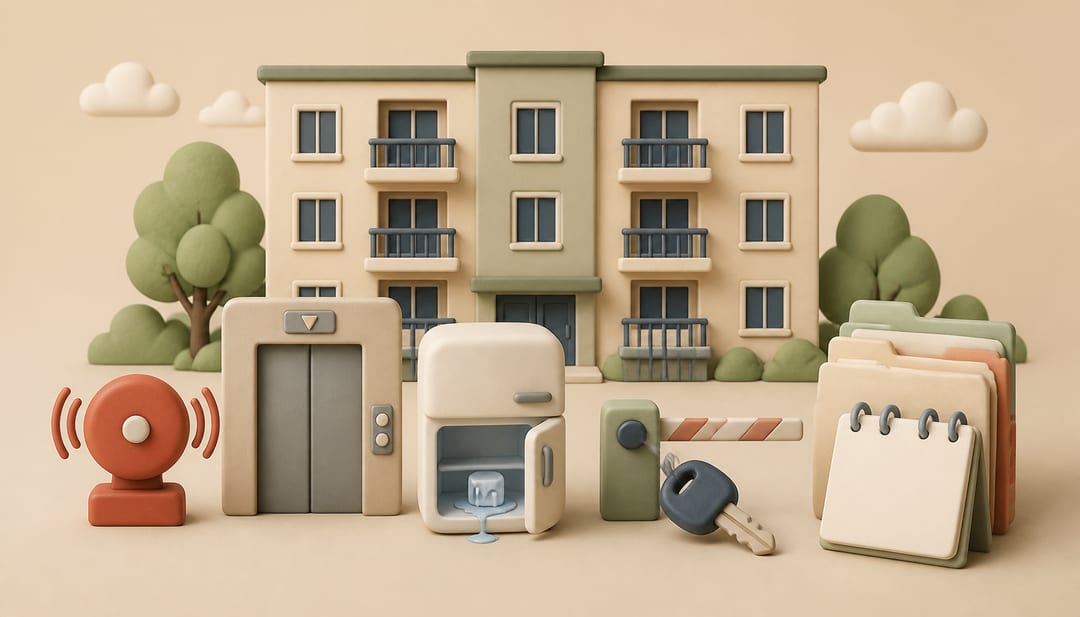
Imagine a renter in a Milwaukee apartment building dealing with several problems in a short period:
- a garage gate fails, requiring paid overnight parking elsewhere;
- an elevator stops working, leaving residents to communicate the problem on multiple floors;
- hot water is unavailable for a day;
- a landlord-provided refrigerator repeatedly fails, and food is lost before the appliance is finally replaced; and
- a fire alarm in a vacant neighboring unit sounds intermittently and then continuously for hours, even after emergency maintenance is contacted and firefighters have checked the unit.
The renter is not necessarily asking for a perfect building. The more useful question is whether management is responding to each condition promptly, safely and in a way that creates a record of what was fixed, when it was fixed and what the disruption cost.
The price or marketing label of the apartment does not decide the legal standard. A high-rent building does not guarantee that every amenity will work every minute. But a premium rent also does not erase the landlord’s duties to maintain the premises, respond to material safety problems or follow Milwaukee’s building and fire-code process.
First Sort the Problem Into the Right Track
One email can describe several different legal and practical issues. Classify the problem before deciding what to ask for.
| Track | Examples | First response | Possible next channel |
|---|---|---|---|
| Immediate danger | Fire, smoke, suspected gas, exposed live wiring, structural danger or another active threat to life | Leave or avoid the area; call 911 or the appropriate emergency service from a safe location; then notify management | Fire department, emergency services and DNS as appropriate |
| Building or fire-code concern | Persistent alarm, unsafe common-area condition, failed life-safety equipment or a condition that may violate code | Report the condition and preserve the response record; ask for a documented inspection or repair | Milwaukee DNS |
| Essential service failure | Loss of water, hot water, heat or another service the landlord agreed to provide | Notify emergency maintenance and management promptly; explain exactly what is unavailable | Management, DNS and tenant-support or legal resources if unresolved |
| Common-area or amenity failure | Elevator, garage gate, laundry equipment, parking access or another shared facility | Check the lease and amenity terms; record how access and use were affected | Management first; DNS if the condition is a building or safety violation |
| Appliance and personal-property loss | Repeated refrigerator failures, spoiled food or damaged belongings | Report the appliance problem, document each failed repair and preserve receipts and photographs | Management, insurer and qualified legal or tenant-support help |
| Service and communication failure | No ticket, missed visit, inaccurate closeout or dismissive response | Send a concise written recap and request a specific next action and date | Management escalation, DNS, DATCP or legal help depending on the issue |
These tracks can overlap. A failed refrigerator may be a routine repair on day one, a repeated breach of a lease promise after several failed visits and a personal-property claim when food is lost. A continuous fire alarm may begin as a nuisance but become a safety and code issue if it is not corrected.
What Wisconsin Law Says About Repairs
Wisconsin’s landlord-tenant rules are not a promise that every repair will be completed instantly. They do, however, recognize a landlord’s duty to maintain property and landlord-controlled equipment.
Wisconsin Department of Agriculture, Trade and Consumer Protection (DATCP) guidance explains that a landlord is responsible for repairs necessary to comply with local housing codes and to keep the premises safe. Wisconsin Statute § 704.07 also describes duties involving portions of the premises under the landlord’s control, equipment used to supply agreed services such as heat, water and elevators, structural repairs and applicable local housing codes. DATCP: Tenants’ Rights and Responsibilities
That framework makes several distinctions important:
- The landlord’s duty is not limited to the inside of the rented unit. Common areas and building-controlled equipment can matter when they affect the tenant’s use or safety.
- The tenant’s own negligence or improper use can change responsibility. The landlord’s duty is not a blanket promise to pay for damage caused by the tenant or the tenant’s guests.
- A repair request is not automatically a money judgment. The duty to investigate or repair and the tenant’s possible claim for a rent credit, damages or abatement are related but separate questions.
- A lease clause is not always the end of the analysis. Wisconsin DATCP says residential agreements cannot waive certain statutory duties, but the exact wording and facts still need to be reviewed.
Elevator, water and hot water are not all the same claim
Section 704.07 expressly uses equipment supplying services such as heat, water and an elevator as examples of landlord-controlled equipment. That does not mean every one-day outage automatically entitles the tenant to a specific refund. Duration, cause, notice, access to alternatives, the lease and the effect on the tenant all matter.
For an elevator outage, ask:
- Was the elevator included as part of the building’s services or represented in the lease or marketing materials?
- Was the tenant unable to access the unit, move essential items or use the building safely?
- Was there a functioning alternative, and did the outage create an accessibility or safety problem?
- What did management do, when did it do it and when was service actually restored?
For a water or hot-water outage, record the exact start and end time, which fixtures were affected, whether the water was unsafe or merely unavailable, and what instructions or alternatives management provided. Do not guess at a technical cause; document the observable condition and ask for the repair record.
A Persistent Fire Alarm Deserves a Safety Record, Not Just a Noise Complaint
A continuously sounding alarm in a neighboring vacant unit may be caused by wiring, a malfunction or another issue. A resident should not diagnose or repair the system personally. The important facts are where the alarm is located, when it started, whether it is intermittent or continuous, whether emergency responders inspected it, what management was told and whether the alarm continued afterward.
For an apartment building in Milwaukee, the Milwaukee Fire Department’s FAQ directs residents with apartment-building smoke-alarm concerns to the Department of Neighborhood Services at (414) 286-2268. DNS’s residential code-enforcement page says it enforces the Milwaukee Code of Ordinances and applicable local, state and national fire codes on apartments and responds to complaints. Milwaukee Fire Department FAQs · Milwaukee DNS: Residential Code Enforcement
Use the emergency lane when the facts indicate an active danger. If there is fire, smoke, a suspected gas leak, a carbon-monoxide concern, visible electrical arcing or another immediate threat, leave the area and call 911. A known wiring problem does not make an alarm safe to ignore; it means the condition needs to be routed to the responsible building or fire-safety authority.
Milwaukee DNS: What It Can and Cannot Do
The City’s Department of Neighborhood Services handles building-related complaints, including apartment building defects and code issues. DNS asks residents to contact the landlord or building owner first, then contact DNS if the response is not satisfactory or the owner is unresponsive. The complaint process asks for the property address, the responsible landlord or manager, a description of the problem and access for inspection. Milwaukee DNS: Complaint Process
DNS can investigate a potential code violation and, where appropriate, issue an order requiring correction. The city’s code-violation information explains that orders are legal documents directing an owner to make repairs within a time limit based on the severity of the condition and the inspector’s judgment. In serious cases involving critical life-safety items or extended loss of utilities, the city may take stronger enforcement steps.
DNS is not a substitute for a civil claim. The city’s guidance distinguishes code enforcement from disputes about cancelling a lease, reimbursing a tenant’s expenses or refunding rent. Those questions may require negotiation, a rent-abatement process, legal advice or a court proceeding, depending on the facts.
If you file a complaint, save:
- the complaint date and confirmation number;
- the inspector’s name and contact information;
- the alleged violation or order number, if one is issued;
- inspection dates and access arrangements;
- photographs, videos and repair invoices; and
- every later notice, rent demand or adverse action.
The record matters both for getting the condition corrected and for evaluating any later rent-relief or retaliation issue.
Rent Abatement Is Not the Same as Rent Withholding
The most dangerous mistake in a repair dispute is treating every kind of rent relief as “just don’t pay.” Milwaukee and Wisconsin have different concepts that should not be collapsed into one instruction.
1. A negotiated rent credit
A renter can ask management for a written credit or reimbursement. The request can cover a defined period and a specific loss, such as:
- a documented period when part of the unit could not be normally used;
- a documented loss of a building service included in the lease;
- reasonable temporary parking costs caused by a failed access system; or
- another expense that the lease or an agreement makes the landlord responsible for.
Management may accept, reject or negotiate. If it agrees, ask for the amount, the affected dates, what the credit covers, whether it changes the next rent balance and whether it resolves any other claim. A written agreement is much safer than relying on a phone promise.
2. Statutory rent abatement
Milwaukee DNS explains that Wisconsin law may allow a tenant to abate, or reduce, part of the rent when conditions make part of the unit unusable. Wisconsin Statute § 704.07(4) addresses conditions that materially affect health or safety or substantially affect use and occupancy. If the tenant remains in possession, the statute does not authorize withholding the entire rent; the potential reduction is tied to the loss of normal use.
This is fact-sensitive. A short outage of one amenity, an unusable bedroom, a failed refrigerator and a continuous alarm may have different effects. The tenant should calculate the dates and functional impact, not choose a percentage because it feels fair. Get advice from a Wisconsin tenant advocate or lawyer before applying a unilateral reduction.
3. Milwaukee’s formal rent-withholding process
The city describes a separate rent-withholding program. Occupants may apply when the rental property has an active overdue DNS order. Rent is then paid to the city’s escrow process rather than directly to the owner, and requests require inspector approval. That process is not the same as stopping payment on your own because management missed a repair appointment. Milwaukee DNS: Code Violation Process
If you are considering rent withholding, call DNS and ask:
- whether the property has an active overdue order;
- whether the reported condition falls within the program;
- whether your tenancy or property type is excluded;
- what application and payment steps apply; and
- whether a tenant-support organization should review your situation first.
Until you have confirmed the correct process, keep rent current and keep proof of payment. Wisconsin DATCP warns that partial, late or unpaid rent can expose a tenant to termination and eviction procedures. DATCP: Tenants’ Rights and Responsibilities
What to Do About Spoiled Groceries and Extra Parking Costs
The tenant’s direct loss can feel obvious, but reimbursement is not automatic. Separate the categories of loss and document the connection.
Spoiled food after refrigerator failure
Create a simple loss record:
| Field | Example of what to preserve |
|---|---|
| Date and time | When the refrigerator stopped cooling and when the food was discarded |
| Appliance history | Service requests, repair visits, replacement date and technician findings |
| Food list | Item, approximate quantity, purchase date and reasonable replacement value |
| Proof | Receipts, photographs, payment records and a short explanation of why the food was unsafe to keep |
| Notice | When management was told and what response was provided |
Then check the lease, the appliance warranty and the renter’s insurance policy. The Wisconsin Office of the Commissioner of Insurance explains that renters insurance coverage depends on the policy’s terms, conditions, limits and the cause of loss. The landlord’s insurance generally protects the building, not the tenant’s personal belongings. Wisconsin OCI: A Brief Guide to Renter’s Insurance
Do not assume that a refrigerator’s mechanical failure is covered, and do not assume that it is excluded. Ask the insurer what evidence and deductible apply. If the loss is below the deductible, a claim may not be economical; it can still be useful to ask whether reporting is required under the policy.
Extra parking after a garage failure
Keep the parking receipt, the dates the garage was unusable and the repair notices. Ask management in writing whether it will reimburse the reasonable cost or apply a credit. The result may depend on whether the garage was included in the lease or a paid amenity, whether the tenant could reasonably use another entrance, how long the failure lasted and whether management provided a workable alternative.
Do not characterize the expense as a legal entitlement until the lease and facts have been reviewed. Make the request specific and supported by the actual receipt.
Build a Repair Timeline Before You Ask for Money
Repeated failures are persuasive only when the sequence is clear. A timeline should distinguish the condition from management’s response.
| Date/time | Condition | Notice or action | Response promised | What actually happened | Impact or cost | Evidence |
|---|---|---|---|---|---|---|
| May 3, 7:00 p.m. | Refrigerator not cooling | Maintenance ticket opened | Inspection next day | Technician attended; no lasting fix | Food at risk | Ticket, photo, receipt |
| May 18, 8:00 a.m. | Elevator unavailable | Email to manager | Update by noon | Update received at 4 p.m. | Stairs only | Email, building notice |
| June 2, 6:00 p.m. | Neighboring alarm continuous | Emergency line and 911 response by another resident | Technician to attend | Alarm continued overnight | Sleep and quiet use disrupted | Call log, video, responder information |
Use one row per event. Avoid combining six months of frustration into one paragraph. A decision-maker can evaluate a dated record much more easily than a general statement that “management never fixes anything.”
Send a Focused Written Request
After an emergency call, send a short recap through the management portal or the email address listed in the lease. Keep the tone firm and factual.
Subject: Written repair and rent-credit request — [unit] — [condition]
I am documenting the following condition at [address and unit]: [observable condition]. It began on [date/time] and is [intermittent/continuous/worsening]. The affected area or service is [location]. At present, [what is usable and what is not].
I reported this through [maintenance channel] on [date/time]. I was told [summary of response]. The condition was [repaired/inspected/marked complete], but [describe what remains]. Attached are [photos, videos, receipts, prior tickets and notices].
Please confirm in writing: (1) the current work-order number, (2) who owns the next action, (3) the next appointment or update time, (4) any safe interim instructions and (5) whether management will provide a written credit or reimbursement for the documented period and costs listed below.
My requested review is [specific credit, reimbursement or rent-abatement discussion] for [dates and amount or calculation]. This request does not waive any rights or admit responsibility for a cause that has not been established.
For a life-safety concern, do not wait for email to replace an emergency call. Use the emergency channel first, then create the written record.
A Practical Decision Framework
| If this is happening | Do this now | Do not assume |
|---|---|---|
| Fire, smoke, suspected gas or immediate danger | Leave, call 911 and notify management from safety | That a previous inspection makes a continuing alarm safe |
| Persistent apartment-building alarm or suspected code issue | Report management’s response and contact DNS about the building/fire-code concern | That a noise complaint alone will create rent relief |
| Water, hot water or another essential service is unavailable | Open an emergency work order, state the exact outage and preserve start/end times | That one outage automatically sets a refund percentage |
| Elevator or garage access fails | Check lease/amenity terms, request a repair update and keep alternative-expense receipts | That a broken amenity automatically permits withholding rent |
| Refrigerator repeatedly fails | Preserve repair history, food-loss evidence and the replacement record; ask about insurance and a written credit | That the landlord or insurer must automatically pay every grocery loss |
| Management closes the ticket without a working repair | Reply with current evidence and ask to reopen or explain the closeout | That a technician visit proves the problem was fixed |
| You are considering reducing or withholding rent | Confirm the legal route with DNS and a qualified Wisconsin tenant resource before changing payment | That “rent abatement” and “rent withholding” are interchangeable |
What Not to Do
Avoid these shortcuts, even when management’s response is frustrating:
- Do not stop paying rent without confirming the procedure. A repair dispute can become a nonpayment case if the tenant uses the wrong process.
- Do not promise a technical diagnosis. Say “the alarm is sounding continuously” or “the refrigerator is not keeping food cold,” not “the wiring is definitely illegal,” unless an authorized inspector has made that finding.
- Do not repair a fire alarm, electrical system, elevator or garage equipment yourself. The work may be dangerous and can complicate responsibility.
- Do not rely only on a phone call. Use the emergency channel when needed, then send a written recap and keep the call record.
- Do not discard all evidence after replacing the appliance or food. Take photographs and save tickets, receipts and technician notes first.
- Do not treat a city inspection as a promise of private reimbursement. DNS can address code enforcement; rent credits, expense reimbursement and lease remedies may require a separate process.
Where Pine Fits
Open Pine to organize the lease, maintenance tickets, emails, photos, alarm videos, parking receipts and grocery-loss records into a dated timeline, separate confirmed facts from assumptions and prepare a focused list of questions for management, DNS or a qualified tenant advocate.
Frequently Asked Questions
Can a Milwaukee renter get a rent reduction for a broken elevator?
Possibly, but there is no automatic percentage based only on the fact that an elevator stopped working. Review the lease and document the duration, alternatives, accessibility or safety impact and management’s response. Ask for a written credit, and obtain advice before asserting a statutory abatement or reducing payment.
Can I withhold rent because my landlord has not fixed several problems?
Do not assume you can do so unilaterally. Milwaukee describes a formal rent-withholding program that requires an eligible property with an active overdue DNS order and inspector approval. Wisconsin’s statutory rent-abatement concept is different and is fact-sensitive. Keep rent current until you have confirmed the correct route with DNS or a qualified Wisconsin tenant resource.
Should I call the fire marshal about an alarm in another apartment?
If there is an active fire, smoke, suspected gas leak or immediate threat, leave and call 911. For apartment-building smoke-alarm or fire-code concerns in Milwaukee, the Milwaukee Fire Department directs residents to DNS at (414) 286-2268. Report the location, timing, whether it is continuous and what management has done. Do not enter or repair the neighboring unit yourself.
Is the landlord responsible for groceries lost when a provided refrigerator fails?
Not automatically. Preserve the appliance history and the food-loss evidence, check the lease and warranty, ask management for a written reimbursement or credit and review renter’s insurance coverage. The Wisconsin insurance regulator says coverage depends on the policy, its limits, exclusions and the cause of loss.
Can I ask for reimbursement for parking after a garage door breaks?
You can make a documented request, but whether reimbursement is owed depends on the lease, whether parking was part of the rental arrangement, the length of the outage, available alternatives and the evidence of reasonable cost. Keep receipts and ask for a written response rather than deducting the amount from rent yourself.
What if management says someone came but the problem never stopped?
Reply on the existing work order with the date of the visit, the symptom that remains and current photographs or video. Ask whether the ticket is being reopened, what was diagnosed and what the next permanent repair is. “Inspected” or “vendor attended” is not the same as “condition corrected.”
Does paying luxury rent create extra renter rights?
The legal floor generally comes from Wisconsin law, local code and the lease, not the marketing label. A higher rent or a promised amenity can matter when evaluating the contract and the value of a lost service, but it does not guarantee that every failure creates a refund or an immediate right to terminate the lease.
Can management retaliate because I report a building-code problem?
Wisconsin DATCP identifies retaliation protections in its tenant guidance, and Milwaukee DNS describes retaliation as an illegal response to a tenant’s building-code complaint. Preserve rent receipts, complaint records, notices, messages and the timing of any rent increase, service reduction or termination threat. Seek qualified local advice promptly if adverse action follows a complaint.
Official Sources
- Wisconsin DATCP: Tenants’ Rights and Responsibilities
- Wisconsin DATCP: Landlord–Tenant Guide
- City of Milwaukee DNS: Complaint Process
- City of Milwaukee DNS: Residential Code Enforcement
- City of Milwaukee DNS: Code Violation Process
- Milwaukee Fire Department: Frequently Asked Questions
- Wisconsin Office of the Commissioner of Insurance: A Brief Guide to Renter’s Insurance
This article provides general information, not legal advice. Rules and remedies depend on the lease, property type, condition, evidence and jurisdiction. If there is immediate danger, call 911. For a rent-abatement, rent-withholding, eviction, retaliation or substantial-damages question, consult a qualified Wisconsin housing attorney or tenant-support organization.