
A platform payout can be impressive and still answer only the first of three questions: what Airbnb paid, what the property earned after operating costs, and what the invested capital actually returned.
An Airbnb earnings screen headed “June 2026” showed a striking result:
- gross earnings of $37,220.15;
- a $350 negative adjustment;
- a $1,116.60 host service fee;
- a final payout of $35,753.55;
- 110 nights booked; and
- an average stay of 3 nights.
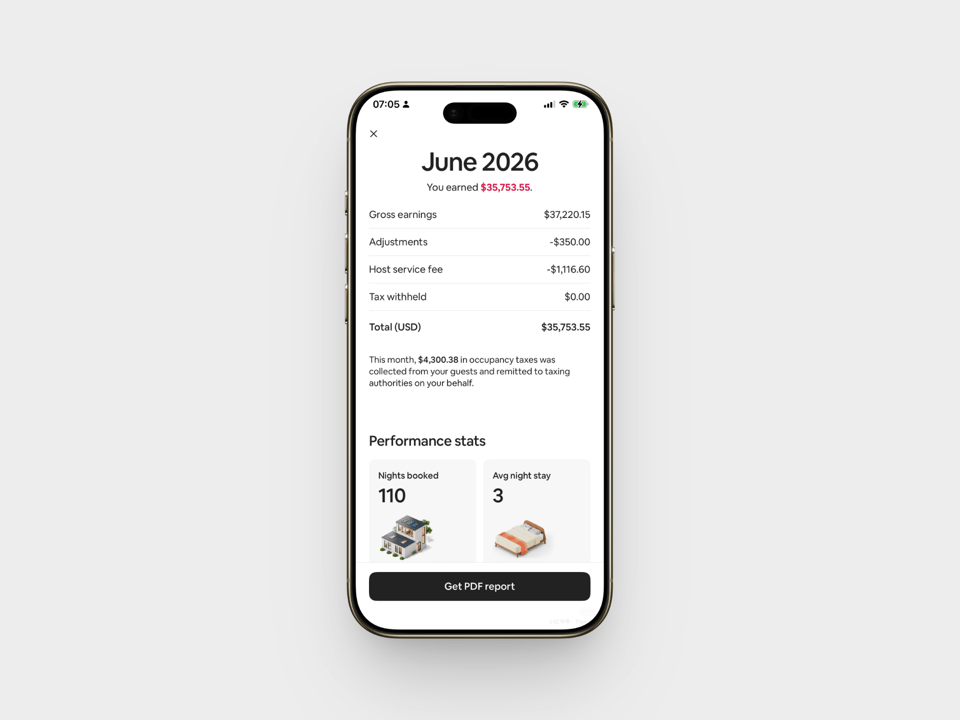
The supplied earnings image presents platform-level revenue and payout figures. It does not establish the property's operating profit, legal status or investment return.
The host described the property as one older Bay Area house operating as four separate rentals, each with its own kitchen, bathroom and entrance. In comments, the host said the property was in the City of Santa Clara, had multiple city-issued addresses, was worth about $2.4 million, carried no mortgage and cost roughly $4,000 a month to operate.
Readers quickly turned the screenshot into a profit story. One estimated annual net income of $150,000–$200,000. Others assumed the 110 nights meant more than $1,000 per night. Several treated the extra addresses and permits as proof that every listing was legal.
The screenshot proves none of those conclusions by itself.
Quick answer: The statement shows a platform payout of $35,753.55, not net profit. The arithmetic reconciles:
$37,220.15 - $350 - $1,116.60 = $35,753.55, and the host fee is almost exactly 3% of gross earnings. But the cropped screen does not show a full reporting-period field or transaction export, so “June single month” remains a source claim rather than an independently verified accounting period. If the reported$4,000truly included every property-level cash expense for the same period, subtraction leaves a provisional $31,753.55 operating cash balance—but that is not a verified NOI, taxable profit or investment return. The result still needs a complete expense ledger, legal-unit and short-term-rental review, trailing-12-month performance and a capital-basis calculation.
Editorial note: This article uses an anonymized summary of user-provided material and reproduces the supplied earnings figures in a privacy-safe phone mockup. The social-media account and property identity are not shown. The property's configuration, permits, expenses, value and compliance were not independently verified. This article provides general information, not legal advice, tax advice, accounting advice or investment advice.
First, Rebuild the Platform Statement
Start with what the screenshot actually says, not what a comment infers.
| Line on the screen | Amount | What it does—and does not—show |
|---|---|---|
| Gross earnings | $37,220.15 |
Airbnb-reported earnings before the displayed adjustment and host fee; the screenshot alone does not reveal every component included in gross |
| Adjustments | -$350.00 |
A reduction that needs a transaction-level explanation such as a refund, resolution or correction |
| Host service fee | -$1,116.60 |
Airbnb's displayed platform fee; it equals approximately 3% of gross earnings in this statement |
| Tax withheld | $0.00 |
No tax was withheld on this payout line; this is not a finding that the host owes no federal or state income tax |
| Total payout | $35,753.55 |
The amount remaining after the displayed adjustment and host fee, before property expenses and owner-level taxes |
| Occupancy taxes collected from guests and remitted | $4,300.38 |
A guest-paid tax amount the screen says Airbnb collected and sent to taxing authorities; it is not an additional host payout |
Airbnb says earnings reports may be generated monthly, annually or for a custom date and listing selection. The complete report or CSV is therefore needed to verify the reporting period, listing set and whether the fields follow stay dates, payout dates or another transaction filter. Airbnb: Earnings Reports
The reconciliation is exact:
$37,220.15 gross earnings
-   $350.00 adjustments
- $1,116.60 host service fee
= $35,753.55 platform payout
The fee calculation is also visible:
$1,116.60 ÷ $37,220.15 = 2.999988%
That is consistent with the 3% host fee Airbnb describes for most split-fee hosts. It does not tell us what guest-side Airbnb service fees were charged, whether cleaning fees were included in gross, whether co-host payouts occurred elsewhere or what fee structure the listings use after later platform changes. Check the actual statement and transaction export for each listing. Airbnb: Service Fees
For the broader fee transition and pricing math, see Airbnb’s 15.5% Host-Only Fee: The Pricing Math Hosts Should Run Before Raising Rates.
$0 Tax Withheld Does Not Mean $0 Tax Due
The screenshot contains two tax lines that answer different questions.
Occupancy tax
The $4,300.38 occupancy-tax note says guests paid that amount and Airbnb remitted it to taxing authorities on the host's behalf. It is not a bonus to add to the $37,220.15, and the screenshot does not show it being deducted from the $35,753.55 payout.
For the City of Santa Clara, the current transient occupancy tax rate is 13.5%, effective January 1, 2025. Airbnb also lists a 13.5% City of Santa Clara tax on reservations of 30 nights or less, applied to the listing price including cleaning fees, and the City has documented a voluntary collection agreement with Airbnb dating to 2015. City of Santa Clara: Transient Occupancy Tax Airbnb: California Occupancy-Tax Collection City of Santa Clara: Airbnb Collection Agreement
Platform collection also does not prove the entire operation is compliant. A host may still need to confirm:
- the correct city and tax jurisdiction for each unit;
- registration, business-tax and short-term-rental requirements;
- which charges belong in the taxable-rent base;
- whether Airbnb collects every applicable tax for every reservation;
- exemptions for qualifying longer stays;
- returns or reconciliations the operator must still file; and
- records supporting the amount Airbnb remitted.
The implied ratio is not itself the legal tax rate:
$4,300.38 ÷ $37,220.15 = 11.55%
At Santa Clara's 13.5% rate, the displayed tax corresponds mathematically to a taxable base of $31,854.67:
$4,300.38 ÷ 13.5% = $31,854.67

$37,220.15 gross earnings
-$31,854.67 implied taxable base
= $5,365.48 difference to reconcile
The difference may involve reporting period, stays longer than the transient threshold, refunds, adjustments, exempt amounts or field definitions. Those are possibilities, not findings. Use the reservation-level tax export to reconcile the actual reason.
Income tax withholding
Tax withheld: $0 means no U.S. federal income-tax withholding appears on that payout line. Airbnb explains that U.S. tax withholding is distinct from occupancy-tax collection and may apply when required tax information is missing or otherwise required by the IRS. Zero withholding does not mean the host has no taxable income or estimated-tax obligation. Airbnb: U.S. Tax Withholding
IRS guidance treats rent and many rental-related receipts as income, while allowable expenses, depreciation, personal use, entity structure, passive-activity limits and the distinction between repairs and improvements affect the eventual tax result. The tax return needs the underlying ledger, not a screenshot total. IRS Publication 527: Residential Rental Property
What Do 110 Booked Nights Mean When There Are Four Listings?
The phrase nights booked is easy to misread when one physical property contains several separately bookable units.
If four listings each sell one night on the same date, the dashboard can record four booked unit-nights for that date. It is not claiming June had 110 calendar days. The screenshot itself does not prove there were four listings; that count comes from the host's separate comment.
Metrics the screenshot supports
Gross earnings per booked unit-night
= $37,220.15 ÷ 110
= $338.37

Platform payout per booked unit-night
= $35,753.55 ÷ 110
= $325.03

Approximate completed stays or turnovers
= 110 booked nights ÷ 3-night average stay
= 36.67
The last figure is an approximation. The displayed average may be rounded, reservations can cross month boundaries and cancellations or adjustments can affect the dashboard.
Do not automatically call $338.37 the average daily rate. Airbnb's payout guidance shows that a potential payout can begin with the nightly price plus host-added charges, then subtract the host service fee and other deductions. Reconstruct ADR from the transaction export using the exact nightly-price field and keep cleaning revenue separate. Airbnb: Payout Calculation
A conditional occupancy estimate
If the report is a June-only report, June has 30 days. If—and only if—all four claimed listings were included, live and available for every day, the maximum inventory would be:
4 listings × 30 days = 120 available unit-nights

110 booked unit-nights ÷ 120 available unit-nights = 91.67% occupancy
That is a conditional estimate, not a confirmed occupancy rate. Owner blocks, maintenance closures, listing launch dates, minimum stays and unavailable inventory change the denominator.
The correct formula is:
Occupancy rate
= booked unit-nights
÷ unit-nights actually available for booking
Use Three Ledgers, Not One Screenshot
A high-performing short-term rental needs three separate financial views.
| Ledger | Main question | Starts with | What it should end with |
|---|---|---|---|
| Platform payout ledger | What did the booking platform pay? | Reservation charges and host-set fees | Payout after platform adjustments and fees |
| Property operating ledger | What did the rental operation produce? | Payout plus any other property income | NOI-style result or operating cash result after property expenses |
| Investment-return ledger | What did the capital earn? | Stabilized annual operating result | Cash flow, unlevered yield, return on invested equity and tax analysis |
Confusion begins when a number from one ledger is given the label of another.
Ledger 1: platform payout
Gross platform earnings
- refunds, resolutions and adjustments
- platform host service fee
- co-host or payout splits not already reflected
= platform cash paid to the owner
Use the reservation export to split nightly revenue, cleaning fees, pet fees, extra-guest fees, discounts and refunds by listing. A single total cannot show which unit, date or fee created the margin.
Ledger 2: property operations
Platform payout
+ permitted off-platform property income
- turnover cleaning labor
- laundry and linens
- guest supplies and consumables
- utilities and internet
- routine repairs and maintenance
- management or co-host compensation
- software, locks and monitoring
- insurance
- property taxes
- business taxes, registrations and permit costs
- bookkeeping, accounting and professional fees
= NOI-style operating result before debt service and major capital work
Cleaning fees deserve special care. A guest-paid cleaning charge may appear in gross platform earnings, while the cleaner's invoice is still a property expense. Counting the fee as revenue but forgetting the labor inflates profit. Subtracting both a cleaner invoice and a management statement that already includes that invoice understates it.
Ledger 3: investment return
Stabilized annual NOI-style result
- debt service
- major capital expenditures or separately defined capital funding
= pre-tax cash flow

Unlevered yield
= stabilized annual NOI
÷ chosen property basis or market value

Cash-on-cash return
= annual pre-tax cash flow
÷ actual cash invested
State which denominator you use. Purchase price, total project cost, current market value and cash equity answer different questions.
What Does the Claimed $4,000 Monthly Expense Mean?
The host reportedly answered that total monthly expenses were about $4,000. If that statement refers to June, includes every property-level cash expense and does not double-count a cost already deducted in the platform statement, the subtraction is:
$35,753.55 platform payout
-$ 4,000.00 claimed monthly expenses
= $31,753.55 provisional operating cash balance
That is useful arithmetic. It is not enough to call the result net profit.
The phrase “total expenses” needs a schedule. Ask whether the $4,000 includes:
| Cost | Why it may be missing from a casual estimate |
|---|---|
| Cleaning and laundry | Sometimes treated as guest-funded and omitted even though the service still costs money |
| Utilities and internet | Four kitchens and four occupied suites can create a different load than one household |
| Consumables and replacement linens | Small per stay, large across roughly 37 approximate reported-period turnovers |
| Repairs and routine maintenance | Uneven; a quiet reported period does not eliminate the annual cost |
| Insurance | Often paid annually and absent from one monthly bank view |
| Property tax | Commonly paid in installments, but economically attributable across the year |
| Business tax, registrations and professional fees | Periodic rather than monthly |
| Software, smart locks, cameras and noise monitoring | Spread across subscriptions and hardware replacements |
| Management and owner labor | Self-management may have little cash cost but substantial time cost |
| Furniture, appliances and major replacements | Capital items arrive irregularly; a reserve or normalized annual cost is needed |
| Income tax | Not a property operating expense and not shown merely because the payout says zero withheld |
| Debt service | Reportedly zero here, but not zero for a financed property |
The strongest test is a trailing-12-month general ledger reconciled to bank, platform, tax and vendor records.
No Mortgage Does Not Mean No Capital Cost
Owning a property free and clear removes monthly principal and interest. That can make cash flow more resilient. It does not make the capital free.
An unlevered owner still has:
- money tied up in the property;
- property tax, insurance and operating risk;
- replacement and regulatory risk;
- transaction costs;
- concentration in one asset and location; and
- an opportunity cost relative to other uses of the capital.
The source comments placed the property value near $2.4 million. That figure is unverified and may refer to market value rather than total investment basis. It should not be mixed with a claimed June result to claim an annual return.
One commenter estimated $150,000–$200,000 in annual net income. If—and only if—those figures were stabilized annual NOI, dividing them by a $2.4 million current value would produce illustrative yields of 6.25%–8.33%. The screenshot verifies neither the numerator nor the denominator, so those percentages are sensitivity examples, not the property's cap rate.
For illustration, if the entire screenshot truly represented one June month, multiplying it by 12 would produce approximately:
Annualized gross earnings:        $446,641.80
Annualized platform payout:       $429,042.60
Annualized provisional balance:   $381,042.60
Those are mechanical multiples, not forecasts. A major event month, summer demand, blocked inventory, later repairs, property-tax timing, winter softness and rate changes can make the other eleven months different.
Use:
- actual trailing-12-month revenue;
- month-by-month available inventory;
- normalized recurring expenses;
- a replacement reserve or multi-year capital schedule;
- separately identified one-time events; and
- a property basis appropriate to the return question.
Only then calculate annual NOI, cash-on-cash return or an unlevered yield.
A World Cup Month Is a Demand Event, Not a Base Case
Commenters speculated that proximity to Levi's Stadium and the 2026 FIFA World Cup helped produce the result. Santa Clara's stadium hosted five group-stage matches on June 13, 16, 19, 22 and 25, followed by a Round of 32 match on July 1. The City also identified one-time World Cup and Super Bowl activity as a contributor to transient-occupancy-tax revenue in its long-range forecast. That makes the event a plausible demand driver; it does not prove that the subject listings' bookings or rates were caused by the tournament. City of Santa Clara: FIFA World Cup 2026 City of Santa Clara: Ten-Year Financial Forecast FIFA: San Francisco Bay Area Stadium
Even when an event clearly drives demand, investors should separate three views:
- Reported month: what actually happened during the event.
- Normalized month: what the same property might have produced without the exceptional event, using comparable non-event dates.
- Forward calendar: what known future events and current market supply support—not what one prior spike guarantees.
Location, unit mix and good operations can improve the probability of bookings. They do not guarantee revenue.
One House, Four Kitchens: Run a Compliance Stack
The most consequential information in the comments was not the revenue. It was the physical configuration: one property described as an older single-family house divided or expanded into four rentals with independent kitchens, bathrooms, entries and multiple addresses.
That may be fully approved. It may also contain several different approvals that do not automatically imply one another.
First confirm the jurisdiction. “Santa Clara” may refer to the City of Santa Clara, unincorporated Santa Clara County or a mailing address in another city. The rules below apply only to property inside the City of Santa Clara.
Santa Clara allows STRs inside a specific permit system
The City's Planning FAQ points operators to Zoning Code § 18.60.250 and says short-term-rental registration has been required since November 2024. The rule permits STR use only in a legal conforming or legal nonconforming residential dwelling unit. Before advertising or operating, the host must obtain a Short-Term Rental Administrative Permit and a valid City Business License. City of Santa Clara Planning FAQ Santa Clara Zoning Code § 18.60.250
The rule distinguishes:
- hosted stays, when the host is present in the unit, with no annual day cap under this section; and
- unhosted stays, when the host is not present in the unit, limited to an aggregate of 90 days per calendar year.
It also requires a local contact available 24/7 who can respond onsite within 60 minutes after a complaint, plus operating standards for parking, trash, occupancy and prohibited special events. Registration is annual and personal to the registrant.
Those rules raise property-specific questions the screenshot cannot answer. Living elsewhere on the same parcel does not necessarily establish that every separately booked unit is “hosted.” And 110 booked unit-nights across four listings do not by themselves show how the City applies the 90-day count to each registered dwelling.
The City also says all businesses need a City Business License, preceded by Planning Zoning Clearance. Its current page identifies an additional rental-unit filing and per-unit business tax for operators with three or more rental units. Crucially, the City states that a business license is evidence of tax payment—not permission to violate zoning, building, fire, plumbing or electrical rules. City of Santa Clara: Business Tax and License
| Layer | Question to verify | Evidence—not an assumption |
|---|---|---|
| Jurisdiction | Is the parcel inside the City of Santa Clara, unincorporated Santa Clara County or another city? | Parcel and city-boundary records |
| Legal dwelling units | How many dwelling units are legally recognized, and what is each unit's approved use? | Approved plans, unit history and applicable planning determination |
| Building work | Were additions, kitchen installations, bedrooms, egress, plumbing and electrical work permitted and finalized? | Permit scope, inspection history and final approval |
| Addressing | What does each assigned address identify? | Official addressing record plus approved unit plans |
| Occupancy and life safety | Does each sleeping and cooking area meet applicable occupancy, egress, smoke/CO and fire-separation requirements? | Final inspections and current code records |
| Short-term-rental use | Is transient occupancy allowed in each legal unit, and is each stay hosted or unhosted under the City rule? | Current STR Administrative Permit, registration records and property-specific approval |
| Business and tax | Are business-tax, transient-occupancy-tax and recordkeeping duties satisfied? | Current certificates, account records and filed returns |
| Private restrictions | Do insurance, lender, HOA or other binding documents permit the use? | Policy, loan and governing documents |
An address is not a use permit
An address helps emergency response, mail, utility and property administration. Santa Clara's current address guidance says addresses support emergency response, utilities, assessor and permitting records and may be assigned before permit issuance. It does not by itself prove that the space is a legal dwelling unit, that construction passed final inspection or that short stays are allowed there. City of Santa Clara: New Addresses Guidelines
A building permit is limited to its scope
A permit to convert a garage into a dwelling, install plumbing or complete an addition is evidence about approved construction. It does not automatically grant every business use. Santa Clara describes final inspections as part of completing permitted work and separately addresses occupancy approval. Review the permit scope, approved plans, conditions, inspections and the separate short-term-rental rule. City of Santa Clara: Building Permit Process City of Santa Clara: Inspections
“Single-family” may be an incomplete label
Marketing, tax, zoning and building records can describe property differently. Four spaces with independent cooking, sanitation and sleeping facilities may raise legal-unit, occupancy and land-use questions regardless of what an owner casually calls the building.
ADUs require a separate check
California and local accessory-dwelling-unit rules may restrict rental duration or impose other conditions. Government Code § 66323(e) requires an ADU created under that section to be rented for a term longer than 30 days. Section 66333(g), effective for the current JADU framework, also requires a JADU rental term longer than 30 days. Determine whether any suite is an ADU, junior ADU, converted garage, addition or primary dwelling unit; then read the approval path, recorded restrictions and final documents that apply to that specific unit. Do not assume every added kitchen is an ADU or that every ADU can be listed nightly. California Government Code: ADU/JADU Provisions
The host said two permitted garage conversions would be used only for long-term rentals. That may reflect an ADU/JADU restriction, an entitlement condition, an unfinished permit, risk preference or another fact. Without the permit numbers, approved plans, finals and recorded conditions, the reason is unknown—and it says nothing conclusive about the other four spaces.
Occupancy Tax Collection Is Not a Compliance Certificate
Airbnb may collect and remit some lodging taxes in a jurisdiction. That is a payment function, not a planning or building approval.
A platform can process occupancy tax while the host still has an unresolved issue involving:
- a business-tax registration;
- a short-term-rental permit or prohibition;
- an ineligible unit type;
- a permit that was never finalized;
- a return or reconciliation the city still requires;
- taxable off-platform bookings;
- record retention;
- insurance; or
- a private restriction.
The right question is not “Did Airbnb remit something?” It is “Which exact obligation did it satisfy, for which listing, dates and tax base—and what remains the operator's responsibility?”
Audit the Month Before You Copy the Strategy
1. Export listing-level transactions
For every reservation, preserve check-in/out dates, nightly price, host-set fees, discounts, refunds, service fee, payout, tax treatment and listing ID.
2. Reconcile unit-nights
Build a calendar for each legal unit showing available, booked, blocked and maintenance nights. Calculate occupancy from available inventory, not four times the days unless all units were actually open.
3. Build the operating P&L
Post every cleaner invoice, utility, supply purchase, repair, subscription, insurance allocation, property-tax allocation, permit cost and management payment. Keep cash timing separate from the month economically served.
4. Normalize irregular expenses
Do not let a repair-free month represent the roof, HVAC, appliances, furnishings and exterior forever. Use a defensible reserve or multi-year capital schedule and disclose it separately from NOI.
5. Verify each approval independently
Collect the approved unit count, permits and finals, address assignments, occupancy documents, short-term-rental eligibility, business registration and tax account. A folder labeled “permits” is not enough; map each document to each unit and use.
6. Separate event demand
Tag World Cup, major convention, holiday and stadium-event bookings. Compare them with ordinary weeks and avoid carrying one-time ADR into an annual base case.
7. Calculate returns using the right denominator
Report both the property result and the capital result:
NOI margin = stabilized NOI ÷ effective gross income

Unlevered yield = stabilized annual NOI ÷ property basis used

Cash-on-cash return = annual pre-tax cash flow ÷ cash invested
Explain whether the basis is purchase price, all-in project cost, current value or equity. Do not switch denominators to produce a more attractive percentage.
Where Pine Fits
A high-revenue short-term rental can involve four listing exports, city permits, address records, tax registrations, occupancy-tax statements, cleaner invoices, utilities, repairs, insurance and a property-tax bill. The dashboard shows only one slice.
Open Pine to organize the earnings statements, permits, tax records, invoices and unit calendars into a dated file, identify missing assumptions and prepare focused questions for the city, accountant, insurer or attorney. Pine does not verify legal use, prepare a tax return or replace professional advice.
Frequently Asked Questions
Is the screenshot definitely one June month?
Not from the cropped screen alone. The display is headed June 2026 and the source described it as monthly income, but Airbnb earnings reports can be monthly, annual or custom. Verify the full Reporting period, listing selection and transaction CSV before treating the amount as one calendar month's revenue.
Is an Airbnb payout the same as profit?
No. A payout is generally the platform cash remaining after the deductions shown on the statement. Profit requires subtracting property operating costs and applying a clearly defined accounting period. Investment return additionally considers debt, capital invested and major replacements; taxable income follows tax rules rather than the bank balance alone.
How can an Airbnb show 110 nights booked in a 30-day month?
Multiple listings can each sell a night on the same date. Four listings open throughout June would create up to 120 available unit-nights. The screenshot's 110 booked nights would imply 91.67% occupancy only if all 120 unit-nights were genuinely available.
Does $4,300.38 in occupancy taxes increase the host's revenue?
Not when the dashboard says the amount was collected from guests and remitted to taxing authorities. It is a guest-paid tax flow, not an extra host payout. The operator should still verify the correct jurisdiction, taxable base, platform agreement and any remaining filing duties.
Does Tax withheld: $0 mean the Airbnb income is tax-free?
No. It means the displayed payout did not have income tax withheld on that line. Federal and state taxable income, deductions, estimated payments and reporting require a separate tax calculation.
Is $338.37 the average nightly rate?
It is gross earnings divided by booked unit-nights. It is not necessarily pure nightly room rate because gross earnings may include cleaning and other host-set fees. Use reservation-level nightly revenue to calculate ADR.
Does having four city-issued addresses prove four Airbnb listings are legal?
No. Address assignment, legal dwelling-unit status, building permits, final inspections, short-term-rental eligibility, business registration and tax compliance are separate layers. Each should be verified for each unit.
Does a building permit authorize short-term rental use?
Not necessarily. A permit authorizes the work and scope described in the approved plans and conditions. The city may regulate transient occupancy separately. A final inspection also matters; an issued permit is not the same as completed approved work.
Can an ADU be used as an Airbnb in California?
Do not apply one statewide slogan. California Government Code § 66323 requires rental terms longer than 30 days for ADUs created under that section, and § 66333 applies a longer-than-30-day rule to JADUs. Other approval paths and local conditions require their own review. Identify the unit type, permit basis, approved plans, final status and recorded restrictions before listing it.
How many unhosted Airbnb nights does Santa Clara allow?
City Zoning Code § 18.60.250 limits unhosted STR use to an aggregate of 90 days per calendar year. Hosted use is not capped by that section, but the host must actually meet the City's definition and the legal dwelling, permit, business-license, local-contact and operating requirements still apply.
Does having no mortgage make the property highly profitable?
It removes debt service, which can improve cash flow. It does not remove operating costs, capital replacement, taxes, risk or the opportunity cost of the owner's equity. Compare stabilized annual NOI and cash flow with a clearly defined property basis and cash invested.
Should one high-revenue event month be multiplied by 12?
Not as a forecast. A mechanical annualization can be shown as a sensitivity scenario, but underwriting should use trailing monthly performance, available inventory, normalized expenses, seasonality and separately identified event demand.
Official Sources
- Airbnb: Earnings Reports
- Airbnb: Adjustments
- Airbnb: Service Fees
- Airbnb: Payout Calculation
- Airbnb: U.S. Tax Withholding
- Airbnb: California Occupancy-Tax Collection
- City of Santa Clara Planning FAQ
- Santa Clara Zoning Code § 18.60.250
- City of Santa Clara: Business Tax and License
- City of Santa Clara: Transient Occupancy Tax
- City of Santa Clara: Building Permit Process
- City of Santa Clara: Inspections
- California Government Code: ADU/JADU Provisions
- City of Santa Clara: FIFA World Cup 2026
- City of Santa Clara: Ten-Year Financial Forecast
- IRS Publication 527: Residential Rental Property
This article provides general information, not legal advice, tax advice, accounting advice or investment advice. Platform terms, short-term-rental rules, taxes, permitted units and return calculations depend on the listing, property, jurisdiction, documents and period reviewed.