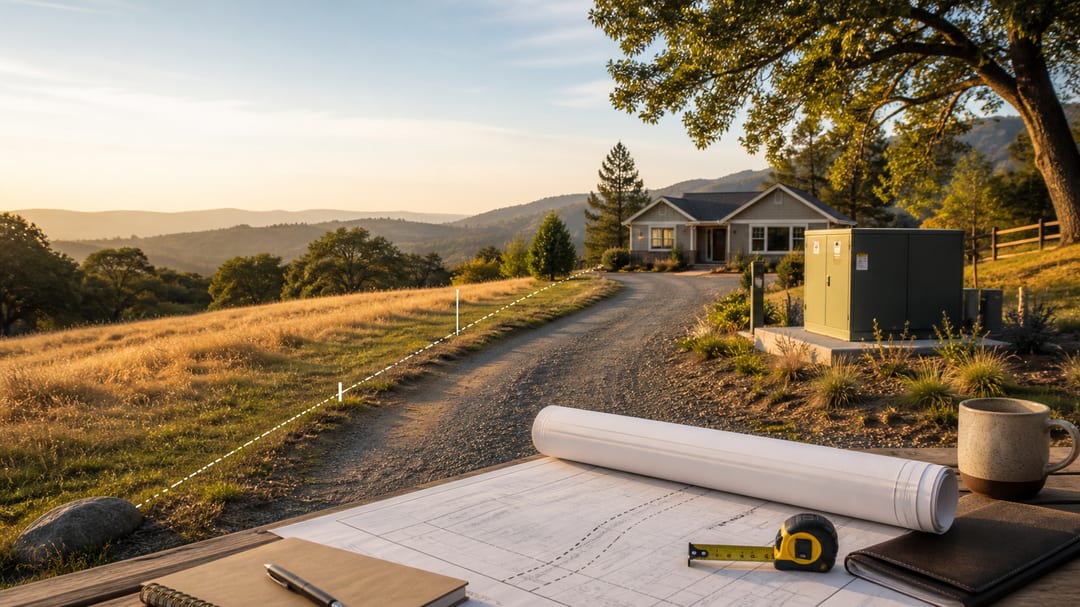
When a utility asks to place underground power lines and a transformer on private property, the first question is usually: How much should I be paid?
That is important, but it is not the first question to answer.
The more useful starting point is: What property rights is the utility asking for, and how will those rights affect the land that remains?
A proposed route along a gravel driveway and a transformer in a front yard may involve far more than a strip of soil. It can affect access, landscaping, future construction, maintenance, title, resale, insurance questions, and how the property can be used. A short letter or standard easement form may not make those consequences obvious.
This guide explains what to review before signing a proposed PG&E easement in California. It is general information, not legal, appraisal, engineering, or insurance advice. The actual grant, map, title documents, project plans, and insurance policy control.
The short answer: there is no reliable flat price
There is no dependable way to determine fair compensation from the length of the route alone. A 400-foot easement can have very different value depending on:
- whether the grant is temporary, permanent, or perpetual;
- the width of the easement and the rights included within it;
- whether the route crosses a driveway, building area, agricultural area, or sensitive landscaping;
- the size and location of the transformer and related equipment;
- access, vegetation-clearance, repair, replacement, and future-expansion rights;
- the cost of restoring the driveway, drainage, fencing, landscaping, or other improvements;
- the effect on the remaining parcel’s use, marketability, or development potential; and
- the terms of the specific agreement and recorded exhibits.
California’s eminent-domain statutes use a fair-market-value framework for property interests acquired and can address injury to the remainder when only part of a larger parcel is taken. That does not produce an automatic price for every voluntary utility easement. It does, however, explain why a serious evaluation should consider both the rights granted and the impact on the rest of the property.
An isolated story about someone receiving a certain amount for a transformer is not a useful comparable unless the property, rights, footprint, project, and valuation method are comparable too. The same is true of a guess such as $50,000 to $75,000.
Why an underground line and transformer are different property issues
It is tempting to think of an underground line as invisible infrastructure that will have little effect once construction is finished. Sometimes the finished project is relatively unobtrusive. But the easement may still grant ongoing rights that matter for decades.
For example, the agreement may address:
- where the line can be installed and how wide the utility corridor is;
- whether the utility can enter the property for inspection, repair, replacement, or emergency work;
- whether additional equipment or larger equipment can be installed later;
- vegetation removal and restrictions on trees or structures;
- access for trucks and crews;
- the transformer’s footprint, clearance area, visibility, noise, and maintenance access;
- restoration standards after trenching; and
- what happens if the facility is relocated, abandoned, or no longer needed.
The physical equipment may be small compared with the parcel. The legal rights can be much broader than the visible footprint.
What compensation may need to cover
Before discussing a number, separate the economic issues. Some may be part of a valuation; others may need to be negotiated as express terms in the agreement.
| Issue | Questions to ask |
|---|---|
| Permanent property interest | What is the value of the easement rights being granted? Is the grant perpetual? |
| Temporary construction rights | Does PG&E need a separate construction easement, staging area, or right of entry? For how long? |
| Damage to the remainder | Will the route or equipment affect access, privacy, usable yard area, building plans, drainage, or marketability? |
| Driveway and site restoration | Who restores gravel, subgrade, paving, drainage, fencing, gates, planting, and irrigation? To what standard? |
| Transformer impacts | What are the footprint, setbacks, clearances, access requirements, noise expectations, and future replacement rights? |
| Construction disruption | Will the owner lose access to a garage, home, field, or other improvement during construction? |
| Professional costs | Can the owner negotiate reimbursement for a survey, appraisal, attorney review, or other project-specific costs? |
| Future obligations | Who is responsible for maintenance, damage, environmental issues, vegetation clearance, and emergency access? |
Not every item is automatically payable as a separate line item, and reimbursement is not guaranteed. The point is to identify the full scope before accepting a lump-sum offer.
Review the complete easement package, not just the signature page
Ask for the complete document package, including the legal description, map, engineering exhibit, construction plan, and any separate access or temporary-work documents.
At a minimum, look for:
- Exact location and width. Is the route shown by survey, centerline, boundaries, or a broad area that could later be selected by the utility?
- Equipment footprint. Is the transformer location fixed? Are pads, cabinets, poles, conduits, vaults, or other facilities included?
- Term. Is the right temporary, for a stated number of years, or perpetual?
- Scope of use. Does the agreement cover only the described line, or also replacement, relocation, upgrades, additional conductors, communications equipment, or other facilities?
- Entry and access. When and how may crews enter? Can vehicles use the driveway? Is advance notice required except in emergencies?
- Construction method. Does the plan require trenching, boring, excavation, staging, or removal of existing improvements?
- Restoration. Are the materials, workmanship, drainage, grading, landscaping, and inspection process described clearly?
- Vegetation and structures. What may the owner plant, build, fence, pave, or store in the easement area?
- Insurance and indemnity. Who bears responsibility for construction damage, utility operations, environmental conditions, and claims involving third parties?
- Relocation or abandonment. Can the owner request a relocation? What happens if the facility is no longer used? When does the easement end, if ever?
- Recording and transfer. Will the grant be recorded? Does it bind future owners? Are there obligations that will appear in the title record?
PG&E’s published underground-facility materials also illustrate why project-specific dimensions and clearances matter. A general utility document should not be treated as a substitute for the actual agreement and site plan proposed for the parcel.
A practical process before signing
1. Confirm what stage the request is in
Ask whether the utility is requesting a voluntary easement, seeking permission to conduct preliminary surveys, presenting a construction agreement, or communicating about a formal acquisition process.
A request for a voluntary easement is not itself a condemnation order. At the same time, it is not wise to assume that the utility has no legal alternatives. Whether a utility has condemnation authority, and how that authority may be used for a particular project, depends on the project and applicable law. A California attorney who handles easements or eminent domain can explain the position more reliably than a generic form letter.
You can ask for a reasonable review period and keep communications in writing while you obtain advice.
2. Order a title report and locate existing rights
Obtain a preliminary title report and copies of recorded easements, restrictions, access rights, and utility documents affecting the parcel. Then compare those documents with the proposed route.
The title report may reveal existing utility corridors, access obligations, or limitations that affect the negotiation. It may also show whether a new easement would overlap another right or create a more significant burden than the proposal suggests.
3. Have the route and transformer location surveyed
A property owner should know the relationship between the proposed facilities and:
- property boundaries;
- the residence and other structures;
- wells, septic systems, drainage, and driveways;
- future building or expansion areas;
- fences, gates, mature trees, and landscaping; and
- emergency and everyday vehicle access.
A surveyor or qualified engineer can help turn a general sketch into a location and footprint that can be evaluated.
4. Obtain an independent valuation
An appraiser experienced in partial acquisitions, utility easements, or eminent-domain work can consider the “before” and “after” property, not just the area occupied by the line.
Ask the appraiser to explain:
- the rights being acquired;
- the appropriate comparable transactions, if any;
- the effect of the transformer and access rights;
- construction and restoration impacts;
- any injury to the remainder; and
- assumptions about future use, restrictions, and marketability.
The appraiser may conclude that the impact is limited, substantial, or difficult to isolate. That is more useful than applying a per-foot multiplier without understanding the property.
5. Price the physical work separately
If the route crosses a gravel driveway, get a written estimate for excavation, subgrade repair, gravel replacement, compaction, drainage work, landscaping, fencing, gates, and any traffic-control needs. If the property has specialized improvements, obtain estimates from contractors who understand those systems.
This helps distinguish the value of the permanent easement from the cost of returning the property to an acceptable condition after construction.
6. Ask the insurer for a written underwriting answer
Do not assume that a transformer automatically raises premiums, cancels coverage, or has no effect at all. Home insurance decisions depend on the insurer, policy, property characteristics, wildfire exposure, underwriting model, and the specific facility.
Give the insurer the proposed map and agreement, and ask in writing:
- whether the recorded easement changes eligibility, renewal, premium, or coverage;
- whether the transformer or access rights create any exclusions or liability concerns;
- whether the utility’s insurance and indemnity language changes the insurer’s view;
- what documentation the insurer needs; and
- whether the answer changes if the route, equipment location, or construction method changes.
The California Department of Insurance recommends reading the policy and declarations and obtaining coverage clarification from the insurer or agent in writing. A utility’s responsibility for its own facilities does not automatically replace the owner’s need to understand homeowner coverage.
Can the owner refuse the easement?
If the request is voluntary, the owner can generally ask questions, negotiate the terms, and seek advice before signing. That does not mean the owner can predict the project’s ultimate outcome or prevent every possible legal acquisition process.
California’s Constitution provides a just-compensation framework for private property taken or damaged for public use. California eminent-domain law also addresses public interest, necessity, the property interest required, and damage to the remainder. Those rules are relevant to a formal acquisition process, but they do not answer whether a particular utility can condemn a specific easement or whether the project’s proposed route is legally sufficient.
If the communication references condemnation, a resolution of necessity, a statutory deadline, or a formal offer, contact eminent-domain counsel promptly. Do not rely on an internet estimate of your rights or on the assumption that signing is the only way to avoid construction.
How an easement may affect resale
A recorded easement can appear in title research and become part of the information a future buyer, lender, surveyor, or title company reviews. Its effect on value is not automatic.
Some buyers may view underground utility service as ordinary infrastructure. Others may care about the transformer’s location, front-yard appearance, access rights, vegetation restrictions, or limits on future construction. The result depends on the parcel, the wording of the easement, the visibility and operation of the facilities, and the local market.
California has statutory transfer-disclosure rules, but the precise disclosure obligations depend on the transaction and documents. Before listing or selling, ask a California real-estate attorney or qualified broker how the recorded easement and related project documents should be disclosed. Do not assume that an informal explanation to a buyer is enough, and do not assume that every easement has the same disclosure treatment.
Negotiation points that may matter more than a higher number
Compensation is important, but a better agreement can reduce future risk. Depending on the project, an owner may ask for:
- a narrower or more precisely located easement;
- a route adjustment that avoids the driveway, building envelope, mature trees, or important drainage;
- boring instead of trenching where feasible and appropriate;
- a fixed transformer location and equipment footprint;
- no expansion beyond described facilities without a new agreement;
- advance notice for non-emergency access;
- defined work hours and construction access routes;
- measurable restoration standards and an inspection process;
- responsibility for damage to driveways, landscaping, fencing, drainage, and other improvements;
- clear indemnity and insurance provisions;
- limits on vegetation removal and owner improvements;
- a relocation or abandonment process; and
- reimbursement of some project-specific professional costs, if negotiated.
Do not assume every requested term will be accepted. The practical goal is to trade a vague, broad grant for a defined set of rights, responsibilities, and protections that can be understood by future owners.
A decision checklist
| What you see | Sensible next step |
|---|---|
| No map, legal description, or equipment exhibit | Request the complete package before evaluating price. |
| Perpetual easement with broad replacement or expansion language | Have a California easement attorney review the scope and obtain an independent valuation. |
| Trenching through a driveway | Get written construction, access, drainage, and restoration estimates. |
| Transformer proposed in the front yard | Confirm footprint, clearances, visibility, noise, maintenance access, and future replacement rights. |
| High wildfire-risk property | Ask the insurer for a written underwriting answer; do not infer the outcome. |
| Concern about future sale | Review recording and disclosure implications with title and real-estate professionals. |
| Threat or notice of condemnation | Speak with eminent-domain counsel promptly and preserve all correspondence. |
Frequently asked questions
How much should PG&E pay for a utility easement?
There is no universal amount. A defensible evaluation usually begins with the value of the rights acquired and then considers construction, restoration, access, and damage to the remaining property. A local appraiser and attorney can help determine which items apply.
Is a 400-foot easement worth $50,000 or $75,000?
Distance alone cannot answer that. The width, route, transformer, property use, restrictions, market conditions, and remainder impacts may matter more than the raw length.
Is a lease better than an easement?
Not automatically. A lease and an easement grant different types of rights, and a utility may require a recorded easement for long-term infrastructure. Ask counsel to compare the proposed legal interest with any alternative structure instead of assuming that one label is always better.
Will the transformer increase my homeowner insurance premium?
There is no universal answer. Ask the actual insurer or broker to review the project documents and respond in writing about eligibility, premium, renewal, exclusions, and liability.
Can a utility force the owner to sign?
An owner should not assume either that the utility can force a signature immediately or that it has no legal acquisition path. A voluntary request is different from formal condemnation. The utility’s authority and the owner’s options are project-specific legal questions.
Who pays for the lawyer, appraiser, and survey?
That depends on the agreement, the negotiation, and whether a formal condemnation proceeding occurs. Ask for reimbursement as part of the negotiation, and ask counsel what rules may apply to the specific acquisition process. Do not assume reimbursement is automatic.
A safer way to organize the decision
Before responding with a number, put the proposed agreement, map, title report, survey, appraisal, contractor estimates, insurance correspondence, and questions in one organized file. A clear record makes it easier to identify missing terms, compare revisions, and explain the project to an attorney, appraiser, insurer, lender, or future buyer.
19pine can help organize those documents and turn a complicated property question into a structured review checklist. It does not replace legal, appraisal, engineering, or insurance professionals; it helps you prepare for a more informed conversation with them.
Official sources
- California Constitution, Article I, section 19
- California Code of Civil Procedure section 1240.030
- California Code of Civil Procedure section 1263.310
- California Code of Civil Procedure section 1263.410
- California Code of Civil Procedure section 1263.420
- California Code of Civil Procedure section 1263.450
- California Government Code section 7267.2
- California Civil Code section 1102.6
- PG&E: Reduced Easement Requirements for Electric Underground Facilities
- California Department of Insurance: Residential Insurance Guide
Disclaimer: This article provides general educational information. It is not legal, appraisal, engineering, tax, real-estate, or insurance advice. Easement rights, compensation, condemnation authority, disclosure obligations, and coverage depend on the specific agreement, title record, project, property, jurisdiction, and policy. Consult qualified California professionals before signing.