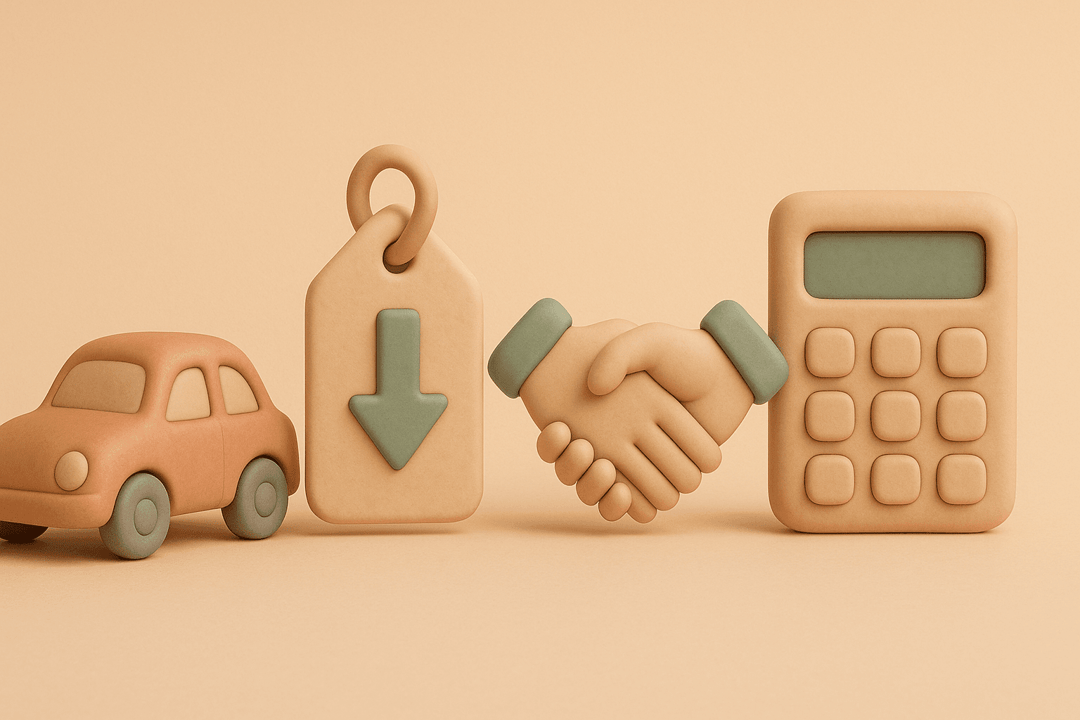
The average new car transaction price hit $48,500 in 2025, and used cars average $27,200. Yet most buyers leave thousands of dollars on the table because they don't know how to negotiate effectively — or feel too uncomfortable to try.
Car dealerships are designed to maximize profit through psychological pressure, information asymmetry, and fee stacking. Here's how to level the playing field and save $2,000-$10,000 on your next vehicle purchase.
Before You Step on the Lot
Research the True Market Price
- Invoice price: What the dealer actually paid (find on Edmunds, TrueCar, or KBB)
- Market average: What others are actually paying in your area
- Holdback: Manufacturer rebate to dealer (usually 2-3% of MSRP) — this is hidden profit
- Incentives: Current manufacturer rebates and financing offers
Your target: Invoice price + $200-$500 for a fair deal on most vehicles. Popular/limited models may command MSRP.
Get Pre-Approved for Financing
Before visiting any dealer:
- Check rates at your credit union or bank
- Get a pre-approval letter with your rate and maximum amount
- This gives you a baseline — if the dealer beats it, great; if not, you have backup
Average rate difference between dealer markup and credit union: 1-3% APR, which equals $1,000-$4,000 over a loan term.
Know Your Trade-In Value
- Get offers from CarMax, Carvana, and KBB Instant Cash Offer
- These written offers are leverage at the dealership
- Always negotiate the new car price BEFORE mentioning your trade-in
The Negotiation Playbook
Step 1: Get Multiple Quotes (Email Strategy)
Email the internet sales department at 5+ dealers within driving distance:
"I'm looking to purchase a [Year Make Model Trim] within the next week. I'm comparing offers from several dealers. What's your best out-the-door price including all fees? I'll be making my decision based on total price."
This creates competition without you sitting in anyone's office for hours.
Step 2: Negotiate the Out-the-Door (OTD) Price
Critical rule: Always negotiate the total out-the-door price, never the monthly payment.
Dealers love to negotiate on monthly payments because they can hide profit in:
- Extended loan terms (72-84 months)
- Higher interest rates
- Unnecessary add-ons
- Inflated fees
Say: "I'm focused on the out-the-door number. What's the total price including all taxes, fees, and charges?"
Step 3: Separate Every Transaction
A car deal has 4 separate transactions. Negotiate each independently:
- Purchase price of new vehicle — negotiate first
- Trade-in value — negotiate second, after new car price is locked
- Financing terms — compare dealer offer to your pre-approval
- Add-ons/extras — decline everything in F&I office (see below)
Step 4: The F&I Office (Finance & Insurance)
This is where dealers make $2,000-$5,000 in additional profit. Decline everything unless you've researched it independently:
| Product | Dealer Price | Actual Value | Recommendation |
|---|---|---|---|
| Extended warranty | $2,000-$4,000 | $800-$1,500 if bought third-party | Decline or buy later |
| GAP insurance | $500-$1,000 | $200-$400 through your insurer | Decline |
| Paint/fabric protection | $500-$1,500 | $50-$100 DIY | Decline |
| Tire/wheel protection | $500-$800 | Rarely used | Decline |
| LoJack/theft deterrent | $400-$700 | Included with insurance | Decline |
Step 5: Eliminate Junk Fees
Fees you should NEVER pay:
- Dealer prep/detail fee ($200-$1,000) — already included in invoice
- Advertising fee ($300-$700) — dealer's cost of doing business
- Additional dealer markup (ADM) — pure profit, negotiate away
- Fabric/paint sealant ($300-$1,000) — $50 product marked up 20x
- VIN etching ($150-$300) — DIY kit costs $20
- Nitrogen tire fill ($50-$200) — regular air is 78% nitrogen already
Fees that are legitimate:
- State sales tax (varies by state)
- Title and registration (state-set amounts)
- Doc fee (capped in many states, typically $75-$500)
Timing Your Purchase
| When | Why | Typical Savings |
|---|---|---|
| End of month | Salespeople chasing quotas | $500-$1,500 |
| End of quarter (Mar, Jun, Sep, Dec) | Dealer volume bonuses kick in | $1,000-$2,000 |
| Model year-end (Aug-Oct) | Clearing inventory for new models | $3,000-$8,000 |
| Monday-Wednesday | Less traffic, more attention | Better negotiations |
| Rainy/snowy days | Fewer customers = motivated sellers | $500-$1,000 |
Used Car Negotiation Tips
- Get a pre-purchase inspection ($100-$200) — findings become negotiation leverage
- Check vehicle history (Carfax/AutoCheck) — accidents reduce value 10-30%
- Compare to private party price — dealers mark up $2,000-$5,000 over private party
- Point out needed maintenance — tires ($800), brakes ($400), timing belt ($1,000)
- Certified Pre-Owned (CPO) — worth $1,000-$2,000 premium for warranty coverage
Power Phrases for Negotiation
- "What's your best out-the-door price?"
- "I have a competing offer at $X from [other dealer]. Can you beat it?"
- "I'm ready to buy today if we can agree on the number."
- "I'll need to remove that fee for this deal to work for me."
- "Let me think about it overnight." (Creates urgency without pressure)
Bottom Line
The average car buyer who negotiates effectively saves $3,000-$7,000 compared to those who pay sticker price. The keys: research beforehand, get competing quotes, negotiate total price (not monthly payment), separate each transaction, and be willing to walk away. The dealer needs your sale more than you need their specific car.